DIY Guide: Concrete Base for Shed Preparation
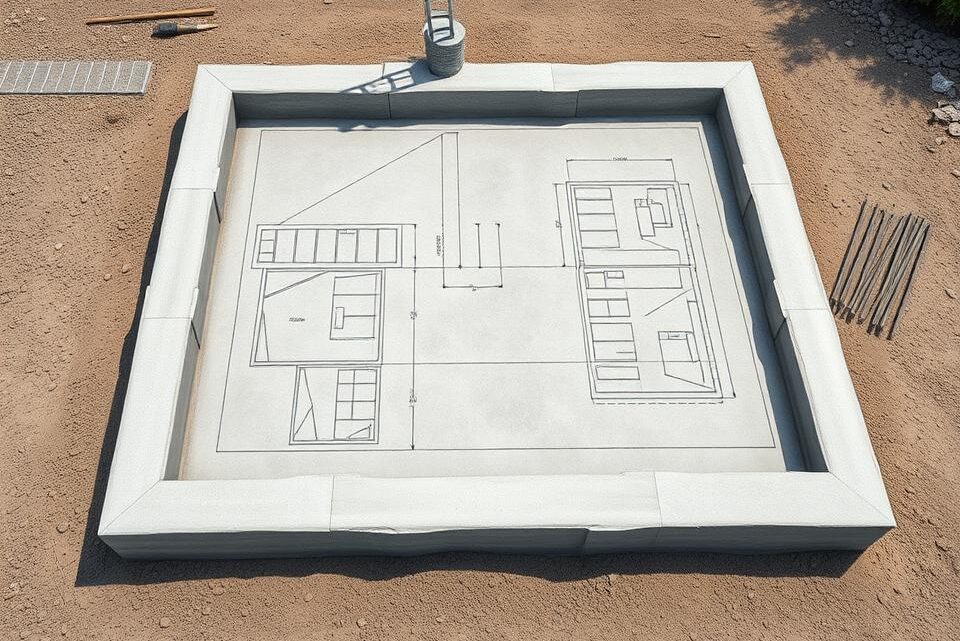
Preparing a reliable concrete base for shed diy projects is the first step to a long-lasting garden building. This shed foundation guide explains scope, outcomes and the standards to follow so homeowners and keen DIYers can proceed with confidence. It covers planning and permit checks relevant to the UK, site selection, tools and materials, groundworks, concrete mix choices and best-practice pouring, curing and finishing techniques.
This concise DIY shed base introduction sets realistic goals: to help you meet British Standards such as BS EN 206, to source manufacturer guidance from Cemex, Hanson and Tarmac, and to adopt safe working practices recommended by the Construction Industry Training Board. By following the step-by-step approach you will be able to plan shed slab preparation, order the right concrete shed base UK supplies and avoid common pitfalls.
Inhaltsverzeichnis
Key Takeaways
- A concrete base for shed diy ensures structural stability and protects against ground movement.
- Check planning guidance on gov.uk and relevant British Standards before you start.
- Select location and drainage carefully during shed slab preparation to avoid future issues.
- Use manufacturer guidance from Cemex, Hanson or Tarmac when choosing mixes or ordering ready-mix.
- Safe working practices from CITB will reduce risk during groundwork and pouring.
Why a Proper Concrete Base Matters for Your Shed
A correctly built concrete base gives a shed a firm platform to sit on. It improves shed stability and spreads loads so the structure stays level. A stable base also helps prevent water pooling and protects timber from long-term damp.
Structural soundness begins with how weight transfers to the ground. A well-designed load distribution concrete slab spreads point loads from the floor, racked walls and stored items evenly. This reduces localised settlement and lowers the risk of tilting or distortion.
Size and thickness matter. Typical domestic slabs range between 75–150mm with a reinforced edge strip for heavier builds. Match slab thickness to shed size and floor load, check soil bearing capacity and provide a compacted granular sub-base to avoid differential settlement.
Reinforcement controls cracking and improves resistance to movement. Mesh, rebar or fibres limit crack widths and add tensile strength. Combined with a correct sub-base, reinforcement helps prevent shed movement during frost heave or seasonal ground shifts.
Using a durable shed base extends service life. A stable granular layer such as Type 1 MOT or crushed concrete reduces migration of fines and supports long-term performance. Add a damp-proof membrane to cut capillary rise and protect concrete from moisture cycling.
Good detailing stops timber decay. Raising the shed on a concrete slab keeps joists clear of soil and reduces the risk of rot. Incorporate a DPM, provide gentle falls for surface water and ensure perimeter drainage to aid shed damp prevention.
Ventilation and material choice add protection. Venting beneath timber floors and using pressure-treated timber or naturally durable species gives an extra safeguard against fungal decay. These measures work together to prevent shed movement and maintain a durable shed base.
| Key concern | Practical measure | Benefit |
|---|---|---|
| Point loads and settlement | Use a reinforced load distribution concrete slab with compacted sub-base | Even load spread, improved shed stability |
| Seasonal ground movement | Install Type 1 MOT sub-base and reinforcement; consider soil type | Reduced frost heave impact, controlled cracking |
| Moisture and timber rot | Include a damp-proof membrane, provide falls and perimeter drainage | Effective shed damp prevention and longer timber life |
| Long-term durability | Correct slab thickness, reinforced edge beam and ventilation | Durable shed base that resists movement and decay |
Planning and Permits for Shed Foundations in the UK
Before you dig, take time to confirm planning rules that affect shed planning permission UK. Small garden buildings often fall under permitted development, but limits on size, height and siting can change with property type. Check whether your plot lies in a conservation area or your home is listed; such factors can remove permitted development shed foundations rights and make an application to the local planning authority necessary.
Verify boundary lines with the Land Registry or an up-to-date site survey before starting works. If the base increases the footprint or is close to a neighbour’s boundary, the Party Wall etc. Act 1996 may apply. Where the party wall overlooking shed or shared structure is affected, serve the required notice and try to obtain written agreement to avoid disputes.
Talk to neighbours about access, excavation spoil and working times. Clear communication reduces the chance of complaints and helps when you need temporary access across a neighbouring garden for plant or material deliveries.
Complex ground conditions, large workshops or heavy equipment on the base call for professional input. If you need to consult structural engineer or chartered surveyor, engage them early to advise on foundation design and loadings. Contact utility companies or use national services to locate underground services prior to excavation.
For uncertain planning cases, consider pre-application advice from your local planning authority or hire a planning consultant. Early checks on permitted development shed foundations and formal guidance save time and limit the risk of enforcement action.
Choosing the Right Location and Orientation
Selecting the correct spot for a shed shapes its longevity and usefulness. Good shed location advice starts with observing how water behaves on your plot and assessing access for construction and daily use.

Ground slope, drainage and surface water considerations
Pick a site with a natural fall away from the shed to limit pooling. If the ground is too flat, design a slight fall in the slab; a slope for shed base of about 1:100 to 1:80 will move water away from doors and walls.
Drainage considerations may call for perimeter channels or gravel runs where surface water collects. For parcels at risk of flooding, consult Environment Agency flood maps before committing to a location.
Accessibility and sunlight for the intended use
Think about how you will use the shed. A workshop needs easy access for materials and tools. A potting shed benefits from morning sun. A general storage shed might be tucked away to stay discrete.
Ensure level, unobstructed access for wheelbarrows or small vehicles during build and future deliveries. Orientation affects light and ventilation, both of which change how comfortable and practical the space will be.
Avoiding tree roots and underground services
Keep clear of large trees when possible. Roots can displace a base and cause long-term heave, so aim to avoid tree roots by siting the shed at least half the canopy spread away from the trunk, adjusting for species where necessary.
Before any digging, carry out an underground utilities check. Use utility plans, contact local providers or hire a CAT scanner to locate gas, water, electricity and telecoms. If roots are close, consider root barriers or raised timber bearers after professional advice.
| Consideration | Practical action | Expected benefit |
|---|---|---|
| Natural fall / slope for shed base | Choose site with fall or set slab at 1:100–1:80 | Prevents pooling and reduces damp risk |
| Drainage considerations | Install gravel channels or perimeter drains where needed | Improves surface water management and longevity |
| Accessibility and sunlight | Position for material access and desired light exposure | Makes the shed fit its intended use |
| Avoid tree roots | Sit at sensible distance; use root barriers if required | Reduces risk of foundation damage and heave |
| Underground utilities check | Obtain plans or use detecting equipment before digging | Prevents dangerous strikes and costly repairs |
Tools and Materials Needed for a Concrete Base
Getting the right kit makes the job quicker and safer. Below is a concise primer on what to have to hand when preparing a concrete base for a shed. The list covers machinery, hand tools and consumables so you can plan purchases or hire items in advance.

Choose between a hired electric or petrol mixer and ready-mix delivery for larger slabs. For moving and placing material, keep a wheelbarrow, shovels and a rake close by. For levelling and setting lines use a spirit level, tape measure and a straight edge or screed board.
For compacting the sub-base, a plate compactor is best. Use a hand tamper for tight spots. Finishing requires a wooden or magnesia float, a steel trowel and a stiff brush for an anti-slip finish. Jointers and a string line help control cracking and ensure neat edges.
Concrete materials list choices depend on project size. Bagged mixes suit small slabs; ready-mix trucks suit larger areas. Typical domestic slabs use C20/25 strength. For site mixing, stock cement, sand and aggregates to the right proportions, or select pre-blended bagged mixes for simplicity.
Reinforcement options include A142 or A193 steel mesh in 100 x 100mm or 150 x 150mm formats for light-duty slabs. Use Y8–Y12 rebar for strengthened edges. Polymer fibres reduce micro-cracking and can be used as secondary reinforcement where mesh is not feasible.
Shuttering and DPM are vital. Use treated timber or aluminium formwork with stakes and battens to hold profiles. Lay a 1000-gauge polythene or BS-compliant DPM over the compacted sub-base to prevent rising damp. Type 1 MOT or crushed stone makes a reliable sub-base at 100–150mm depth.
PPE for concreting should be worn at all times. Provide alkali-resistant gloves, safety boots, eye protection and dust masks for dry mixing. Ear defenders are needed for powered tools. Hi-vis is sensible where vehicle access is present.
Plan waste disposal building materials before work starts. Arrange a skip or licensed removal for spoil and waste concrete. Contain concrete wash-out on site and never allow discharge to drains. Follow local authority guidance if materials are contaminated.
Below is a compact comparison to help decide what to buy, hire or include on a materials order.
| Item | Typical Use | Recommended Option (UK) | Notes |
|---|---|---|---|
| Concrete mixer | Mixing on site for small to medium slabs | Hired electric/petrol mixer | Hire for occasional projects; ready-mix for larger slabs |
| Plate compactor / hand tamper | Sub-base compaction | Plate compactor for >1m², hand tamper for small areas | Ensures stable, non-settling base |
| Levelling & finishing tools | Levelling, screeding and surface finish | 2.4–3.0m screed board, float, steel trowel, brush | Essential for flat, durable finish |
| Reinforcement | Reduce cracking and add tensile strength | A142/A193 mesh; Y8–Y12 rebar; polymer fibres | Mesh for light slabs; rebar for loaded edges |
| Shuttering & DPM | Formwork and moisture barrier | Treated timber or aluminium formwork, 1000-gauge DPM | Secure formwork to avoid blow-out during pour |
| Sub-base material | Load distribution and drainage | Type 1 MOT or crushed stone, 100–150mm depth | Depth varies with load and ground conditions |
| PPE for concreting | Personal safety | Alkali-resistant gloves, boots, goggles, masks, ear defenders | Replace damaged PPE and keep spares available |
| Waste management | Disposal of spoil and concrete waste | Hire skip; licensed disposal for contaminated material | Contain wash-out and follow local regulations |
Site Preparation and Groundworks
Good groundwork sets the stage for a durable shed base. Start with a clear plan, accurate setting-out and safe working space before any digging begins.
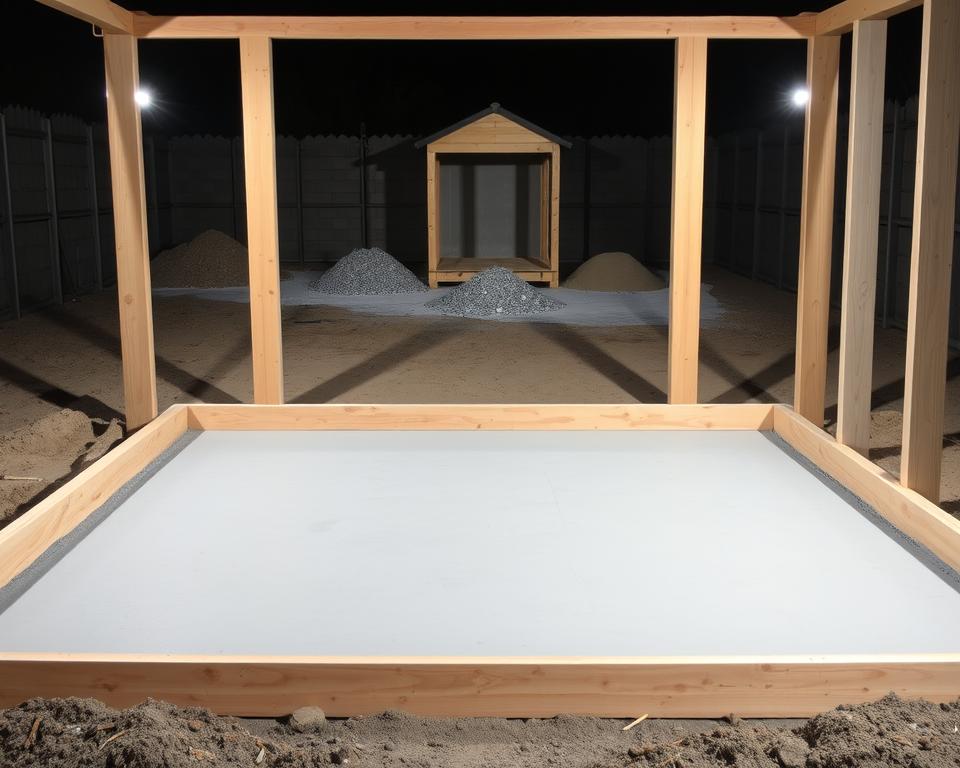
Clear turf, topsoil and vegetation down to a stable layer. Remove roots and organic matter that can rot and cause settlement. Use batter boards or a laser level and string lines to mark exact slab corners and check right angles with a 3–4–5 triangle.
Allow extra room around the slab for formwork and access. A typical allowance is 50–100mm per side so shuttering can be placed and adjusted without disturbing the compacted subgrade.
Depth of excavation depends on slab thickness and the chosen sub-base. For most domestic sheds a 75–150mm concrete slab over a 100–150mm compacted Type 1 sub-base works well. For heavier loads increase the sub-base to 200mm and the slab to 150mm with suitable reinforcement.
Poor ground needs special attention. Deeper excavation, improved aggregate or mechanical compaction may be required. For very weak soils a concrete raft or piled foundation might be necessary; consult a structural engineer when in doubt.
Spread Type 1 in layers no greater than 75mm. Compact each layer with a plate compactor until the surface is firm and well graded. Check levels with a straight edge and spirit level as you work to meet sub-base requirements.
Once compacted, lay a damp-proof membrane to prevent moisture rising into the slab. Overlap seams by at least 150mm and seal with tape designed for DPMs. Where pipes or conduits pass through the slab, seal carefully around openings to retain continuity of the membrane.
Fix upstands or edge shuttering on the prepared sub-base. Ensure formwork is level, plumb and securely braced to resist concrete pressure during the pour. A tidy, well-compacted base and correct membrane placement will make it straightforward to lay DPM shed foundation and finish to a high standard.
| Task | Typical Depth | Key Point |
|---|---|---|
| Remove turf/topsoil | To stable subgrade | Eliminate organic matter to prevent settlement |
| Set out slab | Allow +50–100mm per side | Use batter boards, string lines or laser for accuracy |
| Type 1 sub-base | 100–150mm (domestic) | Compact in 75mm layers to meet sub-base requirements |
| Concrete slab | 75–150mm (standard) | Increase thickness and add reinforcement for heavy loads |
| DPM installation | Over compacted sub-base | Overlap seams 150mm and tape; seal around services to lay DPM shed foundation |
concrete base for shed diy
Getting the mix and materials right makes the difference between a long‑lasting shed base and one that fails early. Use the guidance below to choose a mix, pick a mixing method and order the right amount of concrete and sub‑base for a neat, durable slab.
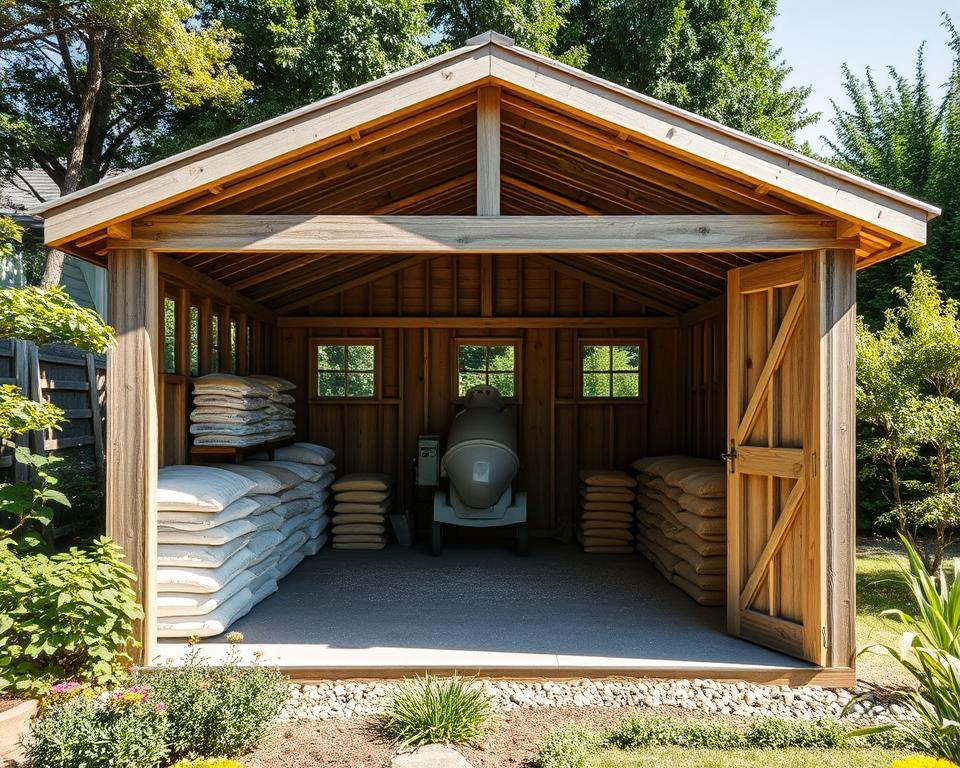
Mix design and choosing the correct concrete strength
For a typical garden shed a C20/25 mix will normally be sufficient. Specify C25/30 or higher if you plan to store heavy machinery or vehicles. Check exposure class for freeze–thaw or chemical risk and follow BS EN 206 for durability and cement type. Aim for a slump of roughly 50–100mm for hand placement. Avoid adding excess water, as this reduces final strength.
Mixing options: ready-mix, bagged mix or on-site mixing
Ready‑mix from suppliers such as Cemex, Hanson or Tarmac gives consistent quality and suits larger slabs. Order by cubic metres and confirm site access for the delivery mixer. Bagged pre‑blended mixes from B&Q, Tarmac or Cemex are handy for small bases and can be mixed in a wheelbarrow or a powered mixer. On‑site mixing from cement, sand and aggregate is feasible for experienced builders but needs strict quality control.
Estimating quantities and ordering materials
Calculate slab volume with length × width × thickness in metres, then add 5–10% for wastage. Use a concrete quantity calculator UK to double‑check figures before ordering. Order Type 1 MOT crushed stone for the sub‑base by cubic metres or tonnes; one cubic metre typically weighs 1.4–1.6 tonnes depending on material. Plan reinforcement: mesh sheets or rolls with at least one‑mesh overlap, and rebar with laps of 40× diameter. Book delivery to match site readiness and labour; for small projects consider hiring a pump or transit mixer with a skip.
Formwork, Reinforcement and Pouring Techniques
Getting the formwork and reinforcement right makes the difference between a tidy slab and costly repairs. Use straight, pressure-treated timber or aluminium formwork to create neat edges. Brace boards with stakes and wales at close centres so the shuttering resists lateral pressure and stays level during the pour.
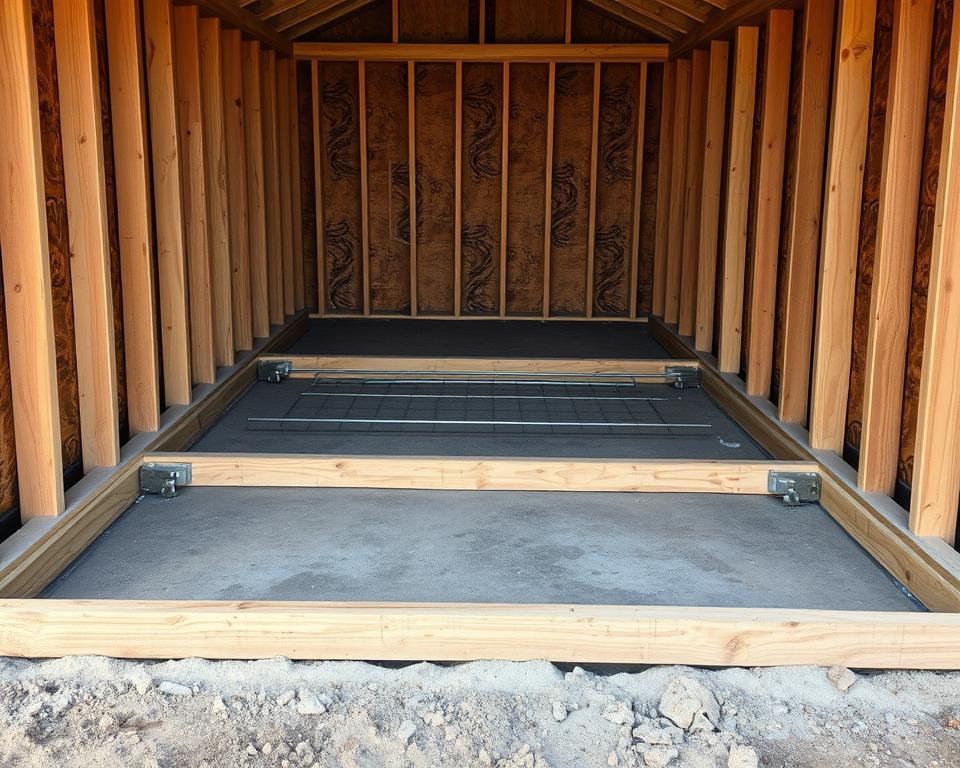
Seal joints to limit bleed loss and consider chamfer strips on external corners to prevent brittle edges. Leave small expansion gaps where the slab meets brickwork or sleepers. Check levels with a spirit level before fixing so the formwork for shed slab is true to the design.
Constructing durable shuttering and edge supports
Choose straight boards and tighten all fixings. Drive supports in line and add diagonal bracing where wind or wet concrete may push the forms out of position. For longer runs use metal corners or proprietary clips to maintain alignment.
Set edge heights with a datum and measure along the length to ensure consistent fall or slope. Remove loose soil beneath the boards and place a compacted sub-base to prevent the shuttering sinking mid-pour.
Types of reinforcement: mesh, rebar and fibre
Weldmesh is standard for domestic slabs. Support the reinforcement mesh rebar fibre centrally using chairs, small bricks or purpose-made spacers so the steel sits in the correct cover. Aim for 20–40mm cover as required by exposure.
Use rebar where edges, beams or heavier loads demand extra tensile strength. Follow lap length guidance and secure bars with wire ties. Add dowels at construction joints to transfer load where separate pours meet.
Synthetic or polypropylene fibres reduce plastic shrinkage and micro-cracks when added at batching. Treat fibres as an aid, not a replacement, for structural mesh or rebar where design loads require steel reinforcement.
Pouring, levelling and trowelling best practice
Plan the pour so sections are continuous to avoid cold joints. If a break is unavoidable, form a planned joint with dowels or keying bars. For larger areas use a poker vibrator to consolidate concrete and remove trapped air.
Strike off with a straight edge or screed board running across the formwork to achieve level. Work in teams so one person screeds while another follows with a float to close the surface and bring paste to the top.
Choose trowelling techniques UK trades use for the finish you need. Use a wood or magnesium float first, then a steel trowel for a hard, smooth surface. Leave a brushed finish if you need anti-slip. Avoid overworking; concrete sets quickly and excess finishing can cause dusting.
| Stage | Best practice | Common pitfall |
|---|---|---|
| Formwork setup | Pressure-treated timber or aluminium; braced at close centres; sealed joints; chamfer strips | Insufficient bracing causing bowed edges |
| Reinforcement placement | Weldmesh centrally on chairs; rebar with correct laps; fibres added at mixing | Reinforcement touching sub-base or sitting too low |
| Pouring and consolidation | Continuous pours where possible; poker vibrator for large areas; tamping for small slabs | Cold joints from interrupted pours |
| Levelling | Screed with straight edge; float to close surface; check levels frequently | Poor screeding leading to uneven slab |
| Trowelling finish | Float then steel trowel for smooth finish; brush for anti-slip; avoid overworking | Overworked surface causing dusting or weak top layer |
Curing, Finishing and Allowing Time Before Installation
Proper curing and the right surface finish determine how well your slab performs under load and traffic. Use sensible concrete curing methods to keep the slab moist during the early days, protect against rapid drying and guard the surface from frost or heavy rain.
Curing options
Keep the surface damp by regular water spraying, cover with polythene sheeting or apply a curing compound such as Sika Concrete Cure & Seal. These approaches preserve moisture for cement hydration and reduce the risk of shrinkage cracks.
Protect the slab early
Shield the concrete from wind and sun in the first 48–72 hours. In cold weather avoid frost on fresh concrete. For ordinary Portland cement mixes aim for at least seven days of sustained curing; longer periods of 14–28 days will improve long-term strength and durability.
Surface choices
For internal shed floors a floated finish gives a smooth, dense surface when finished with a wooden or magnesia float and a steel trowel. A brushed finish creates texture and helps reduce slips when the surface is wet.
Anti-slip options
When external access may be wet, concrete finishes anti-slip such as broomed texture or specialised non-slip coatings work well. For workshops consider power floating then allow full cure before applying epoxy or heavy-duty coatings from manufacturers like Ronacrete or Ardex.
Allowing time before erecting the shed
For a light garden shed you can build after about seven days, but a safer practice is to wait 14 days so the slab gains more strength. For heavier structures, base plates or anchors, follow the 28-day guideline before applying full loads or tensioning fixings.
Anchors and fixings
Use chemical anchors rated for cured concrete where manufacturers specify. Check curing time shed base recommendations and the anchor supplier’s load limits before drilling and installing.
Deciding when to build
Decide when to build shed on slab by matching the use and load to the slab’s maturity. Light use permits earlier erection. Heavy use or machinery calls for a full cure period and, where necessary, an engineer’s sign-off.
Common Mistakes and Troubleshooting on Concrete Bases
Getting a shed base wrong causes long-term headaches. Spotting early warning signs helps you take targeted action before small issues become major repairs. The guidance below covers typical concrete slab problems and practical fixes to protect your investment.
What to watch for
Telltale poor compaction signs include surface depressions, uneven settlement and hairline or wide cracks soon after pouring. Puddles of water on or beside the slab point to inadequate drainage. Tap suspect areas; a hollow or squeaky sound often signals voids beneath the slab that need investigating.
Repair options for minor damage
For hairline cracks, clean the area then use a cementitious repair mortar or a flexible filler such as Sika Repair TX. Wider cracks usually need saw-cutting and sealing with a suitable sealant. If movement is suspected, epoxy or polyurethane resin injection can bond and stabilise the joint.
Addressing surface defects
Laitance and dusting are common surface problems. Remove loose material by light scabbling or carefully using a diluted acid wash. After thorough rinsing and drying, apply a penetrating consolidation product then a protective topcoat to reduce future dusting.
Localised settlement and voids
Minor sinking can be treated with grout injection. Cementitious grout suits stable, low-movement voids. Polyurethane grouts expand to fill irregular gaps under the slab. Major failures may need slab lifting or partial removal and relay with a properly compacted sub-base.
How to repair concrete crack shed base
Begin by cleaning cracks for a secure bond. Choose repair materials matched to crack width and expected movement. For persistent or structural cracks, consult a structural engineer or use specialist contractors such as Sika or Fosroc for resin injection and guaranteed results.
Preventing future problems
To prevent settlement and water ingress, ensure site grading sends water away from the slab perimeter. Install channel drains or a French drain where surface water collects. Keep gutters and downpipes clear so runoff does not undermine the base.
Perimeter sealing and maintenance
Maintain a robust perimeter seal between the shed and slab. Use purpose-made flashing or a high-quality silicone sealant to stop driving rain reaching the joint. Inspect seals annually and replace degraded material promptly.
Routine checks
Inspect the base for blocked drainage, vegetation at the edges and new cracks. Early intervention reduces the chance of extensive repair. Regular maintenance helps avoid many common concrete slab problems and keeps the shed secure for years.
Conclusion
This concrete base for shed diy summary pulls together the practical steps and standards needed to build a durable shed foundation. Start with planning and legal checks, choose the best site, and establish a compacted sub-base. Select an appropriate concrete mix and reinforcement, form accurate shuttering, pour and level the slab, then cure and finish the surface before erecting the shed.
For anyone looking to build shed base UK, logistics matter: schedule materials delivery, ensure you have the right tools and workforce, and source quality products from recognised suppliers such as Cemex, Hanson or Tarmac. Follow British Standards (BS EN 206) and health and safety guidance, and keep neighbours and utility companies informed to avoid delays.
Use the shed foundation checklist provided to confirm dimensions, reinforcement, and curing times. If you face unusual ground conditions, a larger span, or any uncertainty about structural adequacy, consult a structural engineer or chartered surveyor. Save or print this guidance for on-site reference and contact local suppliers for quotes to finalise costs and timelines.
FAQ
What thickness of concrete slab do I need for a domestic garden shed?
For most domestic garden sheds a slab between 75mm and 150mm is appropriate. Light storage or small timber sheds commonly use a 75–100mm slab over a compacted Type 1 MOT sub-base of 100–150mm. Heavier workshops, structures carrying machinery or vehicles should use a thicker slab (typically 150mm) with reinforced edge strips and an increased sub-base depth. Specify C20/25 as a minimum for standard domestic use and consult a structural engineer for higher loads.
Do I need planning permission to lay a concrete base for a shed?
Small garden sheds often qualify as permitted development, but this depends on size, height and location relative to the principal elevation and boundaries. If you are within a conservation area, on a listed property, or the base increases the building footprint beyond permitted limits you may need planning permission. Check gov.uk guidance and contact your local planning authority for certainty. For boundary or party-wall implications, consider the Party Wall etc. Act 1996 and, where necessary, serve notice or obtain specialist advice.
How should I prepare the ground before pouring the concrete?
Remove turf, topsoil and organic matter down to a stable subgrade. Excavate to allow for the slab thickness, DPM and a compacted Type 1 MOT sub-base (typically 100–150mm). Compact the sub-base in layers with a plate compactor, check levels with a straight edge and spirit level, then lay a DPM with overlaps taped and sealed. Set up durable shuttering and secure it to resist lateral concrete pressure before pouring.
Which concrete mix and strength are suitable for a shed base?
C20/25 (previously 25 N/mm²) is generally suitable for standard domestic shed slabs. For heavier use or machinery, consider C25/30 or higher. Choose the mix to suit placement method and exposure class per BS EN 206. Ready-mix from suppliers such as Cemex, Hanson or Tarmac gives consistent quality, while pre-blended bagged mixes are acceptable for small DIY pours.
Can I use fibre reinforcement instead of steel mesh?
Polypropylene or synthetic fibres reduce plastic shrinkage and micro-cracking and are useful as secondary reinforcement. However, fibres do not replace structural steel mesh or rebar where tensile capacity and control of wider cracks are required. For domestic slabs mesh (A142/A193) placed centrally is common; use rebar in edge beams or where higher loads occur.
How long should I cure the slab before erecting the shed?
Maintain curing for at least seven days to ensure adequate early strength, ideally 14 days for better performance. For full characteristic strength and before applying full structural loads or heavy fixings, wait 28 days or follow the manufacturer/engineer’s guidance. Keep the surface damp, use polythene sheeting or a curing compound, and protect the slab from frost and rapid drying during early curing.
What slope or fall should I give the slab for drainage?
Where surface water runoff is a concern, a slight fall of about 1:100 to 1:80 away from the shed is typically sufficient. Ensure positive drainage away from the perimeter and consider perimeter channels or French drains for sites prone to surface water. Avoid siting the shed in low-lying areas or consult Environment Agency flood maps if concerned about flooding risk.
How do I estimate the materials and order ready-mix concrete?
Calculate slab volume by multiplying length × width × thickness (metres) and add 5–10% for wastage. Order ready-mix by cubic metres from suppliers such as Cemex, Hanson or Tarmac, ensuring site access for the delivery truck and that labour is ready. For sub-base, order Type 1 MOT by cubic metres or tonnes (approx. 1.4–1.6 tonnes per m³). Pre-order reinforcement mesh, DPM and shuttering timber to align with the pour date.
What PPE and waste measures should I use during the build?
Use gloves (alkali resistant), safety boots, eye protection, dust masks when handling dry mixes, ear protection for powered tools and hi-vis if near road access. Arrange licensed disposal for spoil and waste concrete; contain concrete wash-out and prevent discharge to drains. Follow CITB and HSE guidance on safe working practices.
How can I repair minor cracks or settlement issues?
Hairline cracks can be filled with cementitious repair mortars or flexible sealants after thorough cleaning. Wider cracks may require saw-cutting and sealing or injection with epoxy/PU resins depending on movement. Localised settlement can sometimes be remedied by grout injection to fill voids; significant failures may need slab lifting, underpinning or partial relay—seek structural advice for major defects.
How close can I build the base to trees and underground services?
Keep a sensible distance from trees to avoid root damage and future heave; a conservative rule is at least half the canopy spread, though this varies by species and size. Locate underground services before digging using utility plans, the national “Before You Dig” services or a CAT scanner, and contact utility providers if in doubt. For roots near the footprint consider root barriers or alternative foundations after consulting an arboriculturist or engineer.
When should I consult a professional for a shed base?
Consult a structural engineer or chartered surveyor when the shed is large, will carry heavy loads or when ground conditions are poor (high water table, very soft soils or steep slopes). Seek planning advice from your local planning authority for complex cases, and contact utility companies before excavation. Engage professionals early if you anticipate the need for piled foundations, engineered edge beams or specialist drainage.