Carport Boundary Rules in the UK – Build with Ease
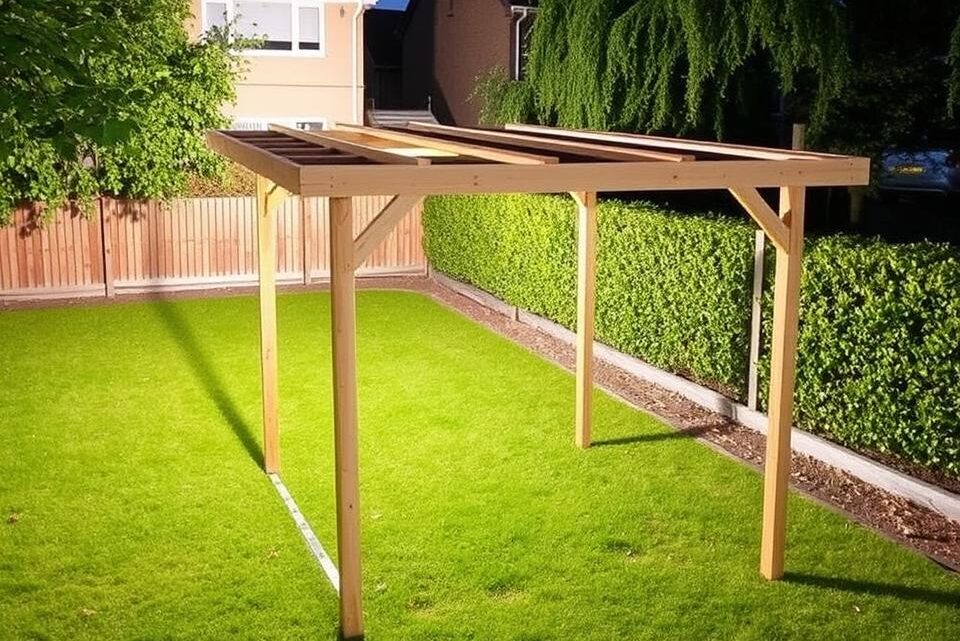
Planning a carport raises a common question: how close to my neighbour’s boundary can I build a carport? This introduction sets out what homeowners, landlords and developers need to know about carport boundary rules UK, carport planning UK and permitted development carport options. It explains why title plans, permitted development rights, party wall duties and building regulations all matter for a successful, compliant project.
This article breaks the subject into clear steps. You will learn when a boundary survey is sensible, when planning permission is likely, and when a Party Wall Notice or building regulations approval is required. The guidance focuses on practical outcomes: distance considerations, minimising neighbour disputes, likely costs and timescales, and preparing a concise submission that planning officers and neighbours can understand.
Read on for detailed sections that cover distance rules in plain terms, permitted development limits, party wall obligations, building standards and tips for keeping neighbours onside. The aim is to help you build with confidence while staying within carport planning UK and carport boundary rules UK requirements.
Inhaltsverzeichnis
Key Takeaways
- Check property deeds and title plans first to establish the exact boundary.
- Permitted development carport rules often apply, but height and proximity limits can vary.
- Commission a boundary survey if there is any doubt about the line between properties.
- Party Wall Notices may be needed where works affect a shared wall or structure.
- Building regulations, insurance and neighbour communication are essential to avoid disputes.
how close to my neighbour’s boundary can i build a carport?
There is no single national rule that fixes how close a carport must be to a neighbour’s land. Planning guidance, permitted development limits and private deeds shape what you can do. Local planning authorities set policies on outbuildings to prevent overbearing or loss of light. Private covenants in property deeds can add further restrictions beyond planning rules.
Understanding distance requirements in plain terms
Permitted development rights usually control size, height and position for outbuildings. Those rules aim to stop structures that dominate a neighbour’s space or harm the street scene. For a typical suburban plot, councils expect reasonable neighbour boundary distance and sensible setbacks so the carport does not appear overbearing.
Where permitted development does not apply, a full planning application will test whether the proposed boundary distance carport is acceptable. If the design sits close to an adjoining garden, expect the planning officer to consider amenity, daylight and privacy impacts.
How property deeds and title plans affect boundary positions
HM Land Registry title plans offer a general outline of ownership. Title plan boundary interpretation shows boundaries as indicative lines, not precise legal limits. The definitive legal boundary is recorded in the deeds and may rest on written descriptions, old plans or physical markers on site.
Many deeds contain covenants restricting outbuildings or prescribing minimum separations from the neighbour boundary distance. If your property deeds boundary UK includes such covenants, you must follow them even when planning rules permit a carport.
When to commission a professional boundary survey
Order a boundary survey carport when deeds are unclear, when your proposed work sits close to the apparent line, or if a neighbour disputes the limit. A chartered surveyor will produce an accurate measured plan and a written report you can use for planning submissions or legal discussion.
The surveyor’s outputs typically include a scaled site plan, measured distances from the legal boundary to the proposed structure and clear notes on methodology. Keep this evidence when you consult neighbours and when you submit plans to the council. That approach helps avoid confusion between a physical fence and the true legal line shown on property deeds boundary UK.
Permitted development rights and carports in the UK
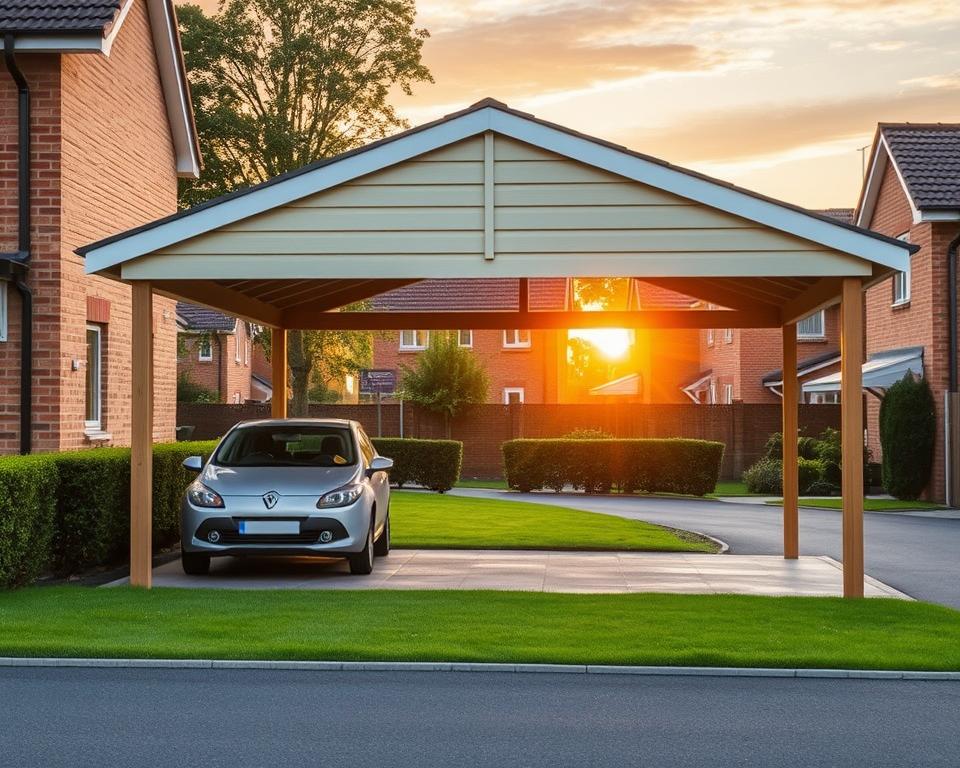
Permitted development can make a carport project straightforward when it meets the statutory tests. Part 1, Class E of the Town and Country Planning (General Permitted Development) (England) Order 2015 allows incidental outbuildings at a dwelling without full planning permission, subject to conditions. Equivalent rules exist for Wales, Scotland and Northern Ireland, each with small differences that matter for a permitted development carport.
A carport will normally qualify as an outbuilding if it remains incidental to the main dwelling and is not used as separate living accommodation. Check whether your proposal, combined with other extensions and outbuildings, stays within PD rights outbuildings so you do not inadvertently create a new unit.
Overview of permitted development rules for outbuildings
Permitted development for outbuildings permits single-storey additions in private gardens provided they meet set limits. The rules cover use, position and size. You must confirm the structure is incidental and not within the curtilage of a separate dwelling. The local planning authority’s interpretation can vary, so read the exact statutory wording for your nation.
Height, footprint and proximity limits that commonly apply
Typical constraints include roof height, eaves and footprint limits. Single-storey flat roofs often have lower height limits than dual-pitch roofs. Many councils treat structures over 2.5m differently if they sit within 2m of a boundary.
Common limits include a maximum overall area for outbuildings so that combined structures do not exceed about 50% of the original garden area in England. There are also rules on maximum ridge and eaves heights and restrictions where a building is close to a neighbour’s boundary.
- Maximum height varies with roof type and location; check local outbuilding height limits UK for precise figures.
- Parts of a structure over 2.5m high are often not allowed within 2m of the boundary.
- Flat roofs may be limited to lower heights than pitched roofs; eaves heights can be crucial for compliance.
- Combined area of all outbuildings is assessed, so a permitted development carport plus other sheds may breach PD rights outbuildings.
How local planning authorities can remove permitted development rights
Local authorities can restrict PD rights through Article 4 directions or specific planning conditions. Conservation areas, national parks and Areas of Outstanding Natural Beauty frequently see tighter controls.
Local plans may include policies that affect outbuildings. If permitted limits are exceeded, enforcement action can follow. For a carport without planning permission, retrospective applications and fines are possible, so check whether an Article 4 direction applies to your street.
Always confirm the statutory tests for your UK nation and consider the cumulative impact of other works. If unsure, seek pre-application advice from the local planning authority or consult a chartered planning consultant to avoid costly mistakes.
Planning permission: when you will need it for a carport
Deciding whether you need planning permission for a carport can feel daunting. Start by checking simple limits such as height, footprint and position. If your project stays within those limits you may use permitted development rights. If it does not, you will need a formal planning permission carport submission.

Scenarios that require a full planning application
Apply for a carport planning application when the structure breaches permitted development thresholds. Examples include a large attached carport with storage above, or a front-facing carport that affects visibility or parking in front of the principal elevation.
Seek permission if the carport would create a separate residential unit or if it would materially harm neighbours’ amenity. A garage-sized carport that enlarges the house footprint beyond the allowed coverage is a common trigger.
Conservation areas, listed buildings and special restrictions
In conservation areas you often lose permitted development rights. Councils expect designs that respect local character. A conservation area carport may require a carport planning application even when identical works would be PD elsewhere.
Listed building restrictions carport cases demand extra care. Works that affect a listed structure or its setting can need listed building consent. National parks and Areas of Outstanding Natural Beauty apply closer scrutiny.
How to check your local planning portal and pre-application advice
Begin at your local authority planning portal to view policies and interactive maps for conservation areas and listed buildings. Use the national Planning Portal for England and consult the corresponding bodies for Wales, Scotland and Northern Ireland when relevant.
Many councils offer a pre-application advice service for a fee. Preparing clear drawings and a concise design rationale before seeking advice speeds the process. Typical planning timescales and fees vary by authority; expect several weeks for validation and longer for decisions on complex proposals.
| Step | What to check | Typical outcome |
|---|---|---|
| Initial review | Local plan, PD limits, property title | Likely PD or need to apply |
| Mapping | Interactive maps for conservation areas and listed status | Triggers extra controls if within a protected area |
| Pre-application | Draft drawings, photos, short design statement | Informal officer feedback and risk clarity |
| Formal submission | Full plans, fees, neighbour notifications | Decision within statutory timescale or longer if complex |
| Post-decision | Conditions, listed building consent or appeals | Works proceed only when permissions are met |
Party wall considerations and neighbourly agreements
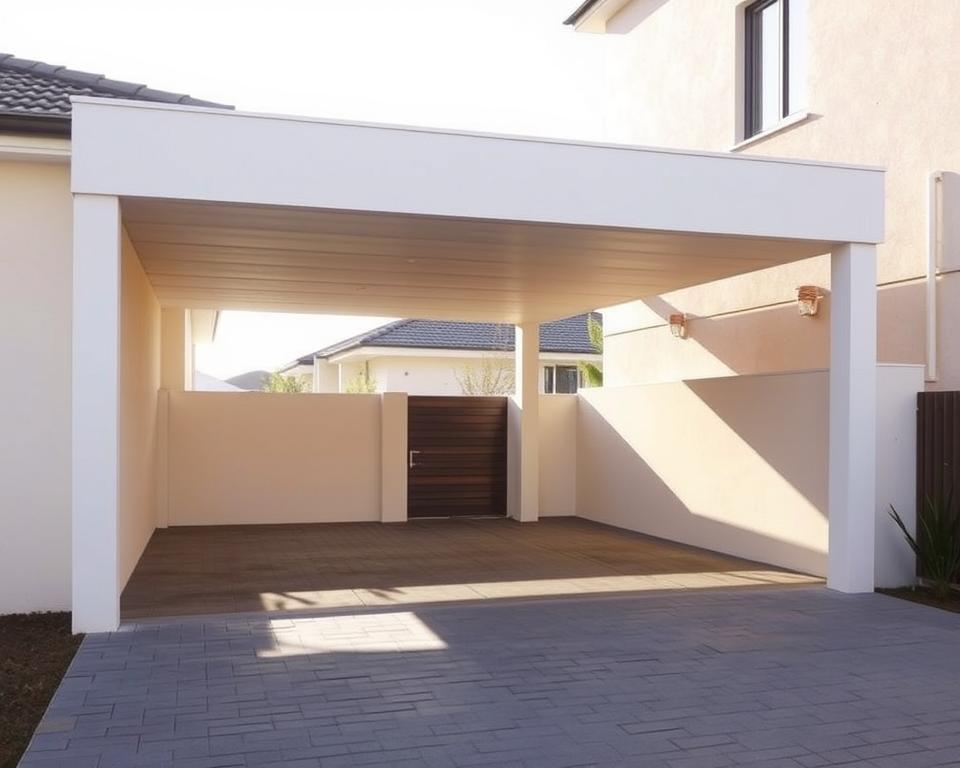
Building a carport near a shared boundary needs careful thought about the Party Wall etc. Act and neighbour relations. Simple projects can be straightforward. Borderline works often need formal steps and clear records.
Is a carport a party structure?
The Party Wall etc. Act 1996 applies when works affect a party wall, party fence wall or excavations close to a neighbour’s foundations. A freestanding carport placed wholly within one garden and clear of the boundary is unlikely to be a party structure carport. An attached carport, one built astride the boundary or one that requires excavations within about 3–6 metres of a neighbour’s foundations may fall within the Act and become a party wall carport issue.
How to serve notice and reach a Party Wall Award
If the Act applies, you must serve written notice on adjoining owners specifying the proposed works. The statutory notice period is usually two months for building on or up to the boundary. If the neighbour dissents, the parties must appoint a surveyor or agree a single surveyor. The appointed surveyor(s) prepare a Party Wall Award that sets out the works, access arrangements, indemnities and a schedule of condition to record the state of the neighbour’s property.
Timings and fees are important to plan for. Surveyor costs and the time to agree an Award will add to the project timeline. Professional advice from an accredited party wall surveyor helps where the status of a Party Wall etc. Act carport is unclear.
Informal neighbour agreements and written permissions
Early, calm conversations can often avoid formal procedures. A neighbour agreement carport in writing can set out a simple method statement, timescale, indemnity against damage and contact details. A signed letter or deed of variation gives certainty and can prevent disputes from escalating.
For borderline cases, get a photographic schedule of condition before work starts and consider a brief independent inspection report. That record protects both parties if damage is later alleged.
| Issue | When it applies | Practical step |
|---|---|---|
| Freestanding carport | Fully inside one curtilage, away from foundation zone | Discuss with neighbour; retain photos; no formal notice usually needed |
| Attached carport | Fixed to a wall shared with neighbour or on the boundary line | Serve Party Wall notice; appoint surveyor if disputed; prepare Award |
| Excavation near foundations | Within 3–6 metres of adjacent foundations depending on depth | Serve notice under Party Wall etc. Act; obtain structural advice; agree safeguards |
| Informal neighbour agreement | Mutual consent to works that might otherwise trigger the Act | Use written permission or deed; include method statement and indemnity |
Building regulations and safety for carports
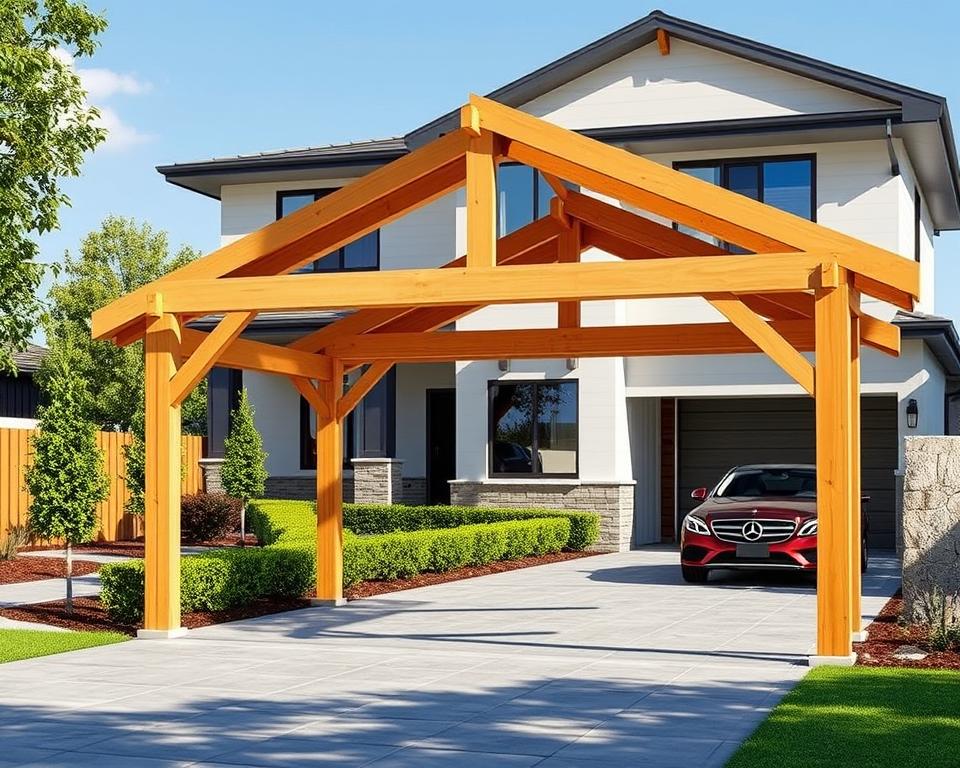
Before you start construction, check how building control applies to your plan. Many simple, single-storey detached carports with open sides fall outside full building regulations approval. If you add a workshop, enclose sides, install electrical work or alter foundations, you will likely need approval under the Building Regulations in England and Wales or the equivalent rules in Scotland and Northern Ireland.
When building regulations approval is required
If the carport is attached to the house or creates an escape route, approval is commonly required. Works that involve structural alterations, drainage connections or new electrical circuits normally trigger the need for building control notification. Keep records of all inspections and any supplied compliance certificates from building control officers.
Structural standards, foundations and drainage considerations
Good design must meet carport structural standards. That means correct beam and post sizing to carry roof loads and resist wind uplift. Use Eurocodes and BS standards as a reference and consult a structural engineer for long spans or poor ground conditions.
Foundations for carport need to prevent settlement. Even modest posts require concrete pads or strip footings sized to soil type and load. Protect metal fixings from corrosion and ensure timber is treated where ground contact may occur.
Drainage carport UK planning should avoid sending run-off onto a neighbour’s land. Install gutters and downpipes that link to existing drainage or soakaways sized to current regulations. Rule out surface water discharge to public sewers without permission.
Fire safety and means of escape implications
Fire risk rises if the carport is attached to the dwelling or used to store combustible materials. Materials, separation distances and ventilation may be regulated when the structure affects escape routes. For freestanding carports the risk is lower, but any fixed wiring must comply with Part P electrical safety requirements.
Retain building control documents and follow Approved Documents for guidance. Arrange scheduled inspections when approvals are required and keep an as-built file of drawings, calculations and compliance certificates for future owners.
Common boundary disputes and how to avoid them
Disagreements about carports are among the most frequent neighbour rows. A well-timed approach can prevent minor concerns from becoming full-blown conflict. The guidance below explains typical triggers, practical steps to communicate early, and when to bring in professionals.

Typical causes of neighbour disputes over carports
Uncertainty over the exact boundary line is a common spark for a neighbour dispute carport. Small errors in title plans or misread deeds can lead to encroachment claims. Perceived loss of light or outlook often follows when a carport sits close to a boundary.
Noise and disturbance during construction may sour relations, especially where work starts early or runs late. Drainage and run-off worries arise when roofwater redirects onto an adjoining garden. Access and parking changes can create friction where a carport blocks a shared drive or obstructs a right of way.
Property owners sometimes fear devaluation of their home if a structure diminishes curb appeal. Examples include carports built partly on a neighbour’s land or that obstruct a public footpath, which can trigger a boundary dispute carport and formal complaints.
Strategies for early communication and mediation
Notify neighbours early with clear drawings and proposed timescales. A simple plan helps reduce guesswork and shows intent to avoid neighbour disputes building. Offer to meet on site so neighbours can see the exact position and raise concerns.
Provide a written summary of proposals with contact details and invite feedback by a set date. Keep photographic records of the site before work begins. If conversations stall, consider independent mediation. Services such as Citizens Advice, Community Legal Advice, or a Royal Institution of Chartered Surveyors mediator specialise in mediation boundary disputes UK.
Record any agreement in writing and keep copies. Small concessions, such as additional planting or a timber screen, often prevent escalation and preserve good relations.
When to seek legal advice or escalate to the courts
If agreement cannot be reached and there is clear encroachment, breach of covenant or failure to comply with the Party Wall etc. Act, seek a specialist property or construction solicitor. Legal help is appropriate where a neighbour dispute carport risks injunctive relief or substantial losses.
Possible remedies include injunctions to remove an unauthorised structure, damages, or rectification orders. Court proceedings can be costly and slow. That is why mediation boundary disputes UK should be explored before litigation.
Retain professionals where needed: a chartered surveyor to confirm the boundary, a solicitor to advise on covenants and remedies, and a builder who will document works. Clear records, polite communication and early mediation reduce the chance that a boundary dispute carport will end in court.
| Issue | Early step | Professional to involve | Likely outcome |
|---|---|---|---|
| Uncertain boundary | Share title plan and commission a survey | Chartered surveyor | Clarified line, reduced risk of encroachment |
| Loss of light or outlook | Provide scaled drawings and sightlines | Architect or planning consultant | Design adjustments or screening agreed |
| Drainage/run-off | Show drainage plans and mitigation | Drainage engineer | Prevented water damage, neighbour confidence |
| Access or shared drive conflict | Discuss access changes and offer alternatives | Property solicitor | Binding easement agreement or redesign |
| Construction disturbance | Agree hours, noise limits and clean-up | Builders with references | Reduced complaints and smoother build |
Materials, design and impact on neighbours
Good carport design considers neighbours from the first sketch. Thoughtful choices about materials, roof form and screening can reduce visual bulk and keep daylight flowing into nearby homes. Use local design guides and neighbourhood planning documents to shape a scheme that fits the street scene and meets neighbour expectations.
Selecting materials that reduce visual intrusion
Choose low-impact carport materials such as timber with natural finishes or powder-coated aluminium with slim profiles to keep massing light. Polycarbonate or translucent roofing lets light through, lowering the apparent bulk. Pick muted colours that blend with brickwork and planting, and specify low-reflective coatings to avoid glare.
Design choices to preserve light and outlook for neighbours
Orient the carport away from key neighbouring windows whenever possible. Use lower eaves, set the structure back from the boundary and keep at least one side open to reduce enclosure. Select roof pitches and glazing details that encourage daylight penetration and avoid overbearing blank walls near habitable room windows.
Landscaping and screening options to minimise impact
Soft landscaping often outperforms solid fences. Native hedging, trellis with climbers and living screens provide screening while enhancing biodiversity. Acoustic fencing can be used where noise is a concern, and green roofs add habitat and visual softness. Check root protection requirements and agree maintenance responsibilities with neighbours.
| Design aim | Practical option | Benefits for neighbours |
|---|---|---|
| Reduce visual bulk | Timber frame or slim aluminium profiles | Blends with surroundings, less imposing |
| Maintain daylight | Translucent roofing, lower eaves, open sides | Preserves light into habitable rooms |
| Minimise glare | Low-reflective finishes and muted colours | Prevents nuisance reflections |
| Soften boundary impact | Native hedging, trellis with climbers, green roofs | Improves outlook and biodiversity |
| Address noise | Acoustic fencing and planting belts | Reduces sound transfer to neighbouring properties |
Balancing function with neighbourly care leads to better outcomes. Early consultation and clear notes on who will maintain planting or screening avoid later disputes. Where appropriate, commission a simple daylight assessment to show how the scheme will preserve neighbour light and justify design choices to planning officers or neighbours.
Access, easements and shared driveways affecting carport placement
Before siting a carport, check whether any legal rights cross your land. An easement can grant another party the right to pass, turn or park across part of your property. A recorded easement or an implied right in older deeds may restrict where you can place a structure such as an easement carport.
Understanding rights of way and vehicular access easements
Rights of way and vehicular access easements commonly appear in title deeds. They can limit the footprint of a build if the carport would block the route. Confirm whether the rights are exclusive, shared or reserved for specific vehicles. If a rights of way carport would impede access, you may need consent from the benefited owner.
How shared driveways influence boundary setbacks
Shared driveways need clear passage widths for turning and emergency vehicles. A shared driveway carport must avoid narrowing lanes or obstructing sightlines near junctions. Where surfaces are jointly owned, altering finishes or adding posts usually requires agreement from all owners.
Resolving access disputes before construction
Start by checking title deeds for registered rights and mapping them against your proposed layout. Speak with neighbours and offer written undertakings where necessary. A formal licence or variation of an access easement UK can clarify responsibilities and reduce future risk.
Where negotiations stall, mediation or solicitor-led advice can formalise an outcome. Legal confirmation of rights prevents costly removal later. Keep emergency access and visibility splays in mind when drafting plans to protect safety and compliance.
Insurance, liability and responsibilities for boundary structures
Building a carport near a boundary raises clear insurance and liability questions. Homeowners should check policies and records before work begins. Keep contracts, warranties and professional reports in one place for easy reference.
Insurance cover for damage caused during build
Ensure the contractor holds public liability and employers’ liability insurance that is current and relevant. Ask for certificates from insurers such as Aviva or Direct Line and confirm cover includes damage to neighbouring property. Request written proof and check policy limits against likely risks.
Consider temporary homeowners’ liability cover for the construction period. That extra protection can cover gaps if a builder’s policy does not extend to your specific boundary works. For high-value fittings or battery storage, discuss separate cover with your broker.
Ongoing liability for maintenance and safety
The owner of the carport normally bears responsibility for maintenance and for harm caused by structural failure. Regular inspections reduce the chance of collapse, falling debris or water ingress that might cause neighbour damage.
If ownership of the boundary structure is shared, set out maintenance obligations in writing. A clear agreement prevents disputes and demonstrates duty of care if a claim arises. Keep inspection notes and repair invoices to support any defence or claim.
Notifying your buildings insurer about the new structure
Tell your buildings insurer before and after construction so your policy reflects the new risk. Many providers require details such as dimensions, materials, and intended use — for example, whether the space will store goods or park a vehicle with an EV charger.
Failing to notify insurer carport changes can affect future claims. Provide construction details, builder contact information and confirmation that work complied with regulations. Ask about boundary structure insurance and how the addition alters premiums under carport insurance UK offerings.
| Risk area | Action to take | Typical documentation |
|---|---|---|
| Builder damage to neighbour | Obtain public liability certificate and confirm cover for neighbouring property | Insurance certificate, contract, photographs of site |
| Owner liability for defects | Schedule periodic inspections and prompt repairs; record all work | Inspection reports, repair invoices, maintenance log |
| Policy update and claims | Notify insurer carport addition before occupancy and after completion | Construction details, materials list, builder contact, planning or approvals |
| High-value fittings or EV equipment | Consider separate cover or extensions to existing policy | Warranties, purchase receipts, specification sheets for batteries/chargers |
| Builder liability carport disputes | Retain signed contract with clear liability clauses and proof of insurance | Signed contract, insurance proofs, correspondence |
Costs, permits and typical timelines for carport projects
Planning a carport means balancing budgets, paperwork and time. Below are practical figures and typical lead times to help you plan your project with greater confidence.
Estimating planning, survey and construction costs
Start with surveys. A boundary or topographical survey typically ranges from £300 to £1,500 depending on site complexity. Expect planning application fees from around £206 for a householder application in England. Party wall surveyor fees vary widely; small matters may cost a few hundred pounds while contested awards can reach several thousand. These party wall costs carport must be budgeted early.
Construction prices depend on materials and size. Simple timber carports often cost between £1,000 and £4,000. Bespoke steel or glazed structures rise well above that figure. Confirm what each quote covers: foundations, drainage and electrics are common extras. Compare multiple suppliers and check warranties before committing.
Typical lead times for planning, approvals and build
Allow time for each stage. A boundary survey usually takes 1–3 weeks once instructed. Pre-application advice from a local authority can take 2–6 weeks. Most householder planning decisions are determined in roughly 8–13 weeks, though local demand can extend that period. Party wall procedures add time; statutory notices and award preparation can add 4–8 weeks to the carport timeline.
Construction lead time varies. Self-assembly kits may take a few days to install. Site-prepared bespoke builds often need several weeks, especially if groundworks are involved. Expect delays if neighbours object or if additional approvals are required.
Budgeting for neighbour consultations and potential legal costs
Set aside contingency for dispute resolution. Mediation and solicitor advice can be costly. If a party wall dispute arises, fees for surveyors or legal representatives can materially increase overall spend.
Ask for fixed-price quotes where possible and check exclusions. Factor in long-term costs such as maintenance and insurance. Comparing installers, checking references and requesting case studies reduces the risk of surprise expenses and improves value for money.
To summarise practical planning, keep contingency for surveys, party wall costs carport and legal advice. That approach helps manage the carport cost UK and expected carport planning costs while keeping the carport timeline realistic.
How to prepare a planning or permitted development submission
Preparing a robust planning submission carport or permitted development submission starts with clear documents and a simple narrative. Present the facts, show distances, and illustrate how the proposal sits within the plot. Keep copies of every version and a short consultation record for the planning file.
Essential documents: site plans, elevations and boundary details
Start with a scaled site plan carport that marks the proposed carport and distances to all boundaries and neighbouring dwellings. Include a location plan and block plan to show context and access.
Provide existing and proposed elevations, a roof plan and a materials specification. Where relevant, add a detailed site survey showing trees, drainage runs and any rights of way. Make sure measurements to neighbouring homes and access points are clear.
Tips for clear, neighbour-friendly plans and statements
Write a short design and access statement in plain language. Explain the purpose, chosen materials and steps to reduce impact such as screening, restricted working hours and drainage measures.
Include annotated drawings that show how the carport preserves light and access for neighbours. Add a simple construction timetable and a note on waste handling during build to reassure nearby residents.
Using professional help: architects, agents and planning consultants
Engage a planning consultant carport or a chartered architect when the site is complex, lies in a conservation area or has disputed boundaries. Professionals supply accurate drawings, stronger justification and direct liaison with the council.
Check credentials before you appoint anyone. Look for RIBA membership for architects and RTPI accreditation for planners. Ask for a fixed fee for preparing and lodging the permitted development submission so costs stay clear.
Where feasible, submit digital copies via the local planning portal and save receipt emails. Keep a folder of correspondence and a version log to support any later queries from the planning officer or neighbours.
Conclusion
There is no single answer to how close to my neighbour’s boundary can I build a carport. Compliance depends on permitted development rules, local planning policies, deed restrictions, party wall considerations and building regulations. Review each of these factors early so you know whether you can proceed under permitted development or need full planning permission.
Practical next steps are simple and effective. Check your title deeds and your local authority guidance, commission a boundary survey if you are uncertain, and speak with neighbours before work starts. Seek pre-application advice from the council and instruct qualified professionals for party wall matters, structural design and planning where required to build carport legally UK.
Adopt a neighbourly, evidence-based approach to reduce the risk of disputes. Clear communication, accurate documentation and thoughtful design choices help secure agreement and speed approvals. Finally, factor in realistic costs, timelines, insurance and ongoing maintenance as part of responsible carport boundary advice UK and to protect your investment and relationships.
FAQ
How close to my neighbour’s boundary can I build a carport?
There is no single national statutory distance for carports. Permitted development rules, local planning policies and covenants within title deeds set the practical limits. HM Land Registry plans are illustrative rather than definitive, so you should measure from the boundary shown in your deeds or from a professional boundary survey if in doubt. If the carport exceeds permitted development limits, affects neighbours’ amenity or falls within a conservation area, you may need planning permission.
Do I need a boundary survey before building?
You should commission a chartered surveyor when deeds are unclear, the proposed build sits close to the apparent line, or if neighbouring owners dispute the boundary. A professional survey provides an accurate site plan, measured distances to features and a written report suitable for planning submissions or legal discussions. Retain the survey as evidence in communications with neighbours and the planning authority.
Will a carport usually fall under permitted development rights?
Many carports qualify as incidental outbuildings under Part 1, Class E of the Town and Country Planning (General Permitted Development) Order (England) and equivalent provisions in the devolved nations. However, there are limits on height, overall garden coverage and proximity to boundaries. Combined outbuildings must not exceed 50% of garden area in many cases, and structures over certain heights within 2 metres of a boundary can breach permitted development.
When is full planning permission required for a carport?
Apply for full planning permission if the carport exceeds permitted development limits, materially affects the character of the area, creates additional residential accommodation, or adversely affects neighbours’ amenity. Special designations — conservation areas, listed buildings, national parks and AONBs — often remove permitted development rights and usually require permission or listed building consent for alterations.
Does the Party Wall etc. Act 1996 apply to carports?
The Party Wall Act applies when works affect a party wall, party fence wall or involve excavations within prescribed distances of a neighbouring foundation. A freestanding carport wholly within your curtilage and not on the boundary is unlikely to be a party structure. If the carport is attached to a shared wall, built astride the boundary or involves deep excavations close to a neighbour’s foundations, you must follow the Act’s notice procedure and may need a Party Wall Award.
How do I serve a Party Wall notice and what happens next?
Serve written notice to adjoining owners describing the proposed works and allow the statutory notice period (commonly two months for building up to or on the boundary). If the neighbour dissents, appoint an agreed surveyor or each side appoints one; the surveyor(s) prepare a Party Wall Award that sets out the works, access rights, indemnities and schedules of condition. Costs are typically shared or borne by the building owner, depending on the award.
When do I need Building Regulations approval for a carport?
Simple, open-sided single-storey carports may not require approval. You will need Building Regulations consent if the carport has enclosed sides, contains a workshop, involves significant structural works (foundations, large spans) or includes electrical installations. Where the carport is attached to the dwelling and affects means of escape or fire safety, compliance with Approved Documents will be required.
What structural and drainage issues should I consider?
Ensure adequate foundations to prevent settlement, correct sizing of beams and posts for roof loads and wind uplift, and corrosion protection for metal fixings. Drainage must be designed to avoid runoff onto neighbouring land. For larger spans or marginal ground, consult a structural engineer and follow relevant Eurocodes and British Standards.
How can I reduce the visual and light impact on neighbours?
Use materials and colours that blend with the surroundings (timber stains, low-reflective finishes), keep eaves low, orient the carport away from neighbouring windows, and favour open sides or translucent roofing where appropriate. Include screening or planting to soften visual effects and consider neighbours’ daylight when siting and sizing the structure.
What about shared driveways, easements or rights of way?
Check title deeds for registered easements and rights of way before siting a carport. Shared driveways often require consent from other owners for significant alterations. Avoid obstructing established access widths and turning areas. If access rights are affected, negotiate a licence, variation of easement or written agreement with the other owners to prevent future disputes.
Who is responsible for maintaining a carport on or near a boundary?
The owner of the carport is normally responsible for its maintenance and for preventing harm caused by its failure. If ownership of the boundary structure is shared, responsibilities should be set out in a written agreement. Regular inspections and prompt repairs reduce liability and risk of neighbour claims.
What insurance should I check before and after building?
Ensure your contractor holds public liability and employers’ liability insurance that covers damage to neighbouring property. Consider temporary liability cover for the construction period. Notify your buildings insurer about the new structure after completion, as it may need to be added to the policy and could affect premiums, especially if the carport contains EV chargers or batteries.
How much will surveys, planning and construction typically cost and how long will it take?
Costs vary widely. Boundary/topographical surveys typically range from around £300–£1,500. Planning application fees start from roughly £206 for a householder application in England (subject to change). Party wall fees and surveyor costs can add several hundred to several thousand pounds. Simple timber carports can cost from £1,000–£4,000; bespoke builds are substantially higher. Timelines: surveys 1–3 weeks, planning determinations 8–13 weeks for householder applications, party wall procedures several weeks, and construction from days for kits to weeks for bespoke builds.
How should I prepare a planning or permitted development submission for a carport?
Prepare scaled site plans showing proposed distances to boundaries, existing and proposed elevations, roof plans, materials specification and a block plan. Include a clear, plain-language design and access statement describing mitigation measures for neighbours, a construction timetable and drainage arrangements. For complex sites or conservation areas, engage an architect or planning consultant registered with RIBA or RTPI.
How can I avoid neighbour disputes over a proposed carport?
Communicate early and openly with neighbours: share drawings, explain timescales and invite feedback. Offer to meet on site, provide a written summary of works and consider reasonable concessions (screening, restricted working hours). Use mediation or RICS dispute resolution services if disagreements arise. Keep photographic records and written correspondence to document the consultation process.
Can local planning authorities remove permitted development rights for outbuildings?
Yes. Local authorities can remove permitted development rights through Article 4 Directions, and conservation areas, national parks or AONBs often have tighter controls. Local plan policies may also impose additional restrictions. Always check the local authority’s planning portal and mapping tools before relying on permitted development.
If my neighbour objects, what are my legal options?
Try mediation and further negotiation first. If agreement cannot be reached and there is a clear legal breach (encroachment, covenant breach or failure to follow the Party Wall Act), seek specialist property or construction legal advice. Remedies can include injunctions to remove unauthorised structures, damages or rectification orders, but court action is costly and time-consuming, so it is usually a last resort.