Constructing Shed Bases on Uneven Terrain

Getting the base right is the single most important step when you learn how to build a shed base on uneven ground. A correctly formed garden shed base UK ensures structural stability, keeps the building weatherproof and helps maintain manufacturer warranties from recognised brands such as Rowlinson, Forest and BillyOh.
This guide covers the main shed base construction options for a shed base on slope and other irregular plots. You will find practical coverage of concrete pads and strip foundations, timber bearers and raised bases, screw piles and concrete piers, plus gravel, block and plastic grid systems. Each option includes a clear summary of pros and cons, typical material lists and the precision levelling techniques needed to meet shed manufacturer tolerances.
Throughout the article we emphasise safety, planning and drainage. UK factors such as frost action, heavy clay soils and high rainfall influence foundation choice and long‑term performance. Party wall issues and local permit requirements are also noted where they commonly apply to shed foundations uneven ground.
Expect a step‑by‑step conceptual approach rather than a single prescriptive method. This introduction sets the scope and terminology so you can compare options, plan materials and tools, and follow the maintenance advice that preserves performance over time.
Inhaltsverzeichnis
Key Takeaways
- Choosing the right base is vital for stability, weatherproofing and warranty compliance.
- Common strategies include concrete pads, timber bearers, screw piles and gravel systems.
- UK conditions—frost, clay and heavy rain—must guide foundation selection.
- Safety, drainage and local permits are recurring considerations.
- Article provides a step‑by‑step conceptual workflow, with pros, cons and tool lists.
How to Build a Shed Base on Uneven Ground
Getting a shed to sit correctly on an uneven plot begins with a clear site assessment for shed base. A straightforward introduction explains why slope, hidden hollows and old roots matter. Use practical checks to decide whether the job needs simple levelling or a more engineered solution.
Assessing slope and small ground changes guides the choice of foundation. Begin with basic slope measurement using a spirit level and straight timber over a batten. Measure the drop over a known run with a tape and calculate gradient. For greater accuracy, bring a laser level or digital inclinometer to record cross‑site variation.
Microvariations can be subtle. Look for local hollows, berms, tree roots, old foundations and utility runs. These features affect bearing and drainage and can force a change in foundation selection uneven garden. Note areas that pond after rain and mark compacted or loose fills.
Assessing site slope and microvariations
Record corner levels and a few intermediate points. Typical manufacturer tolerances sit around 10–15 mm across the floor area. If your readings exceed that, plan stepped footings, adjustable supports or deeper piers. Use repeated checks to confirm any unexpected dips or rises.
Choosing the appropriate foundation type for uneven sites
Match foundation selection to ground bearing capacity, slope severity, shed size and permanence. For steep or hard‑to‑reach plots, screw piles and piers reduce excavation and are quick to install. Timber bearer bases suit moderate slopes and lightweight timber sheds. Concrete pads, strips or a raft work best for heavy or permanent buildings.
Consider cost, excavation, frost resistance and the ease of later adjustment. Screw piles offer minimal disturbance and good frost performance. Raised timber bases are cheaper and adjustable but need rot protection. Concrete is long‑lasting and stable but requires formwork and curing time.
Preparing an accurate site plan and level points
Create a site plan showing dimensions, orientation and existing features such as drains, trees and walls. Mark a datum or baseline and note north for orientation. Add the recorded levels next to each point so the plan becomes a working document.
Set batter boards and place level pegs at corners and midpoints to transfer heights across the footprint. Use the datum to calculate step heights, pile depths or concrete step locations. Keep a simple log of each reading; this helps when ordering materials or discussing foundation selection uneven garden with contractors.
| Task | Tool | Acceptable Tolerance | Best Foundation Match |
|---|---|---|---|
| Slope measurement | Spirit level, tape; laser level for accuracy | Within 10–15 mm across floor | Timber bearer base for minor slopes; screw piles if steep |
| Identify microvariations | Visual inspection, probe rod | Note hollows or roots; address if localised | Localised pad or adjustable support |
| Ground bearing check | Manual probe, hand auger or geotechnical advice | Depends on shed load; record psi/MPa | Concrete strip/pad for heavy loads; screw piles if weak |
| Site plan and datum | Graph paper, tape, levels | Datum fixed; all levels cross‑checked | Used to calculate step heights and pile depths |
| Access and plant | Site visit, door/gate measure | Determine machinery needs early | Screw piles for tight access; concrete if plant available |
Understanding Ground Types and Drainage for Shed Bases
Choosing the right foundation starts with a clear view of what lies beneath the surface. Soil varies across the UK and that variation affects loads, movement and drainage. A measured approach to site investigation helps match the base to local conditions and reduces future maintenance.

Identifying soil types common in the UK and their bearing capacity
Typical UK soil types include heavy clay, loam, free‑draining sand and gravel, chalk and organic peat. Clay shows low permeability and high plasticity. Sandy and gravelly soils give good drainage. Peat and other organic soils have very poor bearing behaviour and compress easily.
Indicative bearing capacities help plan foundations. Compacted granular soils often provide 100–300 kN/m2. Firm clay may range 100–200 kN/m2. Weak organic peat frequently falls below 50 kN/m2. For uncertain or marginal ground, obtain geotechnical advice before finalising the design.
Soil type dictates options. On peat or soft clays, deep piles or screw foundations may be needed. Low bearing soils can require wider concrete pads. A granular infill layer can improve a weak surface layer without deep excavation.
Managing surface water and sub-surface drainage considerations
Water at the base causes rot in timber, loss of bearing and frost susceptibility. Divert surface run‑off away from the shed and avoid ponding under the floor. Create a gentle fall so water runs away from the structure.
Practical measures include French drains, permeable paving around the shed, and connecting to existing drainage if local rules allow. Use geotextile membranes beneath a granular base to separate fill from sub‑soil and retain drainage performance.
For larger buildings, check local guidance on water management and carry out soakaway suitability tests when required. Good drainage for shed base design reduces settlement and protects adjacent ground.
Mitigating frost heave and seasonal movement
Frost heave occurs when fine silts or saturated soils freeze and expand. Freeze–thaw cycles can lift shallow bases and distort frames. Placing bearing levels below the local frost depth is the most reliable defence where practical.
Other methods include using non‑frost susceptible granular fill, maintaining free drainage beneath the base and fitting flexible connections at joins. For timber bases, use preservative‑treated timber, ensure ventilation beneath bearers and keep a clear separation from moist ground to reduce movement and decay.
Site Preparation and Safety Considerations
Proper site preparation and a clear safety plan reduce delays and long‑term problems when installing a shed on uneven land. Start by setting out the footprint, checking levels and noting access for materials and plant. Keep health and safety central from the first dig to final levelling.
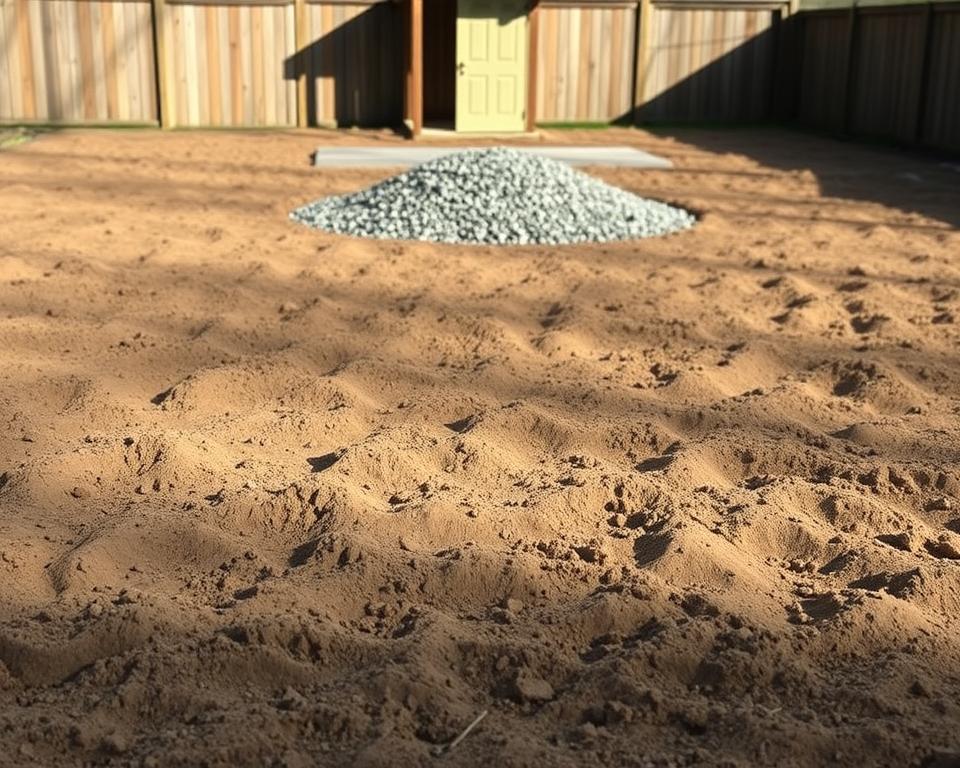
Clearing vegetation and debris on sloping ground
Remove turf, topsoil, rotten timbers and surface debris to reach a competent subgrade or a consistent depth for granular fill. Excavate roots to expose the subgrade; avoid cutting large roots where possible and consult an arboriculturist for protected or significant trees. Exposed tree roots should be treated or retained according to the arboricultural recommendation to protect tree health and prevent future movement.
Lay a geotextile membrane between the prepared subgrade and the compacted sub‑base to prevent mixing of materials and to limit weed growth. This improves long‑term stability where sloping ground clearance is required and helps keep granular fill in place during wet periods.
Establishing safe working zones and access
Define stable working zones and access routes before work begins. Use secure ladders, stable platforms and personal protective equipment such as safety boots, gloves and eye protection. Train all operatives in correct manual handling to avoid injury while moving paving, blocks or timber.
On steeper slopes consider temporary edge protection and harnesses for any work near drop edges. Provide safe wheelbarrow routes and firm platforms for small plant. If a mini‑digger or excavator is needed, hire a trained operator to limit the risk of slope destabilisation and to protect construction site safety UK standards.
Store materials on level areas or on battons to avoid sliding. Use chocks and barriers to prevent slips, trips and falling debris on wet or muddy ground. Regularly inspect the site to maintain tidy walkways and remove trip hazards.
Permits, party wall and neighbour considerations in the UK
Check whether planning permission is required for the proposed shed size, its proximity to boundaries or its intended use. Many small garden sheds fall under permitted development, yet local planning rules can vary. Consult the local planning authority if in doubt.
When works affect or adjoin a neighbour’s structure the Party Wall etc. Act 1996 may apply. Serve appropriate notices and obtain written agreements when necessary. Early dialogue with neighbours over access, drainage and noise reduces disputes and practical problems during construction.
Before excavating check for underground services using utility plans and contact providers or use the national enquiry services for buried cables and pipes. Confirming services protects operatives and preserves construction site safety UK expectations while preventing costly repairs to shared infrastructure.
Siting and Orientation to Minimise Groundwork
Careful siting cuts time and cost when siting shed on slope. Choose a spot where the incline is gentlest or where a natural terrace already exists. Placing the long side across contours lowers step heights and makes bearer runs simpler. Keep clearances from boundaries and drains to preserve stormwater run‑off routes and avoid future disputes.
Positioning the shed to work with existing contours
Start by walking the plot and noting contour lines. A location that follows the slope reduces the need to cut or fill. If you must step the base, stagger levels along the long axis rather than up and down the short side.
When measuring for foundations, mark minimum legal and neighbour clearances. Maintain natural drainage channels so rainwater continues to flow away from garden access slope and neighbouring properties.
Using existing features to reduce excavation
Well-built retaining walls, terraces and raised beds can act as part of the base if they are structurally sound. Tie into these features with stainless fixings and ensure a damp‑proof separation to avoid trapped moisture against timber or shed cladding.
Old walls may hide defects. If in doubt, commission a structural inspection before relying on masonry to support a shed. Using existing hard landscaping can considerably use contours reduce excavation volumes and labour.
Considerations for sunlight, wind and access on sloped plots
Orient doors and windows to maximise usable light, typically favouring a south‑facing aspect for sheds in the UK. Position entrances away from prevailing winds to reduce draughts and make the internal space more usable.
Plan garden access slope for moving garden tools and heavy items. Steps or gradual ramps help; place heavier equipment on the downhill side where ground is closer to level for safer handling and better stability.
Where possible, test different orientations on a small scale with string lines and stakes. This simple check shows how sun, wind and access interact with the slope before committing to excavation or permanent fixings.
Concrete Pad and Strip Foundations on Uneven Ground
Choosing the right base for a shed on sloping ground affects stability, cost and longevity. Small to medium garden buildings often suit a concrete pad shed on slope, while heavier workshops may require a continuous slab or a robust strip foundation for shed walls. The following notes explain when each option fits, how to form stepped supports and best practice for reinforcement, compaction and concrete curing UK conditions.
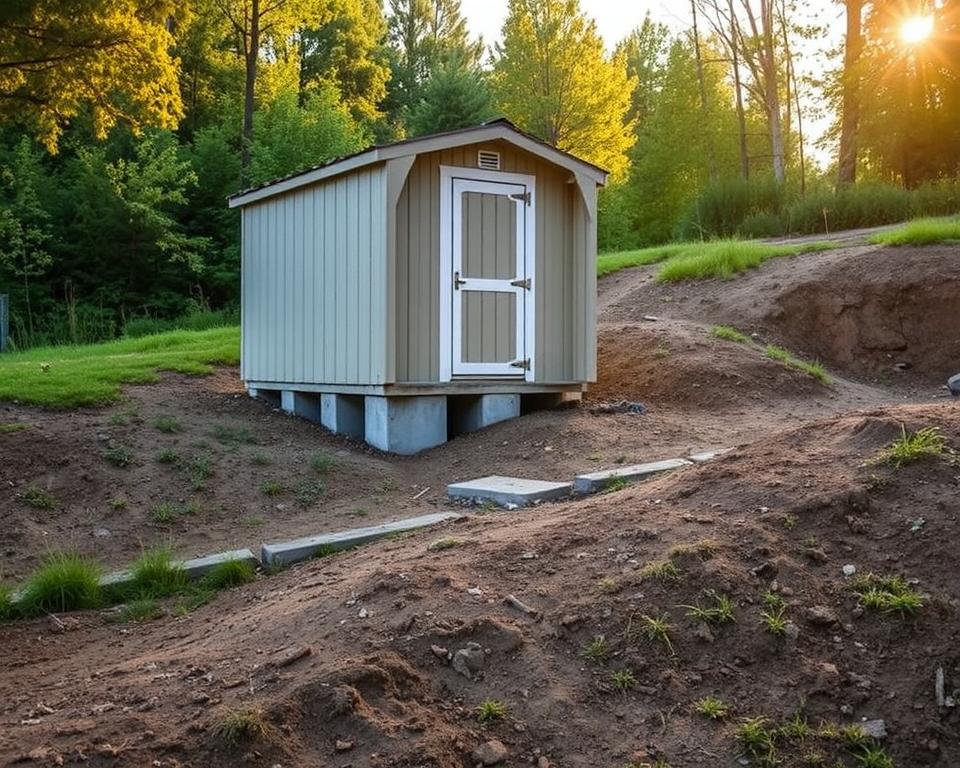
When to use isolated pads versus continuous slabs
Concrete pads are individual footings that support timber bearers or posts. They work well for a concrete pad shed on slope because pads can be set at varying levels to match the incline. Pads reduce excavation and are cost effective for most garden sheds. Continuous slabs suit permanent, heavy structures and those needing a finished floor. A slab demands more excavation, formwork and reinforcement but gives a rigid base with thermal mass and a cleaner finish.
Comparing cost and performance
- Concrete pads: lower material cost, quicker install, simple repairs.
- Continuous slabs: higher cost, long life, better for machinery or heavy storage.
- Strip foundation for shed walls: a middle option where a run of concrete supports masonry walls or close-spaced posts.
Stepped foundations and forming level pads on slopes
On a slope, a stepped foundation follows the contour with levelled pad stages. Each step is independently level and sized to suit loads. Typical small-shed pads measure about 450–600 mm square and 150–225 mm thick, but check manufacturer guidance or structural advice for higher loads or poor soils.
Form shuttering for each pad or strip, provide chamfers on exposed edges to aid water run‑off and reduce edge spalling. For strip foundation for shed walls, form continuous shuttering in stepped sections so the top of each step remains level where walls or bearers will sit.
Reinforcement, compaction and sub‑base
A well compacted sub‑base is essential. Use Type 1 MOT or crushed aggregate with a minimum 150 mm compacted granular fill beneath pads. Place geotextile where soft soils need separation. For slabs use mesh or rebar with adequate bar chairs to ensure correct cover and reduce corrosion risk.
Concrete specification and curing
Choose a mix suited to UK conditions; C25/30 is common for many bases. Protect fresh concrete from frost and rapid drying. Use wet hessian, polythene sheeting or a curing compound to retain moisture. Typical minimum waiting periods are seven days before light loading and 28 days for full design strength. Proper concrete curing UK practices reduce cracking and increase durability.
Practical checklist
- Assess loads and soil before choosing pads, stepped foundation or slab.
- Compact sub‑base to specification and use geotextile on soft ground.
- Follow pad dimensions and reinforcement guidance for the shed size.
- Form chamfers, provide drainage and protect edges from water exposure.
- Observe concrete curing UK best practice and delay loading to achieve strength.
Timber and Raised Bearer Bases for Sloping Sites
On sloping ground a timber bearer shed base gives a practical, lightweight solution that reduces heavy excavation. A well‑planned system combines timber joists, adjustable supports and retaining elements to form a stable, level platform. This approach suits small to medium garden buildings and can be adapted if the slope or soil conditions change over time.
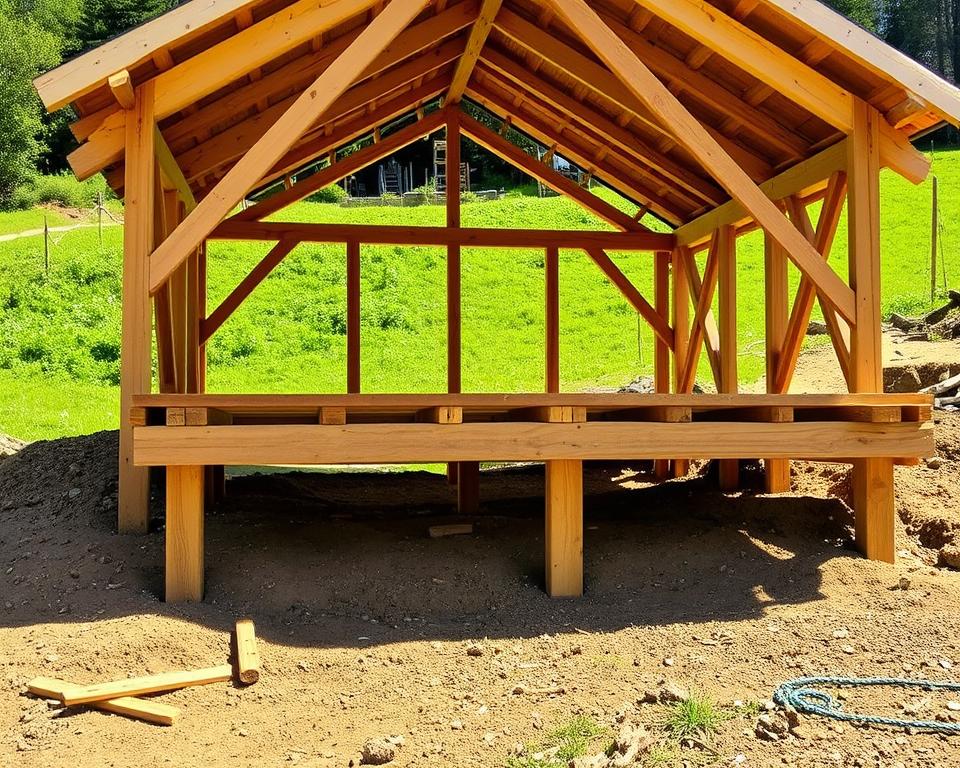
Designing adjustable timber bearers and sleeper walls
Timber joists can rest on galvanised pedestal supports, adjustable steel jack posts or concrete pads to create a level deck across a slope. Use pedestals where fine levelling is needed. Jack posts allow easy adjustment during installation and for later settlement.
Sleeper walls serve as infill or perimeter retaining elements. A raised sleeper wall built in brick or timber gives a tidy edge and raises the base above ground. Provide ventilation gaps and inspection access to the cavity so damp can be monitored and remedied if needed.
Corrosion and rot protection for timber in UK climates
Choose BS EN 351‑1 compliant pressure‑treated timber, such as tanalised timbers rated to class 3 or 4 where contact with ground or damp is expected. This treated timber protection extends service life and reduces decay risk.
Insert a damp‑proof course between masonry sleepers and timber bearers. Use stainless steel or hot‑dip galvanised fixings to resist accelerated corrosion where timber meets metal. Keep ventilation clear beneath the floor and fit breathable membranes to avoid trapped moisture beneath joists.
Anchoring and lateral stability for raised bases
Raised bases on slopes need lateral restraint against wind uplift and sliding. Ground anchors, chemical fixings into concrete pads and metal straps all help resist movement. Choose sheath anchoring where straps pass around or through structural elements for secure load transfer.
Connectors should be robust: galvanised anchor straps, coach screws or through‑bolts with suitable washers work well for timber‑to‑masonry joins. For sites with higher wind exposure consult Eurocode national annexes or a structural engineer to confirm uplift and shear capacities.
| Element | Purpose | Recommended fixings/materials |
|---|---|---|
| Adjustable pedestals | Fine levelling and settlement compensation | Galvanised steel pedestals, plastic headplates |
| Steel jack posts | Adjustable vertical support under bearers | Hot‑dip galvanised posts, base plates fixed to concrete pads |
| Raised sleeper wall | Perimeter retaining, ventilation provision | Brick or pressure‑treated timber, DPC between masonry and timbers |
| Treated timber protection | Prevent rot where timber meets damp/soil | BS EN 351‑1 tanalised timber, class 3/4 treatment |
| Sheath anchoring | Lateral restraint and uplift resistance | Galvanised anchor straps, chemical anchors, stainless fixings |
| Ventilation and membranes | Reduce trapped moisture under floor | Breathable membrane, ventilated air gaps, insect mesh |
Using Screw Piles and Concrete Piers on Uneven Terrain
On slopes and uneven plots, foundations that reduce excavation and allow for immediate loading often make the most sense. Screw piles for shed projects and concrete piers on slope offer two practical routes. Both can be tailored to site constraints, soil conditions and access, giving builders options when standard pad or slab solutions would be disruptive or expensive.
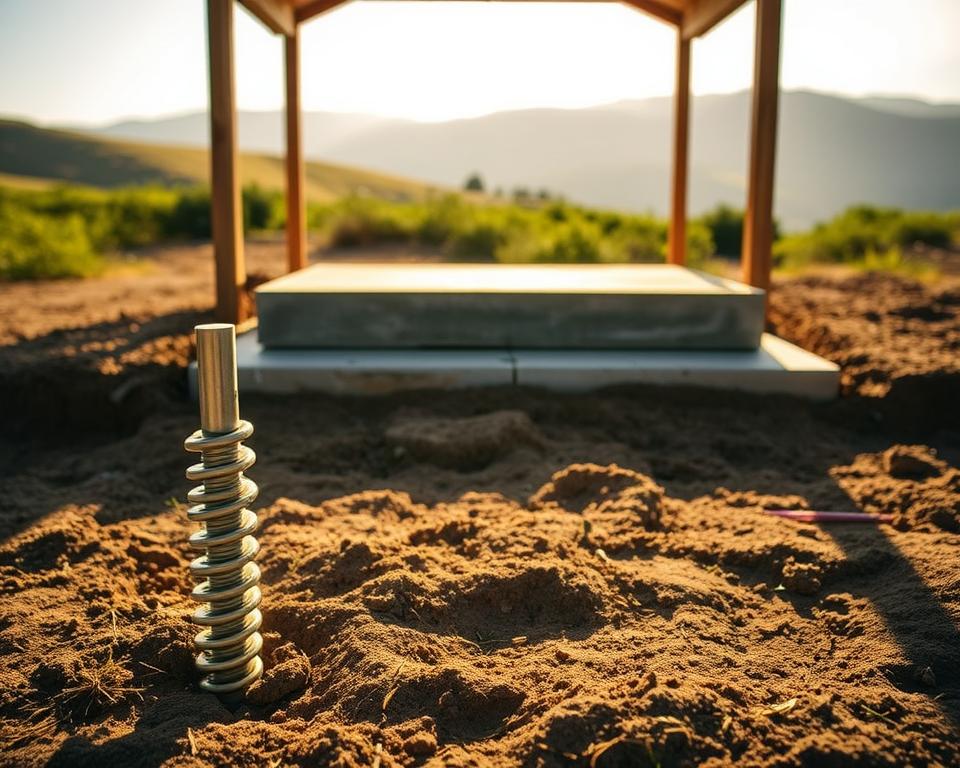
Helical screw piles provide deep, transfer-type support with very little spoil to remove. They install quickly, bear load straight away and suit restricted access on terraced gardens or narrow plots. Galvanised screw piles are widely available from UK suppliers and plant-hire firms, making them a convenient choice for domestic and light commercial sheds.
Advantages of helical screw piles for minimal excavation
Where surface soils are weak but a competent layer sits a modest depth below, helical piles shed base systems reduce the need for heavy concrete on steep sites. Manual drive rods work for small domestic piles while small hydraulic rigs handle deeper or higher-capacity installations. The minimal excavation cuts programme time and mess.
Determining pile depth and load distribution
Pile depth calculation begins with imposed loads: dead load of the shed, live loads such as storage or occupants and wind uplift. Apply recommended safety factors and check capacity against supplier tables or a geotechnical report. Typical practice places a pile at each corner with intermediate piles under long bearers, spaced per the shed manufacturer’s guidance.
Torque testing during installation gives an immediate indicator of pile capacity. For uncertain soils or larger structures, commission a geotechnical survey or structural engineer calculation to confirm pile sizing and positions.
Installation process and equipment considerations
Small screw piles for shed use can be wound in by hand with extension rods and batter boards for alignment. For deeper or higher-capacity piles, hire a small hydraulic rig that fits garden access. Check for utilities before drilling, note the depth to the water table and ensure vertical alignment and consistent top levels for bearer attachment.
Use cut-to-size pile extensions and galvanised brackets to match bearer heights. Reputable installers supply pile testing records and manufacturers’ data on capacity and galvanising life. Where concrete piers on slope remain the preferred option, cast-in-place piers still require careful forming, compaction and localised spoil management on steep ground.
Gravel, Block and Plastic Grid Bases for Uneven Ground
On sloping sites a well planned base keeps a shed level and durable. Choose a method that suits the ground, access and the shed manufacturer’s tolerance. Below are practical approaches for stepped gravel platforms, edge restraints and modern grid systems that help reduce excavation while keeping structural integrity.
Creating compacted stepped platforms
Form stepped gravel pads by cutting shallow benches into the slope and filling with Type 1 MOT or crushed stone. Build each tread in 100–150 mm lifts and compact with a plate compactor. Place geotextile between subgrade and aggregate to prevent contamination and aid drainage.
Use timber battens, kerb units or compacted blockwork to retain each step. Check that each platform has a slight fall away from the shed to shed surface water. For long runs, stagger the steps to match site contours and reduce excavation.
Edge restraint options
Prevent lateral migration of aggregate with concrete haunching, paving edge restraints, pressure‑treated timber edging or concrete block upstands. Fix timber edging on a compacted foundation and secure with galvanised spikes or concrete anchors.
When using paving restraints or kerbs, bed them on a mortar or foam joint and backfill behind with compacted Type 1 to lock the gravel in place. Concrete haunch provides the most durable restraint where vehicle access or heavy loads are expected.
Interlocking grid systems to level and stabilise
Plastic grid base products and cellular paving systems act as an interlocking grid ground stabiliser. Brands such as Tensar and other reputable geosynthetic manufacturers offer grids that distribute loads and keep infill locked under traffic and point loads.
Install by levelling and compacting a sub‑base, lay the grid and join panels with the manufacturer’s clips or jointing straps. Infill with angular stone or resin bound aggregate, then compact and sweep to finish flush. The plastic grid base contours to gentle slopes and improves drainage while reducing depth of excavation.
Tolerances and final levelling for shed fitters
Most shed manufacturers require a base level within 10–15 mm across the footprint and flat across diagonals. Always check the specific documentation from the shed supplier before finalising the base.
If the shed has delicate floor joists, place a thin sheet of plywood or OSB over the granular infill to spread loads. Use a straightedge and spirit or laser level to verify the surface. Small discrepancies can be corrected with levelling packers at fixing points during installation.
Quick installation tips
- Compact subgrade and each aggregate lift to avoid future settlement.
- Use angular stone for infill; it locks better than rounded shingle.
- Fit perimeter restraints before final compaction to keep edges neat.
- Where minimal excavation is desired, pair a plastic grid base with a shallow stepped base edging to reduce digging.
Levelling Techniques and Precision Tools
Accurate levelling makes the difference between a long‑lasting shed base and one that needs early repair. Choose the right levelling tools shed base projects demand. Match handheld spirit levels, laser kit and simple stringline setups to the site’s scale and the chosen foundation type.
Long spirit levels of 2–3 m suit quick checks and small adjustments. They are affordable, simple and give instant feedback. Their limitation is reach; across a wide footprint they become impractical. Use a spirit level for bearer alignment and final tweaks.
Optical or rotary laser levels deliver far higher precision. A laser level for foundations will hold millimetre accuracy over tens of metres when set on a stable tripod. Battery life, bright sunlight and wind can affect performance. For outdoor work fit a detector or receiver unit to locate the beam where visibility is poor.
Digital inclinometers measure slope angle directly. They excel at setting a deliberate fall for drainage or for verifying step foundations. Use them alongside either spirit levels or laser kit to confirm angles rather than relying on a single instrument.
Setting out with stringline works well to transfer corner positions and line levels across the footprint. Erect batter boards outside the working area and run taut stringlines between them. Mark intersection points and ensure the strings are level before staking positions.
Establish a permanent datum peg or marker beyond the excavation. Reference every measurement back to this datum to avoid cumulative errors. Transfer levels from the datum using a staff and laser, or choose a water level for a low‑tech but accurate alternative.
- Use batter boards to hold corner offsets and repeatable line levels.
- Check string tension and re‑tie if it stretches during work.
- Record offsets from datum to each corner for quick re‑checks.
Re‑check levels at critical stages: after sub‑base compaction, after pad formation, before fixing bearers and again after the first seasonal cycle. Good settlement monitoring flags movement early and reduces repair costs.
For adjustable raised bases make small, incremental adjustments and keep a log of changes. For fixed bases use firm, non‑compressible shims to correct minor discrepancies under bearers. Fit a few discreet inspection holes or removable boards to view the underside; this aids ongoing settlement monitoring and moisture checks.
Practical accuracy expectations matter. Modern rotary lasers can reach millimetre accuracy over tens of metres when tripod stability and calibration are maintained. Inspect batteries, protect the unit from strong sunlight where possible and use detector units on large sites.
Maintenance, Inspection and Long-Term Performance
Proper care keeps a shed base functioning for years. Start with a clear inspection plan and routine tasks to spot wear early and avoid costly repairs. Record findings with photos and dates to support warranties and future decisions.
Routine checks after settlement and seasonal inspections
Carry out initial checks at one month, three months and twelve months after installation. Thereafter inspect annually and after severe winter weather. Measure diagonals and levels, note visible cracks in concrete, look for movement of timber bearers and check for loosened fixings.
Look for pooling water, signs of rot or corrosion and any soil washaway around edges. Photograph any change and keep a simple log to track progression.
Preventative maintenance for drainage, fixings and seals
Clear gutters, drains and discharge points to prevent water flowing toward the base. Maintain surrounding ground falls so surface water runs away from the shed. For gravel or plastic grid bases, top up infill where washout has occurred and re-compact as needed to prevent settlement.
Inspect floor perimeter seals and replace deteriorated DPM or membrane where exposed. Re-tighten or replace corroded fixings with stainless steel or hot-dip galvanised alternatives to lengthen service life and prevent future moisture entry.
Repair strategies for minor movement and subsidence
Small levelling issues can be resolved by raising deck areas on adjustable pedestals or adding non-compressible packers beneath bearers. For timber rot, remove affected sections, fit correctly treated replacements and improve ventilation while removing moisture sources.
For hairline cracks in concrete use structural epoxy or stitched repairs. Larger settlement, worsening tilt or deep cracking needs a structural assessment. A chartered structural engineer can advise on underpinning, additional pads or pile options to repair subsidence shed problems safely and effectively.
Conclusion
This shed base summary pulls together the practical steps for building shed on slope UK projects. Start by assessing site slope and soil type, then choose right foundation to match load, ground conditions and access. Accurate levels, clear drainage runs and compacted granular layers beneath concrete or block work reduce future movement and help the structure perform.
For most UK gardens, treated timber bearers with galvanised fixings offer a durable option; for difficult sites consider screw piles or concrete piers to minimise excavation. Use step foundations or raised bearers to adapt to contours, and protect timber and metal from moisture and corrosion to extend life. Compact sub‑bases, adequate edging and clear surface drainage are practical details that pay dividends.
Follow manufacturer guidance for shed bases and seek geotechnical or structural advice on large or complex installations. Regular inspections, prompt drainage maintenance and tightening of fixings limit settlement issues. Getting the initial works right will reduce long‑term maintenance and improve shed longevity, making the whole project more economical and reliable.
FAQ
What is the single most important factor when building a shed base on uneven ground?
The most important factor is a correctly formed, level and well‑drained base that suits the shed’s weight and the ground conditions. A stable base prevents structural distortion, water ingress and voiding manufacturer warranties from brands such as Rowlinson, Forest and BillyOh. Assess soil type, slope and drainage first, then choose an appropriate foundation—concrete pads, timber bearers, screw piles or a compacted gravel/plastic grid system—so the load is transferred to competent ground and frost or seasonal movement is mitigated.
How level does a base need to be for most garden sheds?
Most manufacturers expect the base to be level within about 10–15 mm across the floor area. If the site has larger microvariations or a steep slope, consider stepped pads, adjustable timber bearers or screw piles to achieve that tolerance. Always check the specific shed manual, and verify levels with a spirit level, laser level or digital inclinometer before finalising the base.
Which foundation type is best for a steep or inaccessible site?
Helical screw piles are often the best choice for steep or restricted‑access sites. They require minimal excavation, produce little spoil, allow immediate loading once installed and can reach competent strata below weak surface soils. For very heavy or permanent structures, a geotechnical appraisal may indicate deeper piles or concrete piers. Use certified installers who provide capacity data and torque or test records.
Can I use a gravel base or plastic grid system instead of concrete?
Yes. A compacted granular base or an interlocking plastic grid system (installed over a compacted sub‑base and geotextile) offers good drainage, load distribution and simpler installation on moderate slopes. They are cost‑effective for lightweight sheds and easy to adjust. Ensure adequate edge restraint, compaction in 100–150 mm lifts and that the finished surface meets manufacturer tolerances for flatness and level.
How do I measure slope and microvariations accurately?
Use a simple 2‑point method with a straight timber and spirit level for quick checks. For greater accuracy, use a rotary or optical laser level on a tripod and a measuring staff, or a digital inclinometer to read slope angles. Transfer a permanent datum with batter boards and pegs, record corner and intermediate levels, and use those figures to calculate step heights, pile depths or pad positions.
What are common ground types in the UK and how do they affect foundation choice?
Typical UK soils include clay (low permeability, prone to seasonal movement), loam, sandy/gravelly soils (good drainage) and peat/organic soils (poor bearing). Compacted granular soils often have bearing capacities of 100–300 kN/m²; firm clay around 100–200 kN/m²; peat can be under 50 kN/m². Weak or organic soils usually require deeper foundations such as screw piles or wider pads and specialist advice from a geotechnical engineer.
How can I reduce frost heave and seasonal movement under the base?
Reduce frost heave risk by placing bearing levels below local frost depth where possible, using non‑frost susceptible granular fill, and ensuring excellent drainage away from the base. For timber bases, use pressure‑treated, Class 3 or 4 timber, provide ventilation beneath the floor, and separate timber from damp masonry with DPC. Flexible fixings and adjustable supports also help accommodate small seasonal movements.
What safety and permit checks should I do before starting work?
Check for underground utilities via local service plans or utility companies before excavation. Confirm whether planning permission or permitted development rights apply based on size and proximity to boundaries. If works affect a shared structure or are close to a neighbour, consider the Party Wall etc. Act 1996 requirements and serve notices where necessary. Establish safe working zones, wear PPE and consider hiring trained operators for plant like mini‑diggers on steep sites.
How should I prepare the site on sloping ground before laying the base?
Remove turf, topsoil, roots and loose debris to expose competent subgrade. Treat significant roots with arboricultural advice and use geotextile to separate subgrade from granular fill. Create stepped platforms or a single level platform depending on slope severity, set out datum and batter boards, and compact Type 1 MOT or crushed aggregate in layers to the required depth and level.
When should I choose concrete pads or strip foundations over timber bearers?
Use concrete pads or stepped strip foundations for heavier, permanent buildings or where a rigid, frost‑resistant support is needed. Pads are suitable for small to medium sheds and uneven sites where they can be stepped. Continuous slabs suit workshops and where a finished floor is required. Timber bearers or adjustable pedestal systems are appropriate for lightweight sheds, moderate slopes and where minimal excavation is preferred.
What corrosion and rot protection is recommended for timber bases in the UK?
Use BS EN 351‑1 compliant pressure‑treated timber (tanalised) rated to Class 3 or 4 where ground contact occurs. Install DPC layers between masonry and timber, use stainless or hot‑dip galvanised fixings, and ensure ventilation beneath the floor. Avoid trapping moisture with impermeable membranes; breathable membranes and adequate drainage prolong timber life.
How do I anchor a raised or timber bearer base against wind uplift and lateral movement?
Provide lateral restraint with ground anchors, galvanised anchor straps fixed to concrete pads or piers, and coach screws or through‑bolts with washers into masonry sleeper walls. For adjustable pedestals, fix bearer straps or metal brackets to pile tops or pads. In exposed locations, follow uplift and shear guidance in Eurocode or consult a structural engineer for calculated capacities.
What are recommended reinforcement and curing practices for concrete used in shed bases?
Use a compacted granular sub‑base (min. 150 mm) and geotextile over soft soils. For slabs use steel mesh or rebar with correct cover (bar chairs) and consider C25/30 concrete for many bases. Protect fresh concrete from frost and rapid drying with wet hessian or curing compounds and observe minimum cure times—light loading after 7 days and full design strength typically at 28 days.
How many inspection checks should I carry out after installation and when?
Carry out initial checks at one month, three months and one year after installation, then annually thereafter. Inspect level and diagonal measurements, check for cracks in concrete, movement of timber bearers, corrosion of fixings and any pooling of water. Photograph and log findings to support warranty claims or future repairs.
What are quick remedies for minor settlement or levelling issues?
For small settlement, adjust timber bearers using adjustable pedestals or add non‑compressible packers beneath joists. On gravel or grid bases, compact and top up infill where washout has occurred. For hairline concrete cracks use structural epoxy; for more significant subsidence consult a structural engineer to assess underpinning or additional pads or piles.
Do I need a geotechnical report for a domestic shed base?
Most small, lightweight garden sheds on typical backfill or compacted granular layers do not require a formal geotechnical report. However, seek geotechnical advice for very poor soils (peat, soft clays), large or heavy structures, sites with high groundwater, or where piles or deep foundations are proposed. A report reduces risk and informs pile capacity, pad sizing and frost depths.
Can I tie a new shed base into existing retaining walls or terraces?
You can use existing walls or terraces if they are structurally sound and designed to carry imposed loads. Tie‑in details must ensure proper damp proofing, drainage separation and adequate fixings. Old or suspect walls should be checked by a structural engineer before loading; impermeable tie‑ins can trap moisture, so provide drainage and a DPC where appropriate.
Which tools provide best precision when setting out levels over a sloping site?
For precision use a rotary laser level with a receiver for long runs and millimetre accuracy. Optical builders’ levels on a tripod are reliable for moderate work. Long spirit levels (2–3 m) are suitable for quick checks, and digital inclinometers give accurate slope angles. Always stabilise tripods, check calibrations and use a permanent datum with batter boards for repeatable measurements.
What are practical tips to reduce excavation and groundworks on a sloping plot?
Position the shed on the gentlest part of the slope or across contours so the long side runs across the rise. Use existing terraces, retaining walls or raised beds where structurally feasible to avoid cut and fill. Consider raised timber bearers on adjustable pedestals or screw piles to reduce excavation and spoil removal.