UK Greenhouse Size Without Planning Permission
Many homeowners and gardeners ask the same practical question: how big can a greenhouse be without planning permission in the UK? This article begins by explaining the basic rules that govern permitted development greenhouse size and how those rules fit into wider UK greenhouse regulations.
Under the Town and Country Planning (General Permitted Development) (England) Order 2015 (as amended) — and equivalent provisions for Wales, Scotland and Northern Ireland — certain outbuildings including greenhouses can be erected without a formal application. These permitted development rights are subject to conditions on height, footprint, position and use. They also change where properties lie in conservation areas, are listed, or form part of flats and maisonettes.
This long-form guide will set out those limits and practical steps. You will find clear detail on height and footprint allowances, positioning rules near boundaries, materials and neighbour impact, and when planning permission greenhouse UK rules make an application mandatory. It also covers how to apply, enforcement and tips for choosing a greenhouse that stays within permitted development greenhouse size limits.
Please note that guidance can change and that local planning authorities have some scope for interpretation. Check your local council planning pages or gov.uk for the latest official text before you buy or build.
Inhaltsverzeichnis
Key Takeaways
- Permitted development allows many domestic greenhouses without a planning application.
- Limits depend on height, footprint and position, and differ in conservation areas and for listed buildings.
- Check UK greenhouse regulations for devolved administrations (Wales, Scotland, Northern Ireland).
- Local councils may interpret rules differently; always confirm with the council or gov.uk.
- If rules are exceeded, you may need planning permission or listed building consent.
how big can a greenhouse be without planning permission?
Understanding permitted development rights helps homeowners decide whether a new greenhouse needs planning permission. The Town and Country Planning (General Permitted Development) Order 2015 sets the primary rules for England. Wales, Scotland and Northern Ireland use similar frameworks with different wording and limits. A permitted development greenhouse must be incidental to the dwellinghouse and not used for commercial growing.
Permitted development rights overview
Permitted development allows certain outbuildings without a full planning application, subject to conditions and limits. Key conditions include the structure being within the curtilage, not exceeding specified height and area thresholds, and not causing harm to neighbours. The rules vary by location and by whether a property has retained permitted development rights.
Specific size limits for freestanding greenhouses
For freestanding greenhouses, common height rules are 4 metres for a dual-pitched roof and 3 metres for other roof types when more than 2 metres from the boundary. If the greenhouse sits within 2 metres of the boundary the maximum height drops to 2.5 metres. Ground coverage is capped so that all outbuildings combined do not cover more than 50% of the garden or curtilage.
Local planning authorities may apply stricter controls and conservation or listed-property status can remove permitted development rights entirely. Always check local guidance before ordering a structure to ensure freestanding greenhouse dimensions comply with local interpretations of greenhouse size limits.
Differences for detached houses versus flats
Detached houses usually retain the standard permitted development allowances for outbuildings. Homeowners with a detached property have clear guidance on freestanding greenhouse dimensions and permitted development greenhouse rules, provided there are no restrictive conditions or covenants.
Flat owners, maisonette residents and many converted properties face tighter limits. In many cases outbuildings are not permitted, or permission is needed. Properties in multiple-occupation or those that have lost permitted development rights must seek planning permission for a greenhouse. Always confirm whether your dwelling is treated as a house or a flat for planning purposes.
| Aspect | Typical limit for houses | Typical limit for flats/converted properties |
|---|---|---|
| Maximum height (dual-pitched) | 4.0 m | Usually not permitted or needs application |
| Maximum height (other roofs >2 m from boundary) | 3.0 m | Often restricted; planning required |
| Maximum height (≤2 m from boundary) | 2.5 m | Planning likely required |
| Footprint limit (combined outbuildings) | Must not exceed 50% of curtilage | Usually not applicable without permission |
| Use | Incidental domestic use only | Strictly controlled; commercial use needs permission |
Permitted development rules for outbuildings and greenhouses
Understanding permitted development conditions helps homeowners plan garden structures with confidence. This short guide explains what is an outbuilding for planning purposes, the key limits you must follow and how conservation area restrictions can affect a simple greenhouse project.
What counts as an outbuilding under planning law
An outbuilding is a detached structure within the curtilage of a dwelling used for purposes incidental to the dwellinghouse. Typical domestic examples include glass greenhouses, polycarbonate polytunnels and wooden potting sheds.
Incidental use means the building must be ancillary to the home. It must not form a separate self-contained dwelling. It must not be used for commercial horticultural production. Large commercial glasshouses usually need full planning permission because they exceed what domestic permitted development allows.
Conditions and restrictions that apply
Permitted development rules include several limits you must observe. Height caps, total area limits and positional rules form the core constraints. The combined footprint of outbuildings must not exceed 50% of the curtilage.
Structures must not be placed forward of the principal elevation. Verandas, balconies and raised platforms are not permitted under these rights. Some windows, flues and fixed services can trigger building regulations or remove permitted development protection.
Local councils may issue Article 4 directions to withdraw permitted development rights in specific areas. That means a homeowner who thought they met the standard limits may still need planning permission if an Article 4 direction applies.
How permitted development interacts with conservation areas
Conservation area restrictions tighten the rules. Local planning authorities expect new outbuildings to preserve or enhance an area’s character. As a result, permitted development rights are often reduced or removed inside conservation areas.
Before installing a greenhouse, check local guidance and speak to the LPA. You may need permission where conservation area restrictions apply, even for modest domestic greenhouses. A quick pre-application enquiry can save time and avoid enforcement action.
Maximum height and footprint limits for greenhouses

Before checking detailed measurements, read the permitted development framework that applies to your property. The rules below set out typical allowances and the practical steps you should take when planning a greenhouse.
Standard height allowances and exceptions
For most dwellings the standard greenhouse height limit UK follows familiar thresholds. A dual-pitched roof may reach up to 4.0 metres. Other roof types are usually limited to 3.0 metres where the structure sits more than 2.0 metres from the boundary. If the greenhouse sits within 2.0 metres of the boundary the maximum height is normally 2.5 metres.
Some designs change classification. An integrated lean-to greenhouse might be treated differently from a free‑standing building, while terraces or changes to natural ground level can alter how local planners view height. Any structure taller than these allowances will generally need planning permission.
Footprint calculations and combined outbuildings
Footprint means the ground area covered by the greenhouse and any other outbuilding. Local authorities apply outbuilding footprint rules by aggregating all garden buildings to check the 50% curtilage limit for permitted development.
To calculate curtilage, measure the land attached to the dwellinghouse and exclude the house footprint itself. Add together the areas of garden sheds, greenhouses and other structures. If boundary lines are unclear, consult the local planning authority to avoid miscalculation.
Multiple small greenhouses plus sheds count towards the limit. Knowing the combined greenhouse size before ordering a structure helps you stay within the permitted allowance and prevents costly enforcement issues.
Impact of eaves and ridge measurements
Height is measured from the natural ground level to the highest point, usually the ridge. Authorities may also look at eaves and ridge measurement to assess visual bulk and overlooking risk.
Eaves height can affect neighbours’ views and light. Some local planning teams place special emphasis on eaves where it alters perceived massing. Providing scaled drawings that show both ridge and eaves levels speeds up any check with the council.
If you need certainty, include sectional elevations and spot levels in your submission. Clear illustrations of eaves and ridge measurement reduce the chance of disagreement with the local planning officer.
Positioning rules: distance from boundaries and property lines
Proper siting of a greenhouse affects compliance and neighbour relations. This short guide explains key setback rules, measurement methods and common neighbour concerns so you can place a greenhouse with confidence.
Setback requirements and measurement methods
The principal rule is straightforward: if an outbuilding sits within 2.0 metres of the property boundary the maximum permitted height is 2.5 metres. Measurement runs from the external face of the outbuilding to the boundary line.
Accurate distances matter on tight sites. Use Ordnance Survey-based mapping, a professional measured site plan or a garden survey to resolve disputes. Local planning officers may expect precise drawings when dimensions are borderline.
Effect of neighbouring properties and overlooking concerns
Permitted development focuses on size and position but councils will still weigh neighbour amenity. Issues include loss of light, overshadowing and loss of privacy from raised glazing or windows.
Design steps reduce overlooking and greenhouse boundary distance complaints. Fit lower eaves, use opaque glazing on sides facing neighbours and plant evergreen screens to break sightlines. Sit the structure to avoid direct views into neighbouring windows.
Even if the greenhouse meets setback rules greenhouse dimensions, excessive overshadowing or material harm to neighbours can prompt complaints and enforcement action.
Placement in front of the principal elevation
Outbuildings placed forward of the main house frontage are not covered by permitted development. A greenhouse in front of house typically requires planning permission.
The principal elevation means the front-facing wall with the main entrance. If this is unclear, consult the local planning authority for guidance. Front-garden greenhouses are usually resisted on visual amenity grounds.
| Issue | Practical rule | Recommended action |
|---|---|---|
| Distance to boundary | Measure from external face to boundary line | Use Ordnance Survey or measured site plan |
| Height within 2.0m of boundary | Maximum 2.5 metres | Reduce ridge or lower eaves to comply |
| Overlooking and greenhouse privacy | Raised glazing can cause loss of privacy | Use opaque panels, planting screens, reposition |
| Greenhouse in front of house | Not permitted development | Apply for planning permission and seek LPA advice |
| Disputed measurements | Local authority may require accurate plans | Commission a garden survey or measured drawing |
Materials, appearance and impact on neighbours
Choosing the right greenhouse materials UK owners often starts with practical needs. Aluminium and timber frames remain popular. Toughened glass, twin‑wall polycarbonate and greenhouse plastics suit different budgets and uses. Polytunnels made from polyethylene suit seasonal growing.
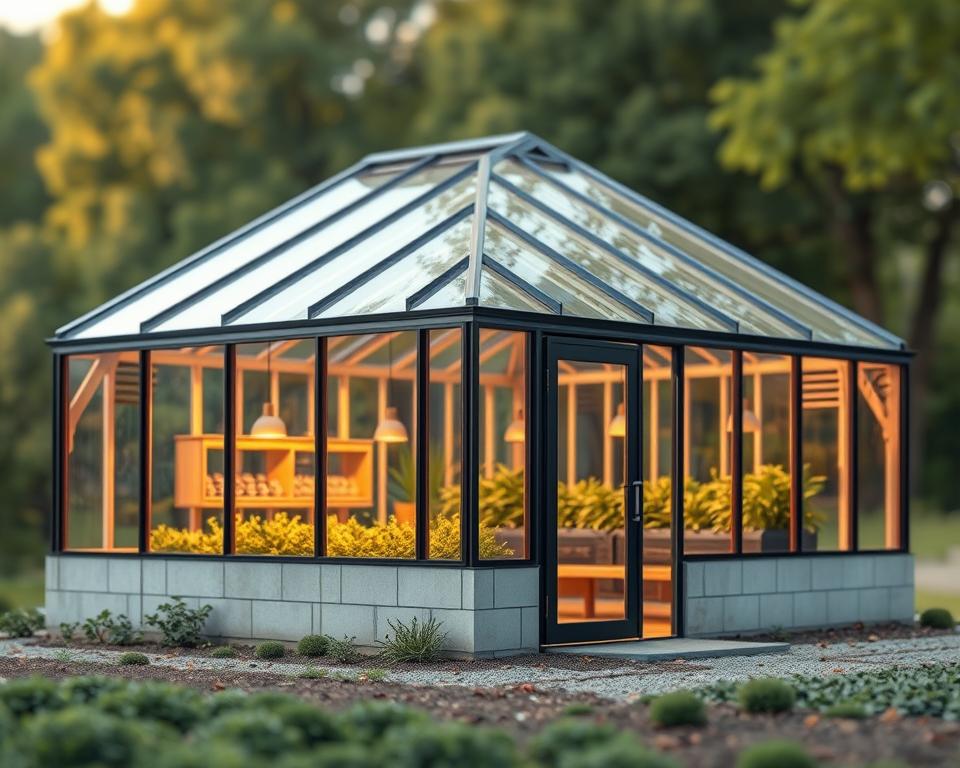
Material choice affects the visual impact greenhouse designs make in a garden. Frameless glass and high aluminium structures can be reflective and stand out. Timber frames or muted finishes tend to blend with planting and hedge screens. Using natural tones reduces the sense of permanence and may lessen scrutiny from planning officers.
Typical greenhouse materials and visual considerations
Aluminium gives a sleek, modern look and long service life. Timber offers a softer, more traditional appearance that suits conservation areas. Polycarbonate provides good insulation and lower risk of shards if broken. Plastic sheeting is cheap and light but looks temporary. Each option carries trade‑offs between appearance, durability and planning perception.
Noise, odour and light spill issues
Greenhouses themselves are quiet. Noise concerns usually come from heaters, extraction fans and irrigation pumps. Composting or processing plant material can create smells, but this is rare for ordinary domestic use.
Artificial lighting for winter growing can cause nuisance. Local planning authorities consider light spill greenhouse projects may create, particularly near rural dark‑sky areas. Unshielded grow lights create glare through glazing. Timed use increases the chance of neighbour complaints.
Mitigation measures to reduce neighbour objections
Siting is the simplest fix. Place the structure away from nearest neighbour windows and doors. Use frosted or high‑level glazing on side panels to maintain light while limiting views.
Screening helps. Planting evergreen hedges, installing a green wall or using timber cladding can soften edges and mask reflective surfaces. Choose subdued paint colours such as dark green, soft grey or brown to help the building sit within the garden.
Equipment choices make a measurable difference. Select low‑noise fans and pumps, mount machinery on vibration‑reducing pads and run timers to avoid night‑time operation. Fit fully shielded light fittings and direct lamps downward to reduce light spill greenhouse lighting causes.
Talk to neighbours before installing. A simple pre‑application consultation with clear drawings and an explanation of intended uses can reassure neighbours and reduce the likelihood of formal objections.
Greenhouses in conservation areas and listed properties

Working on a greenhouse at a historic property needs careful thought. Listed status and conservation area designation add layers of control. Planning permission alone will not cover changes that affect heritage value or the setting of a listed building.
Additional consents required for listed buildings
Listed building consent is required for any work that affects the character or special interest of a listed building or its curtilage. A replacement greenhouse, a new structure within sight of the main house, or hard landscaping can all trigger the need for greenhouse listed building consent.
Obtaining listed building consent is separate from planning permission. Local planning authorities can refuse listed building consent even when planning permission has been granted. Engage the conservation officer early and use conservation-sensitive designs and traditional materials where possible.
Restrictions specific to conservation areas
Conservation areas exist to preserve or enhance local character. Local planning authorities may remove or limit permitted development rights within these zones. Proposals are assessed on scale, materials, siting and visibility from public vantage points.
Conservation area greenhouse rules therefore focus on how a structure affects the wider streetscape and heritage context. Seek pre-application advice and consult any local conservation or design guidance before finalising plans.
How to apply for listed building consent
Start by contacting the LPA’s conservation officer for pre-application advice. Prepare clear drawings, a materials specification and a heritage impact statement that explains how the proposal will preserve the building’s character.
Submit an application for listed building consent through the local authority’s planning portal or website. Include photographs, site and location plans and a justification for the works. Be aware that fees, consultation periods and timescales vary. Some applications need input from statutory consultees, which can extend decision times.
When you must apply for planning permission
If you plan to add a greenhouse to your garden, it helps to know when a full planning application is needed. Small domestic structures usually fall under permitted development. Certain situations remove those rights and trigger the need to apply. Read on to see the common triggers and practical examples.
Situations that invalidate permitted development rights
Permitted development rights do not apply in a number of clear cases. If your property is a flat, you will often lack the rights that apply to houses. An Article 4 direction can remove permitted development in a local area. Conservation areas and World Heritage Sites frequently have restrictions that prevent use of permitted development for outbuildings. Restrictive covenants on the title or earlier planning conditions can also bar garden structures.
Any part of a greenhouse that would encroach on a public highway, protected open space, or land within a safety zone will require permission. Land within the curtilage that sits inside a listed building setting usually needs extra consent. These constraints are common reasons for an application.
Extensions that exceed size or position limits
Permitted development sets rules for height, footprint and position. If a greenhouse goes beyond those limits you must submit a planning application. Examples include a glazed building with a ridge height above 4m or one that covers more than half the property’s curtilage. Placing a greenhouse forward of the principal elevation is another frequent trigger for refusal under permitted development.
Even modest breaches can prompt an application. A small increase in height or moving the structure closer to a boundary can change the assessment. Local planning officers will compare the proposal against the allowed dimensions and the site context.
Large or commercially used greenhouses
Domestic growing for personal use usually fits within permitted development limits, subject to the rules already noted. When the structure is used for business, the planning use class changes. Commercial glasshouses for production, retail sales or storage are treated as separate uses and typically need full permission and building control compliance.
Greenhouse commercial use planning applies where regular sales, employment of staff, or large-scale growing takes place. Councils expect formal applications for these developments. If you are unsure whether a project will exceed permitted rights or require greenhouse commercial use planning, contact your local planning authority before you start.
| Trigger | When permission is needed | Typical outcome |
|---|---|---|
| Property type | Flat or dwelling with removed rights (Article 4) | Planning application required; higher chance of refusal in restricted areas |
| Protected locations | Conservation area, World Heritage Site, listed setting | Application needed; may require listed building consent |
| Size limits | Ridge height >4m, footprint >50% of curtilage, or exceeds earlier limits | Full planning application and site assessment |
| Positioning | Forward of principal elevation or encroaching on highways | Permission required; likely refusal if prominent |
| Commercial use | Regular sales, production, storage or staff employment | Greenhouse commercial use planning needed; building regs may apply |
| Restrictive legal controls | Restrictive covenants or prior planning conditions | Application or legal consent required; possible prohibition |
How to apply for planning permission and what to include
When you need to apply for planning permission greenhouse projects, a clear and well-structured application speeds up the process. Start with accurate drawings, concise statements and evidence of neighbour engagement. Good presentation reduces queries from the local planning authority and helps avoid delays.
Preparing a clear site plan and drawings
Provide a location plan at 1:1250 that shows adjacent plots and roads. Include a site plan at 1:500 or 1:200 with the greenhouse footprint and distances to boundaries. Add elevations that show ridge and eaves heights, plus section drawings and a simple floor plan. All drawings should carry a scale bar, north arrow and scaled dimensions.
List materials and finishes, for example aluminium frame, polycarbonate glazing or timber cladding. Include context photographs showing views from the street and from neighbouring properties. For complex proposals or sites in conservation areas, use an architect or planning consultant to prepare planning application greenhouse drawings to a professional standard.
Supporting documents: design statements and neighbour reports
Attach a design and access statement that explains intended use, design rationale and how the scheme respects local character. Where a building is listed, include a heritage impact assessment that addresses fabric and setting. If trees or protected species are present, submit an ecological report.
Carry out a neighbour consultation and include a short statement of neighbour engagement. Record feedback and any changes made to reduce impact. Evidence of compliance with building regulations, or confirmation that you will obtain approval where required, strengthens the application.
Typical timelines and fees for applications
Householder planning applications are usually decided within eight weeks. Listed building consents and complex proposals may take longer. Early pre-application advice from the local planning authority can clarify timescales for your site.
Check planning application fees UK with the local planning authority before you submit. Householder fees are lower than non-householder or commercial rates. Submitting complete documentation, including accurate planning application greenhouse drawings, helps avoid validation delays and extra fees.
Practical tips for choosing the right greenhouse size
Choosing the right greenhouse starts with a clear look at your garden. Measure the available area and work out the curtilage so the total footprint of outbuildings stays within the 50% rule where that applies. Think about sun patterns, shade from trees and prevailing winds; these factors shape the best siting and the size you can use.
Delivery and installation access can limit choices as much as planning rules. Check gate widths, steps and tight corners before you commit. A professional delivery from Eden or Harrod’s may need a plain route, while modular kits from companies such as Vitavia can be carried through narrower gaps if planned correctly.
Assessing your garden space and access
Measure gate openings and pathway heights to avoid surprises on installation day. Note where a greenhouse would sit relative to drains and tree roots. If access is poor, smaller units or modular greenhouse UK options often work better.
Balancing functionality with permitted development limits
Decide what you want the greenhouse for. Seed-raising or overwintering needs less floor area than full-time vegetable production. A compact layout with shelving, vertical growing systems and efficient heating can boost productivity without increasing footprint or height.
Design to fit permitted development limits when possible to reduce the risk of enforcement. Prioritise internal organisation and plant selection rather than simply expanding size.
Alternative solutions: lean-to or modular greenhouses
A lean-to greenhouse attached to the house saves space by using an existing wall as support. Confirm rules about altering the principal elevation before you start. Attachment method can affect whether planning permission is needed.
Modular greenhouse UK products offer flexibility. Prefabricated or demountable units can be relocated and reconfigured, making it easier to remain within permitted development thresholds. Polytunnels provide a cheaper option for seasonal use, but they are more visible and may face planning scrutiny if large or sited in prominent locations.
Enforcement, appeals and retrospective permission
The council has a range of powers to tackle unauthorised garden buildings. Officers may open an investigation after a complaint, issue a planning contravention notice to gather facts, serve an enforcement notice to require changes or removal, and use a stop notice in urgent cases. Enforcement is discretionary and councils weigh public interest, harm caused and time since construction when deciding next steps.
How local authorities enforce unauthorised development
Local planning authorities (LPAs) begin with enquiries and site visits. If the structure breaches planning rules they may serve formal notices. Persistent non-compliance can lead to prosecution, injunctions or direct action to remove the building.
Steps to take if you receive an enforcement notice
Read the notice carefully to note required actions and deadlines. Contact the LPA to discuss options and request clarification. Seek specialist planning advice from a chartered town planner or solicitor if you plan to contest the notice.
Options include complying by altering or removing the structure, applying for retrospective planning permission greenhouse to regularise the development, or lodging an appeal planning enforcement UK within the statutory timeframe. Keep neighbours informed and try to negotiate practical solutions to reduce conflict.
Applying for retrospective planning permission
Make a retrospective application using the same documents as a standard submission while stating the development has already been built. Provide a clear justification, propose mitigation measures and include good supporting evidence.
Strong evidence improves prospects. Include dated photographs, a design and access statement, structural or safety reports and details of remedial works to address visual or amenity impacts. LPAs assess retrospective planning permission greenhouse against planning policy and neighbour harm; permission can be refused and an enforcement notice greenhouse enforced if concerns remain.
If you decide to appeal planning enforcement UK, act fast. Appeals follow strict timetables and benefit from concise grounds, professional representation and a clear record of communication with the LPA and neighbours.
Conclusion
This greenhouse planning summary pulls together the key points so you can answer the simple question: do I need planning permission greenhouse? In general, a freestanding greenhouse is permitted if the ridge does not exceed 4m for a dual‑pitched roof and 3m for other roofs when located more than 2m from the boundary. If the structure sits within 2m of a boundary, the maximum height is commonly reduced to 2.5m. All outbuildings combined must not cover more than 50% of the curtilage, and eaves, footprint and position rules still apply.
Certain property types and locations change the picture. Flats, listed buildings and conservation areas often have tighter controls or no permitted development rights at all. Commercial use, larger hobby glasshouses or structures that breach size and position limits will normally need formal planning consent from the local planning authority.
For tricky cases, seek local advice first. Check the General Permitted Development Order and official guidance on gov.uk, and consider pre‑application advice from your council. A short pre‑app can prevent refusal and save time if the rule interpretation is unclear.
Practically, choose a greenhouse that meets your gardening needs while staying within the summary greenhouse rules UK where possible. Use sympathetic materials and careful siting, consult neighbours early to reduce objections, and engage a planning consultant or architect when submitting applications or responding to enforcement. That approach keeps projects efficient and compliant.
FAQ
How big can a greenhouse be without planning permission in the UK?
Under permitted development rules a domestic greenhouse is treated as an outbuilding incidental to the dwelling. Typical limits are a maximum ridge height of 4.0 metres for a dual‑pitched roof, 3.0 metres for other roof types where the structure sits more than 2.0 metres from the boundary, and 2.5 metres where it is within 2.0 metres of the boundary. All outbuildings combined must not cover more than 50% of the property’s curtilage. These are general rules under the Town and Country Planning (General Permitted Development) Order 2015 (as amended) for England; Wales, Scotland and Northern Ireland have broadly similar but separate provisions. Check your local planning authority for variations.
What counts as an outbuilding or domestic greenhouse for permitted development?
An outbuilding is a detached structure within the curtilage of a dwelling used for purposes incidental to the house. Domestic greenhouses, polycarbonate polytunnels for hobby use and potting sheds usually qualify. Structures used for commercial horticulture, separate self‑contained living, or storage for business purposes do not qualify and normally need full planning permission.
Do permitted development rights apply to flats, maisonettes or converted houses?
Often not. Flats, maisonettes and some converted houses have more restricted permitted development rights or none at all. Properties in multiple occupation or those subject to Article 4 directions may have had rights removed. Many owners of flats will therefore need to apply for planning permission before erecting a greenhouse.
How do I calculate the 50% curtilage limit for outbuildings?
The 50% limit is based on the total area of the curtilage excluding the area covered by the dwellinghouse. Add the ground footprints of all outbuildings, including greenhouses, sheds and garages. If the combined footprint exceeds half the curtilage area, planning permission is required. Where boundary lines are unclear, consult your local authority or a measured site plan.
What are the rules about siting greenhouses close to boundaries?
If an outbuilding is within 2.0 metres of the boundary the maximum permitted height is 2.5 metres. Measured distances run from the external face of the building to the boundary line. Greenhouses sited forward of the principal elevation (in front of the main house frontage) are not permitted development and will usually need planning permission.
Are there special rules for conservation areas or listed buildings?
Yes. Conservation areas frequently have tighter controls and some LPAs remove permitted development rights by Article 4. Listed buildings require listed building consent for works affecting their special interest or setting; planning permission alone is not sufficient. Always consult the local planning authority and, for listed properties, seek pre-application advice from the conservation officer.
Will building regulations apply to my greenhouse?
Most simple, unheated domestic greenhouses do not trigger building regulations. However, if the structure contains fixed services, heating, substantial electrical installations or forms a workshop or habitable space, building regulations may apply. Check with Building Control where fixed services or structural alterations are proposed.
What materials are appropriate to reduce the chance of planning scrutiny?
Timber frames, subdued colours and non‑reflective glazing tend to be more sympathetic in domestic and conservation settings. Aluminium and large expanses of reflective glass can appear more permanent and may attract scrutiny. Choosing modest, domestic‑scale materials and finishes helps the greenhouse sit quietly within the garden.
Can neighbour objections force me to remove a permitted greenhouse?
Neighbours can complain, and the local planning authority may investigate. Even if dimensions comply with permitted development, issues such as significant loss of light, overlooking, noise from equipment or light pollution can lead to enforcement action. Good design, screening, frosted glazing and prior neighbour consultation reduce the risk of disputes.
When is planning permission definitely required for a greenhouse?
You need planning permission if the greenhouse exceeds the height or footprint limits, if it would be placed forward of the principal elevation, if the property lacks permitted development rights (for example flats or Article 4 areas), or if the greenhouse is for commercial use. Large glasshouses for production or retail almost always require full planning consent and building regulations compliance.
How should I prepare a planning application for a greenhouse?
Provide a clear location plan (typically 1:1250), a site plan (1:500 or 1:200) showing the footprint and distances to boundaries, elevations showing ridge and eaves heights, and materials specifications. Include photographs, a design and access statement and, where relevant, a heritage impact statement or ecological report. Professional drawings from an architect or planning consultant improve clarity and reduce delays.
What are typical timescales and fees for a householder application?
Householder planning applications are normally determined within eight weeks. Fees vary by type and region; check the local authority or gov.uk for current charges. Listed building consent and more complex applications can take longer depending on statutory consultation and site‑specific issues.
What should I do if I receive an enforcement notice for my greenhouse?
Read the notice carefully and note the timescale for compliance. Contact the local planning authority to discuss options and consider professional planning advice. You can comply by altering or removing the structure, submit a retrospective planning application, or appeal the enforcement notice within the statutory timeframe. Prompt, constructive communication with the LPA and neighbours is important.
Are modular or lean‑to greenhouses treated differently?
Lean‑to greenhouses attached to a dwelling can be classed differently and may interact with rules about altering the principal elevation. Modular and demountable greenhouses are often more flexible and easier to relocate, which can help remain within permitted development parameters. However, permanence, attachment and services provision influence whether permission is needed.
How can I minimise light and noise impacts from a greenhouse?
Use low‑glare, downward‑shielded exterior lighting, restrict use of high‑intensity grow lights or fit them with timers and shields, select low‑noise fans and heaters, locate equipment away from neighbour boundaries, and screen the structure with planting or fencing. These measures reduce nuisance and support any planning application or neighbour discussions.
Where can I find the official legislation and local guidance?
Refer to the Town and Country Planning (General Permitted Development) Order 2015 (as amended) and the guidance on gov.uk for England. For Wales, Scotland and Northern Ireland consult the respective devolved government planning portals and your local planning authority’s webpages. Local planning officers provide authoritative advice and pre‑application services.
What practical tips help choose the right greenhouse size while staying compliant?
Measure the garden and calculate the curtilage percentage to keep combined outbuildings under 50%. Prioritise the greenhouse’s intended uses to select an efficient internal layout. Consider lean‑to or vertical growing systems to maximise usable area without increasing footprint. Choose materials and siting to minimise visual impact and neighbour issues, and seek pre‑application advice if in doubt.