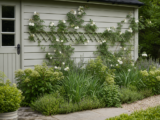
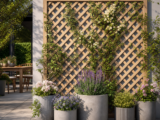
Smooth-Planed Timber Trellis for Garden Screens and Plant Support

You may be planning to soften a bare fence, divide a patio from a working area of the garden, or give roses, clematis or honeysuckle something more attractive to climb than plain posts and wire. In all of these situations, framed smooth-planed timber trellis can be a practical and decorative choice. It is light enough to handle, visually softer than solid fencing, and useful for adding height, structure and planting support without making the garden feel enclosed.
Choosing trellis is not simply a matter of picking a pattern you like. You need to consider where it will go, how exposed the site is, what it will support, how it will be fixed, and how long it is likely to last outdoors. This guide explains how to assess framed smooth-planed timber trellis for garden screens and climbing plant support, using a pressure-treated diamond trellis panel only as a practical example of the type of product you may compare.
Inhaltsverzeichnis
What framed smooth-planed timber trellis is best used for
Framed timber trellis is made from timber battens arranged in a lattice pattern and held within a perimeter frame. The frame gives the panel definition and helps it keep its shape when fixed properly. A smooth-planed finish means the timber has been planed to a smoother surface than rough-sawn timber, making it more pleasant to handle and neater in appearance.
This type of trellis is particularly suitable when you want:
- a decorative screen that still lets light and air through;
- a support for climbing plants against a wall, fence or freestanding framework;
- a softer boundary between different garden areas;
- added height above an existing fence, subject to appropriate fixings and planning considerations;
- a wall-mounted feature to break up expanses of brick, render or timber cladding.
Because trellis is more open than a fence panel, it is often less visually intrusive. However, once covered with mature plants, it can catch more wind and become heavier, so you should assess both the timber panel and the supporting structure before you buy.
Start with the job you need the trellis to do
Before comparing products, decide whether your priority is screening, plant support, decoration, or a combination of all three. This affects the size, style and fixing method you should choose.
For garden screening
If you want privacy, remember that trellis is not a solid screen. A diamond or square lattice will obscure views only partly until plants grow through it. It works well where you want filtered screening around seating areas, patios, bin stores or boundaries, but it may not be enough on its own if you need immediate privacy.
For faster screening, choose planting that suits your soil and aspect, and consider whether evergreen climbers are appropriate. Be realistic: a trellis panel should be viewed as a framework for growth, not a complete privacy solution from day one.
For climbing plant support
Climbing plants vary greatly in weight and habit. Lightweight annuals and many flowering climbers need less substantial support than vigorous roses, wisteria or mature honeysuckle. A framed trellis can be ideal for many garden climbers, but heavier plants may need additional wall wires, stronger posts or a more robust support system.
Check how the plant attaches itself. Some plants twine naturally around slender supports, while others need tying in. A diamond lattice gives multiple tie-in points and can guide growth neatly, but the panel still needs to be securely fixed to take the load as the plant matures.
Key decision criteria when assessing timber trellis
1. Size and proportions
Measure the space carefully before you buy. Trellis panels are commonly sold in imperial-style dimensions with metric equivalents, such as 6ft x 2ft or approximately 1.8m x 0.6m. Check the stated size and allow for posts, brackets, wall battens or gaps between panels. If the trellis will sit above a fence, measure the full height from ground level, not just the height of the trellis panel.
Proportion matters visually. Tall, narrow panels can work well on walls or between posts, while longer runs may need multiple matching panels. If you are using trellis as a garden partition, think about sight lines from the house, patio and neighbouring properties.
2. Frame construction
A perimeter frame gives trellis a more finished look and can make it easier to handle and fix. Look for neat joints, straight sides and an even lattice. The frame should not appear twisted, badly split or loosely assembled. A framed panel is usually preferable where the trellis will be visible from close range, used as a screen, or mounted in a prominent position.
Smooth-planed battens are a good choice where appearance matters. They tend to look more refined than rough-sawn timber and are less likely to snag hands or plant ties during installation and maintenance. Even so, timber is a natural material, so minor knots and grain variations are normal.
3. Treatment and durability
Outdoor timber needs protection from moisture and fungal decay. Pressure-treated timber is treated to improve resistance to rot and is commonly used for garden structures. When comparing trellis, check whether it is pressure treated, whether a manufacturer’s anti-rot guarantee is offered, and whether any additional treatment is recommended after installation.
An anti-rot guarantee can be useful, but read the conditions. Guarantees often depend on correct installation, avoiding direct ground contact where not intended, and not cutting or modifying the treated timber without protecting exposed ends. If you intend to cut a panel to fit an awkward space, check the manufacturer’s guidance first.
4. Timber sourcing
If sustainability matters to you, look for certification such as PEFC or FSC, where stated. Certification indicates that timber has been sourced from managed forests under recognised standards. It does not remove the need to assess construction quality, but it is a useful factor when choosing between similar products.
5. Pattern and visibility
Diamond trellis has a traditional decorative look and suits cottage gardens, rose planting and boundary screens. Square trellis can look more contemporary and may be easier to align with modern fencing or architecture. The more open the pattern, the more light and air will pass through; the closer the lattice, the more immediate screening it may provide.
Consider how the trellis will look before plants cover it. In winter, deciduous climbers may leave much of the structure visible, so the pattern and finish are still important.
Practical example: how to read a trellis product description
When assessing any trellis panel, read the description as a set of practical clues rather than as sales wording. For example, a panel described as a framed, smooth-planed, pressure-treated diamond trellis tells you several useful things: the finish is intended to be neat, the frame should help with presentation, the diamond lattice is decorative and plant-friendly, and the pressure treatment is relevant to outdoor durability.
As a practical comparison point, a product such as the Forest 6′ x 2′ Rosemore Decorative Pressure Treated Diamond Trellis, listed as 1.8m x 0.6m, represents a typical narrow decorative panel size that can be used on a wall, as part of a screen, or as climbing plant support. Its stated features include square-edged smooth-planed battens, a smooth-planed perimeter frame, PEFC-certified timber, pressure treatment and a 15-year anti-rot guarantee. Those are the sorts of details you should look for and verify when comparing alternatives.
Do not let one example determine your choice automatically. The right trellis for you depends on the exposure of your garden, the plant you want to grow, the fixing surface and the overall design. A 1.8m x 0.6m panel may be ideal for a vertical wall feature or a narrow screen, but a larger or repeated arrangement may be needed for a long boundary. Always match the product dimensions and construction to the job.
Where and how you plan to fix the trellis
Fixing to a wall
When fitting trellis to masonry, avoid fixing the panel flush against the wall if you are growing plants. A small gap improves air circulation and gives stems room to grow behind the lattice. This can be achieved by fixing treated timber battens to the wall first, then attaching the trellis to the battens. Use suitable wall plugs, screws and fixings for the wall type.
Check for pipes, cables and damp issues before drilling. On rendered or old brick walls, take extra care to avoid damaging the surface. If the wall is not yours, obtain permission before fixing anything to it.
Fixing to fence posts or panels
Trellis can be added between posts or above existing fencing, but the existing structure must be strong enough. Fence panels and posts already under strain from wind, age or rot should not be asked to carry extra loads. If you are adding height, consider whether taller posts or purpose-made post extensions are needed.
Be particularly careful in exposed locations. Trellis may look open, but once covered in foliage it can act like a sail. Strong fixings and sound posts are essential.
Using trellis as a freestanding screen
For a freestanding screen, the posts and ground fixings are as important as the trellis. Posts should be set securely and aligned accurately so the panels do not twist. Allow for wind direction, soil conditions and the eventual weight of plants. If the screen is near a seating area or path, make sure it cannot rock or lean.
Checklist before buying framed timber trellis
- Measure the space: confirm height, width and any allowance for posts, brackets or battens.
- Define the purpose: decide whether you need decoration, screening, plant support or all three.
- Assess exposure: note wind, sun, shade and shelter from buildings or trees.
- Check the fixing surface: make sure walls, fences, posts or frames are sound.
- Match the plant: consider mature weight, growth habit and maintenance needs.
- Review timber treatment: look for pressure treatment or stated outdoor protection.
- Read guarantee terms: check what is covered and what installation conditions apply.
- Look at the finish: inspect for smooth-planed battens, neat joints and a straight frame.
- Consider sustainability: look for PEFC, FSC or other stated certification if important to you.
- Plan delivery and handling: ensure panels can be transported through gates, paths and side passages.
Practical installation steps
Good installation makes a major difference to how well trellis performs. Even a well-made panel can fail early if it is poorly fixed, left in prolonged contact with wet ground, or overloaded with plants.
- Mark the position: use a spirit level and pencil or string line to mark where the panel will sit.
- Prepare the supports: fit wall battens, posts or rails before offering up the trellis.
- Keep it off the ground: where possible, leave a small clearance so the timber is not sitting in standing water or soil.
- Use suitable fixings: choose outdoor-grade screws and fixings appropriate to timber, masonry or posts.
- Fix without forcing: do not bend the panel to suit an uneven surface; correct the support instead.
- Check level and alignment: step back and view the panel from several angles before fully tightening fixings.
- Tie in plants gently: use soft garden ties and allow room for stems to expand.
- Inspect after bad weather: check screws, posts and plant ties, especially during the first season.
Choosing plants to suit the trellis
The best plant is one that suits both the trellis and the growing conditions. For sunny sites, roses, jasmine and some clematis varieties may be suitable, depending on soil and local conditions. In shade or partial shade, you may need more tolerant climbers. Always check the mature size and vigour of the plant before committing.
A common error is planting a very vigorous climber against a lightweight decorative trellis and then struggling to control it later. If you want a large, woody climber, consider whether the trellis is mainly decorative and should be supplemented with stronger wires, eye bolts or a heavier support frame.
Leave enough space between the plant and the trellis for roots to establish. Against walls, soil can be dry because of the rain shadow created by the building, so watering during establishment is important. Mulch can help retain moisture, but avoid piling mulch directly against timber or plant stems.
Maintenance and long-term care
Pressure-treated trellis is designed to reduce the need for ongoing treatment, but it is not maintenance-free in every sense. You should still inspect it periodically. Look for loose fixings, damage from storms, plant stems forcing battens apart, or areas where debris is trapping moisture.
Prune climbing plants regularly so their weight remains manageable and air can circulate. Remove dead growth and untie stems that are cutting into the plant. If the trellis has been painted or stained after purchase, follow the coating manufacturer’s maintenance guidance. If you cut, drill or modify treated timber, check whether exposed areas need an appropriate end-grain preservative.
Common practical mistakes to avoid
Buying for appearance alone
A decorative trellis may look perfect in a photograph, but it still needs to be suitable for your site. Check construction, treatment, size and fixing requirements before buying.
Underestimating wind load
Open lattice reduces wind resistance compared with a solid fence, but foliage changes that. A mature climber can turn an airy panel into a dense screen. In exposed gardens, invest time in strong posts and fixings.
Fixing directly against a wall for climbers
If plants are meant to grow through the trellis, they usually need space behind it. Fixing the panel hard against masonry can restrict growth and reduce air movement.
Ignoring mature plant weight
Small plants are deceptive. A climber that looks light in its first year may become heavy and woody later. Match support strength to the plant’s mature size.
Letting timber sit in wet soil
Even treated timber benefits from sensible installation. Avoid direct, prolonged contact with wet ground unless the product is specifically intended for that use.
Forgetting access for pruning
Do not install trellis where you cannot reach it safely. Climbers need training and pruning, and fixings may need tightening over time.
Short FAQ
Is smooth-planed trellis better than rough-sawn trellis?
It depends on the look and use you want. Smooth-planed trellis generally has a neater, more refined finish and is pleasant to handle, making it suitable for visible screens and decorative planting features. Rough-sawn timber may suit more rustic settings.
Can trellis provide privacy?
Yes, but usually partial privacy at first. Trellis becomes more effective as plants grow through it. If you need immediate privacy, you may need closer lattice, additional planting or a different screening solution.
Does pressure-treated trellis need painting?
Not necessarily. If the manufacturer states that no further treatment is required, you can usually leave it unfinished. You may still choose to paint or stain it for appearance, but use products suitable for exterior treated timber and follow the instructions.
Can I cut a trellis panel to size?
Sometimes, but cutting may affect the frame, strength, appearance and treatment protection. Check the product guidance first, and protect any exposed cut timber if required.
How far from a wall should trellis be fixed?
There is no single rule for every situation, but leaving a small gap using battens is usually helpful for climbing plants. It improves airflow and gives stems room to grow and be tied in.
Conclusion
Framed smooth-planed timber trellis is a versatile option for garden screens, wall features and climbing plant support. To choose well, focus on purpose, size, construction, treatment, fixing method and the mature weight of the plants you intend to grow. A pressure-treated, framed diamond trellis with smooth-planed battens and certified timber can be a strong candidate for many decorative garden uses, but it should still be assessed against your own site conditions.
Measure carefully, check the supporting structure, use suitable outdoor fixings and plan for maintenance from the start. Done properly, trellis can add structure, height and seasonal planting interest without the heaviness of solid fencing.