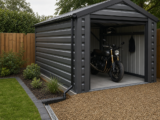
Layered Security Considerations for Garden Motorcycle Storage

You come home from a ride, wheel the motorcycle through the side gate and leave it in the garden overnight. It feels safer than parking on the road, but a garden is not automatically secure. A thief may have privacy once they are behind the house, noise may be masked by fences and neighbouring buildings, and a poorly positioned store can give them time to work undisturbed. The aim of layered security is to make every stage of an attempted theft slower, noisier, more visible and less predictable.
This article explains how to assess layered security for domestic motorcycle storage in the garden. It is written for homeowners who want practical, proportionate protection, whether you use a metal motorcycle garage, a shed, a purpose-built bike store or a converted outbuilding. The product mentioned later is included only as a practical example of the type of features you may compare when choosing storage.
Inhaltsverzeichnis
What layered security means for garden motorcycle storage
Layered security is not about relying on one impressive lock. It means combining several measures so that if one is defeated, the next one still has to be overcome. For a motorcycle kept in a garden, the main layers are:
- Perimeter control: gates, fences, walls and access points.
- Visibility control: stopping casual observers from identifying what you own.
- Physical enclosure: a robust shed, garage or motorcycle store.
- Anchoring: securing the bike to the ground or structure.
- Locking hardware: chains, padlocks, hasps, door bolts and internal locks.
- Detection: alarms, lighting, cameras and neighbour awareness.
- Procedures: how consistently you lock, park and maintain the set-up.
The strongest arrangements are usually those where the bike cannot be seen, cannot be reached easily, cannot be wheeled away, and cannot be attacked quietly for long.
Start with a realistic risk assessment
Before buying more equipment, assess how a thief would approach your property. Walk from the road to the garden as if you were trying to take the motorcycle. Look for weak points rather than reassuring features.
Consider access from the street
A side passage is convenient for you, but it may also be the easiest theft route. Ask yourself whether the gate can be lifted off its hinges, whether the latch can be reached from outside, and whether bins, low walls or garden furniture help someone climb in. A strong store is less effective if the whole garden is easy to enter unseen.
Assess privacy and concealment
High fences can be helpful because they prevent the bike being seen, but they can also provide cover once an intruder is inside. If your garden is not overlooked, detection becomes more important. Motion-activated lights, audible alarms and cameras may be more valuable than they would be in a highly visible front driveway.
Think about time and tools
Most thieves want speed. They may use bolt croppers, pry bars, portable grinders or lifting techniques. Your security should not assume that a basic padlock will be enough. The purpose of several layers is to add delay and uncertainty: a locked gate, a windowless store, a ground anchor, a substantial chain, and an alarm all increase the effort required.
Choosing the right location in the garden
Where you place the motorcycle store matters almost as much as the store itself. A location close to the house may make an alarm more audible and reduce the time you take to respond. A position that is fully hidden from the street can reduce targeting, provided it does not create a secluded working area for an intruder.
Look for a position that allows you to ride or push the bike in safely, close the doors fully, and lock up without awkward manoeuvring. If storage is inconvenient, you are more likely to take shortcuts, particularly when it is raining or dark.
Base and ground conditions
A level, stable base is essential. Many secure motorcycle stores require a level concrete or paved base, and this is particularly important if the doors need to align correctly and if you are using a ground anchor. Uneven slabs can leave gaps, distort doors, or make fixings less reliable.
If you are creating a new base, plan the anchor location before the concrete is poured or before paving is laid. The anchor should allow the chain to pass through the motorcycle frame or a substantial part of the bike, not merely through a wheel that can be removed.
Security of the enclosure
The enclosure is your main visible barrier. It should prevent casual access, resist forced entry for a practical period, and keep the motorcycle out of sight. A flimsy garden shed may be adequate for low-value tools, but motorcycles require a higher standard because they are valuable, portable and often targeted.
What to look for in a motorcycle store
When comparing options, focus on evidence rather than sales language. Useful decision criteria include:
- Material: steel, reinforced timber or other robust construction appropriate to your site.
- Doors: wide enough for safe access, but with strong hinges, bolts and locking points.
- Windows: no windows, or secure obscured windows, to avoid advertising the contents.
- External fixings: bolts and screws should not be easily removable from outside.
- Security approvals: independent certification can help you compare products.
- Ventilation: enough airflow to reduce condensation without creating easy access points.
- Base requirements: check whether it must be installed on concrete, paving or another level surface.
- Maintenance: consider corrosion resistance, moving parts and long-term upkeep.
For example, some purpose-built motorcycle stores combine a steel enclosure, secure door mechanisms, a ground anchor, approved chain and padlock, hasp protection and an alarm. Those features are not a substitute for good siting and daily locking habits, but they can form a strong central layer within a wider plan.
When reviewing a specific product, check the exact current specification, certification and installation requirements rather than relying on assumptions from photographs. Confirm whether accessories are included or optional, and whether your insurer recognises any approvals.
Anchoring the motorcycle: the layer many people underuse
A locked shed can be forced open, and a motorcycle with only a steering lock can still be lifted or wheeled away. Anchoring is therefore one of the most important layers. A properly installed ground anchor, used with a suitable chain and padlock, means the bike remains attached to the property even if the enclosure is breached.
Position the anchor correctly
The anchor should be close enough that the chain cannot be laid on the ground easily, because a chain lying flat can be more vulnerable to attack. At the same time, it must be practical to use every time. If you have to crawl under the bike or thread the chain awkwardly around hot parts, you may stop using it consistently.
Ideally, pass the chain through the frame or another substantial structural point. Avoid relying only on a front wheel, rear wheel or removable component. If you use more than one motorcycle, plan the anchor and parking layout so each bike can be secured properly without damaging bodywork or creating trip hazards.
Do not ignore installation quality
A good anchor installed poorly may perform badly. Follow the manufacturer’s instructions, use the correct fixings, and install into a suitable base. If the base is weak, cracked or loose, address that before fitting security hardware. For high-value motorcycles, professional installation can be worthwhile.
Locks, chains and door hardware
Locks and chains should match the risk. A small padlock on a thin hasp can undermine an otherwise solid store. Choose hardware that is physically compatible, difficult to crop, and not easily accessed with tools.
Use the right lock for the right task
Door locks need to resist prying and twisting as well as picking. Chains need to resist cutting and should be used so that they are not conveniently positioned for attack. Disc locks can add another layer, especially if they include an alarm, but they should not be your only security in a garden store.
Key management also matters. Do not leave keys hanging near the back door, in a garage, or in a predictable kitchen drawer if the house itself could be entered. Keep spare keys secure and avoid labelling them in a way that identifies the motorcycle or store.
Detection: alarms, lighting and cameras
Physical barriers delay theft; detection increases the chance that the attempt is abandoned. In a garden setting, detection should be planned carefully to avoid nuisance alerts that you eventually ignore.
Lighting
Motion-activated lighting can make an intruder visible and uncomfortable. Position lights so they cover the approach route and the store entrance, not just the patio. Avoid dazzling neighbours or shining directly into bedroom windows. Reliable, well-aimed lighting is better than very bright lighting that causes complaints or is switched off.
Alarms
A shed or store alarm should be audible enough to attract attention. Battery-operated units can be useful where mains power is unavailable, but you must test batteries and sensors regularly. If the motorcycle has its own alarm, remember that it may be less effective inside an enclosure unless it can still be heard clearly.
CCTV and smart cameras
Cameras can deter, alert and provide evidence. Place them to capture faces and approach routes, not only the top of a helmet or the back of a hood. If you use domestic CCTV, be mindful of privacy rules and avoid recording more of neighbouring property or public space than necessary. Signage and sensible camera angles help keep the system proportionate.
Insurance and documentation
Do not assume that any garden storage arrangement will satisfy your insurer. Policy wording may require the motorcycle to be kept in a locked garage, secured by a particular type of device, or stored at the declared address overnight. If you change from road parking to garden storage, tell your insurer and ask what evidence they require.
Keep receipts, photographs and installation records for anchors, locks and storage buildings. If a product has independent security approval, retain documentation showing the exact model and approval level. In the event of a claim, clear records can help demonstrate that you took reasonable precautions.
Practical layered security checklist
- Check that the garden gate is strong, lockable and not easily lifted from its hinges.
- Keep the motorcycle out of sight from the road, footpaths and neighbouring access routes.
- Install the store on a level, secure base suitable for the structure and anchor.
- Use a robust enclosure with secure doors and limited external access to fixings.
- Fit a suitable ground anchor and use it every time the bike is stored.
- Choose a chain and padlock appropriate to the value of the bike and the risk level.
- Position the chain so it is difficult to attack with tools.
- Add detection, such as a store alarm, motorcycle alarm, lighting or camera system.
- Keep keys secure inside the home, away from doors, windows and obvious places.
- Confirm insurance requirements in writing where possible.
- Inspect doors, hinges, locks, fixings and batteries regularly.
Common practical mistakes to avoid
Relying on the shed alone
A locked store is important, but it should not be the only barrier. If the doors are opened, the motorcycle should still be chained to an anchor. The best approach assumes that any single layer might fail.
Buying equipment that is inconvenient to use
Security that is awkward tends to be skipped. If the chain is too heavy to handle, the door clearance is tight, or the anchor is in the wrong place, you may stop following your own routine. Convenience is not a luxury; it is part of effective security.
Leaving tools nearby
Garden tools, ladders, bricks and metal bars can all assist forced entry. Keep tools locked away separately and do not leave items near the store that could be used to lever doors or climb fences.
Advertising the motorcycle
Running the bike noisily in the garden, leaving branded covers visible, or posting identifiable storage details online can increase risk. Be discreet about what you own and where it is kept.
Forgetting maintenance
Locks seize, batteries fail, hinges loosen and bases move. Build a simple monthly check into your routine. A neglected security system can look impressive but perform poorly when tested.
FAQ
Is a garden motorcycle store better than a normal shed?
Often, yes, if it is purpose-built with stronger doors, secure fixings and motorcycle-specific features such as anchoring provision. However, the overall result depends on installation, locking practice and the security of the garden itself.
Do I need a ground anchor if the store is lockable?
For most motorcycles, a ground anchor is strongly advisable. It adds an important layer if the enclosure is breached and helps prevent the bike being wheeled or lifted away quickly.
Should the store be visible or hidden?
Ideally, it should not advertise the motorcycle from outside the property, but it should not be so secluded that an intruder can work unseen for a long period. Balance privacy with lighting, alarms and natural surveillance.
Will secure garden storage reduce my insurance premium?
It may, but this depends on your insurer, policy and the exact security measures used. Ask your insurer before relying on a discount, and keep evidence of any approved equipment or installation.
How often should I review my security?
Review it whenever you change motorcycle, storage location or access arrangements, and at least every few months. Also inspect after storms, attempted break-ins, building work or changes to neighbouring boundaries.
Conclusion
Good garden motorcycle storage is not defined by one lock, one shed or one alarm. It is the result of layered decisions: controlling access to the garden, hiding the bike from view, using a robust enclosure, anchoring the motorcycle properly, adding reliable detection and following the same locking routine every time. Start by assessing how someone would approach and attack your storage, then strengthen each weak point in turn.
A purpose-built secure motorcycle store can be a valuable central layer, particularly when combined with a sound base, ground anchor, quality chain, effective door security and clear insurance documentation. The most effective system is practical enough that you will use it consistently, and strong enough that a thief is likely to decide the effort, time and risk are not worth it.