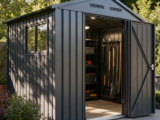
Door Alignment and Locking Points in Metal Garden Sheds

A metal garden shed door that will not close cleanly is more than a small nuisance. You may find yourself lifting one door to get the bolt into its keeper, pushing the frame with your shoulder to turn the key, or leaving the bottom bolt unfastened because it no longer lines up. In many cases, the problem is not the lock itself but the way the shed, base, door frame and locking points are working together. Metal sheds rely on accurate alignment: if the base is not level, the frame is slightly racked, or the doors are carrying uneven tension, the bolts and lock can quickly become difficult to use.
This guide explains how to check, adjust and maintain door alignment, bolts and locking points in metal garden sheds. It is written for practical shed owners who want a reliable, secure door without forcing components or causing unnecessary damage.
Inhaltsverzeichnis
Why door alignment matters in a metal shed
Unlike a timber shed, where minor movement can sometimes be absorbed by the wood, a metal shed is typically made from formed steel panels, channels, frames and fixings that depend on being assembled squarely. Small errors can travel through the structure. A base that is only a few millimetres out can affect the door opening, and a door opening that is slightly twisted can prevent the lock tongue, shoot bolt or sliding bolt from entering its receiving point.
Good alignment matters for three main reasons:
- Security: Bolts and locking points need full engagement. A bolt that only partly enters its hole offers less resistance.
- Weather protection: Doors that sit evenly against the frame are less likely to admit wind-driven rain or draughts.
- Ease of use: A lock that operates smoothly is less likely to be forced, bent or worn prematurely.
If your shed doors have become stiff over time, do not immediately assume the lock has failed. Start with the structure and the alignment, then move on to the lock and bolts.
Common signs that the doors are out of alignment
Door alignment issues often develop gradually. You may notice one symptom first, then several more as the shed settles or fixings loosen.
Typical warning signs
- The key turns only if you push or pull the door at the same time.
- The top bolt engages but the bottom bolt does not, or vice versa.
- One door leaf sits higher than the other.
- The gap between the two doors is wider at the top than at the bottom.
- The door rubs on the threshold, roof trim or side frame.
- The lock tongue or latch strikes the edge of the keeper instead of entering it cleanly.
- Bolts scrape their receiving holes and leave shiny wear marks.
- The doors spring open slightly when you release pressure.
These signs point towards either a local issue, such as a loose hinge screw or bent bolt, or a wider issue, such as a base that is not level or a frame that has not been assembled square.
Decision criteria before you start adjusting anything
Before loosening fixings or bending anything, assess the likely cause. This prevents you from “correcting” the wrong part and making the problem worse.
1. Is the base level, flat and stable?
A metal shed should sit on a firm, level base. Many higher-security metal sheds are intended to be bolted down to a concrete base. If the base slopes, has high spots, or has settled at one corner, the door opening can twist. In that situation, filing bolt holes or adjusting locks may only mask the real problem.
2. Are the doors newly installed or has the problem appeared later?
If the shed is newly assembled, the issue is likely to be assembly alignment, base level or fixings not yet fully squared. If the shed has worked well for months or years and then changed, look for loose fixings, ground movement, impact damage, heavy wind loading, or corrosion around moving parts.
3. Are both doors affected?
If only one door leaf is rubbing, check that door’s hinges, top and bottom edges, and any bracing. If both doors seem misaligned, the frame or base is more likely to be involved.
4. Is the locking point too tight or completely missed?
A bolt that is slightly tight may need cleaning, lubrication or minor realignment. A bolt that misses the hole by several millimetres usually indicates a squareness or frame issue.
5. Is the shed being used for high-value storage?
If you store tools, cycles or equipment, do not accept a lock that “just about” catches. Security depends on full engagement of every locking point, not just the main key-operated lock.
Checklist: tools and safety precautions
You do not usually need specialist tools for basic alignment checks, but you do need to work methodically. Use the manufacturer’s instructions for your shed wherever available.
Useful tools
- Spirit level, preferably long enough to check the threshold and side frame.
- Tape measure for comparing diagonals.
- Appropriate screwdriver or socket set for the shed fixings.
- Rubber mallet for gentle adjustment where appropriate.
- Pencil or masking tape for marking contact points.
- Light machine oil or suitable lock lubricant.
- Clean cloth and soft brush for removing grit from channels and bolt holes.
- Work gloves to protect your hands from sharp metal edges.
Safety checks
- Do not force a door against a locked bolt, as this can bend the bolt or distort the door skin.
- Support door leaves if you are loosening hinge fixings.
- Avoid drilling or enlarging holes unless you are confident it will not weaken the locking point.
- Be careful around cut metal edges, especially on older sheds or where components have been modified.
- If the shed is bolted to concrete, check anchors carefully before loosening them.
Understanding bolts and locking points
Many metal garden sheds use more than one locking point. A typical arrangement may include a key-operated central lock, a top bolt into the head of the frame, and a bottom bolt into the threshold or base channel. Some designs use internal shoot bolts, surface-mounted bolts, hasps, padlocks or a combination of these.
The important point is that each part has a specific job. The central lock keeps the main meeting point secure. Top and bottom bolts help resist the doors being pulled or flexed. If one of these is not properly engaged, the overall door security is reduced.
As a practical example, a larger windowless metal shed with wide double doors may include a key-operated lock and bolts at both the top and bottom of the doors. A product such as the 8’8 x 6′ Trimetals Premium Titan 960 Pent Metal Shed, listed at 1789.00 EUR, illustrates the type of shed where alignment is especially important: the doors, locking mechanism and base fixing all need to work together for proper performance. The specific product is not the focus here, but it is a useful reminder that secure metal sheds often depend on several locking points rather than one lock alone.
Step-by-step: how to diagnose door alignment problems
Step 1: Empty the doorway area
Remove anything leaning against the doors, threshold or side walls. Stored items can press against panels and slightly distort the door opening. Sweep debris from the bottom channel and around the bolt receiver holes. Grit, leaves and small stones can prevent bottom bolts from entering fully.
Step 2: Check how the doors sit when unlocked
Open and close the doors slowly without locking them. Watch the gaps around the door edges. A good fit should be reasonably even, with no obvious rubbing. If the doors catch before the lock is engaged, the issue is not primarily the lock; it is the door position, frame or hinges.
Step 3: Test each locking point separately
Do not try to diagnose everything with the door fully locked. Test the bottom bolt on its own, then the top bolt, then the main lock. If one point is difficult while the others are smooth, concentrate there. If all points are tight, look at the frame squareness and base level.
Step 4: Look for witness marks
Shiny scraped metal, chipped coating or rubbed paint shows where parts are clashing. Mark the contact area with masking tape so you can check whether an adjustment improves it. Do not ignore a small scrape; it often shows exactly where the misalignment begins.
Step 5: Check the base and threshold
Place a spirit level across the doorway threshold and from front to back near the door opening. If the shed is sitting unevenly, the doors may be pulled out of square. On a concrete base, look for raised spots under the frame or loose anchor fixings. On any base, ensure water is not pooling around the threshold, as dirt and damp can affect bolt operation over time.
Step 6: Compare the diagonals of the door opening
Measure from the top left corner of the door opening to the bottom right, then from the top right to the bottom left. If the measurements differ noticeably, the opening is racked. Minor differences may be corrected by loosening selected frame fixings, squaring the structure, and retightening. Follow the shed manufacturer’s guidance, as construction methods vary.
Practical adjustments you can make
Tighten loose fixings
Loose screws, bolts or nuts around the hinge side, door frame and threshold can allow movement. Tighten them evenly, but do not overtighten to the point that you crush panels or distort channels. If a fixing spins without tightening, it may need replacement with the correct type of fixing.
Re-square the frame
If the door opening is racked, slightly loosen relevant frame and base fixings, then gently shift the structure back towards square. This may require two people: one to hold the frame and one to check measurements. Once the gaps look even and the diagonals are closer, retighten fixings progressively rather than fully tightening one corner first.
Adjust hinges where possible
Some metal shed hinges offer limited adjustment through slotted holes or fixing positions. If a door has dropped, you may be able to lift it slightly while retightening the hinge fixings. If the hinge is bent, adjustment may not be enough; replacement may be safer and more reliable.
Clean and lubricate moving parts
Bolts should slide cleanly. Remove dirt from bolt guides and receiving holes, then apply a small amount of suitable lubricant. Use lock lubricant for key cylinders rather than heavy grease, which can attract grit. Wipe away excess lubricant so it does not collect dust.
Check bolt receivers
The hole, bracket or keeper that receives the bolt must be clear and firmly attached. If it has shifted, tighten it back into the correct position. If it is damaged, avoid simply forcing the bolt through; a weakened receiver reduces security.
Avoid unnecessary filing
Enlarging a bolt hole may seem like a quick fix, but it can create a loose, poorly supported locking point. Only consider very minor dressing of a burr or rough edge. If the bolt is missing the hole because the door is out of alignment, correct the alignment first.
Common practical mistakes
Forcing the key
If the key will not turn without pressure on the door, the lock is probably under load. Forcing the key can bend internal parts or snap the key. Relieve the pressure by checking bolt alignment and door position.
Ignoring the base
Many door problems are blamed on the lock when the base is the cause. A metal shed needs a stable, level foundation. If the base moves, the lock may keep going out of alignment no matter how often you adjust it.
Only using the central lock
Where top and bottom bolts are provided, use them. They are part of the security design. Leaving them open because they are inconvenient is a sign that the alignment needs attention.
Overtightening fixings
Metal shed panels and channels can distort if fixings are overtightened. Tighten firmly and evenly, following the supplied instructions, but do not use excessive force.
Adding padlocks without correcting alignment
Additional hasps or padlocks can improve security when fitted correctly, but they do not solve a poorly aligned door. If the door is twisted or the bolts do not engage, extra hardware may simply hide the underlying problem.
Ongoing maintenance routine
A metal shed may require less maintenance than many timber structures, but the door hardware still benefits from periodic checks. Build the following into your routine, especially after strong winds, heavy rain or moving heavy items in and out.
- Open and close the doors fully and listen for scraping.
- Check that all bolts engage fully without lifting or forcing the door.
- Turn the key with the door relaxed, not under pressure.
- Inspect hinge fixings and frame fixings for looseness.
- Clear debris from bottom channels and bolt holes.
- Lightly lubricate bolts, hinges and lock parts where appropriate.
- Check that the shed remains securely fixed to its base if it is designed to be bolted down.
It is sensible to check the doors at the start of autumn and again after winter. Seasonal wind, rain and ground movement can reveal small issues before they become more difficult to correct.
When to repair, replace or seek help
Minor stiffness, loose fixings and dirty bolt holes are usually straightforward to deal with. However, some problems call for replacement parts or professional help.
Consider replacing components if a hinge is visibly bent, a bolt is badly worn, a lock cylinder is unreliable, or a receiver plate has been damaged. Seek help if the shed is significantly out of square, if the base has failed, or if security has been compromised by attempted entry. Where the shed is under warranty, check the terms before modifying parts, drilling new holes or fitting non-standard hardware.
FAQ
Why does my metal shed door only lock if I lift it?
The door has probably dropped slightly or the frame is out of square. Check hinge fixings, base level and the gaps around the door. Lifting the door to lock it is a temporary workaround, not a proper fix.
Can I make the bolt hole bigger?
Only remove a small burr or rough edge if necessary. Enlarging the hole to compensate for misalignment can weaken the locking point and create a loose fit. Correct the cause of the misalignment first.
Should I oil the lock?
Use a lubricant suitable for locks and apply it sparingly. Avoid thick grease in key cylinders, as it can attract dirt. Bolts and hinges can usually be cleaned and lightly lubricated, but always avoid excessive residue.
Why has the door changed after months of working properly?
Likely causes include loose fixings, movement in the base, wind stress, impact damage, debris in the threshold, or gradual wear in hinges and bolts. Inspect the whole door opening rather than only the lock.
Do top and bottom bolts really matter?
Yes. On double-door metal sheds, top and bottom bolts help secure the inactive door leaf and resist flexing. If they are fitted, they should engage fully and be used as intended.
Conclusion
Door alignment in a metal garden shed is a structural and security issue, not just a matter of convenience. If the doors, bolts and locking points do not meet cleanly, start with the basics: clear debris, check the base, inspect the frame, test each locking point separately and tighten fixings evenly. Avoid forcing locks or enlarging holes as a first response. A well-aligned metal shed door should close smoothly, lock without strain and allow every bolt to engage fully. Regular checks will help keep your shed secure, weather-resistant and easy to use for years to come.