Secure Garden Shed Storage for Bikes, Tools and Outdoor Equipment
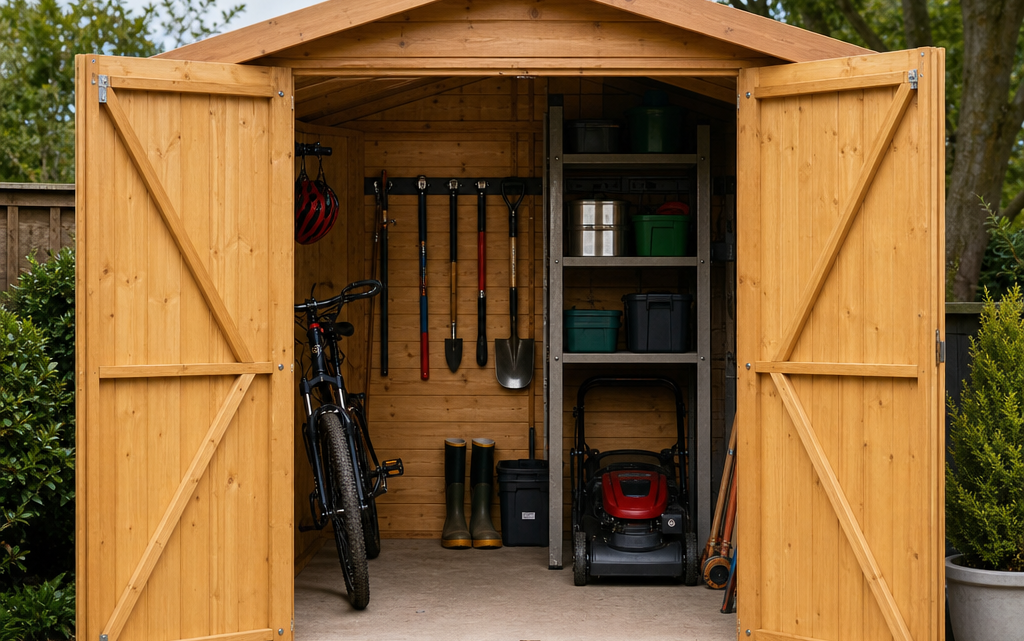
You have invested in decent bicycles, a mower, power tools, garden furniture and seasonal equipment, but all of it ends up crowded into a shed with a basic latch and poor lighting. That is a common situation in UK gardens, especially where the shed has gradually become the overflow space for the house, garage and patio. Secure garden shed storage is not just about buying a lock; it is about planning the shed, base, layout, access, lighting and daily habits so that your valuable items are harder to steal, easier to find and less likely to be damaged by damp or careless stacking.
This guide explains how to plan secure storage for bicycles, tools and outdoor equipment in a garden shed. It covers practical security decisions, sensible internal organisation, common mistakes and a checklist you can use before you buy or upgrade your shed.
Inhaltsverzeichnis
Start by deciding what the shed must protect
Before looking at locks, anchors or shelving, make a realistic list of what you need to store. A shed used only for compost, plant pots and hand tools has different requirements from one used for bikes, power tools, golf clubs, camping kit and patio furniture.
Group items by value, weight and frequency of use. For example, bicycles and cordless power tools are high-value and should be secured directly. A mower or strimmer may be bulky rather than especially easy to remove, but it still needs a clear route in and out. Cushions, parasols and outdoor furniture covers need dry, raised storage so they do not become mouldy. Chemicals, fuels and sharp tools should be separated from children’s toys and general household storage.
Prioritise the most attractive items to thieves
Thieves usually look for items that are quick to identify, quick to remove and easy to resell. Bikes, hedge trimmers, drills, saws, pressure washers and branded garden machinery are obvious targets. If your shed contains several of these, you should plan for layered security rather than relying on a single door lock.
Layered security means combining several measures: a strong shed structure, a good lock, protected hinges, an internal anchor, discreet windows, lighting and sensible positioning. Each layer increases the time and effort needed to get to the item.
Choose a shed structure that suits secure storage
A shed can only be as secure as its weakest point. Thin panels, poorly fitted doors and flimsy floors make it easier to force entry, even if you add a good padlock later. When comparing garden sheds, look beyond external dimensions and check the construction details.
For timber sheds, tongue and groove cladding is generally more robust than simple overlap boarding, and a framed, ledged and braced door is preferable to a light, unreinforced door. A floor strong enough for bicycles, mowers and heavy storage boxes is also important. If you plan to use internal ground anchors or wall-mounted storage, check whether the floor and frame are suitable for the fixings you intend to use.
Window position matters
Windows improve natural light, but they can also show a thief exactly what is inside. For secure storage, smaller windows positioned high on the shed are usually better than large, low-level panes. Toughened glass is more resilient than ordinary glass, but it is still wise to avoid displaying valuable tools or bikes directly in view.
If you are buying a shed for security, consider whether you need windows at all. A windowless shed is darker inside, but it gives less away from outside. If you do choose windows, use blinds, translucent film or internal screening so valuable contents are not visible from paths, alleys or neighbouring land.
Plan the base before you fill the shed
A level, stable base is a security feature as well as a structural necessity. A shed that twists, drops or sits on damp ground may develop gaps around the door and panels, making it easier to force. Poor bases can also lead to damp floors, sticking doors and premature timber decay.
Common options include concrete slabs, a poured concrete base, timber bearers, gravel grids and proprietary plastic shed base systems. The right choice depends on the ground, the shed weight, drainage and whether the building is intended to be permanent. Whatever you choose, the base should be level, properly supported and slightly larger than the shed footprint only where the manufacturer recommends it. Avoid creating ledges that collect rainwater against timber walls.
Drainage and air movement reduce long-term damage
Security is not only about theft. Bikes, tools and machinery can be ruined by corrosion, damp and mildew. Raise the shed floor from wet ground where appropriate, keep soil and vegetation away from the walls, and allow air to circulate around the building. Store soft furnishings and electrical tools in sealed boxes or on shelves, not directly on the floor.
Make the door the first serious security point
The door is the part of the shed you will use every day, and it is usually the first point an intruder will attack. Choose a door that closes squarely and does not flex easily. A lockable door is useful, but the lock fitting and surrounding timber matter just as much as the lock itself.
Use a good-quality closed-shackle padlock or a robust hasp and staple designed for outdoor use. If the shed has external hinges, consider hinge bolts or security screws so the door cannot simply be lifted or unscrewed. A pad-bolt protector, where fitted, can help reduce access to the fixing point, but you still need to use a suitable padlock if one is not supplied.
Do not leave the key in a predictable place such as under a pot, on a hook in the porch or inside a nearby meter box. If several people need access, use a controlled key routine rather than making casual spare copies.
Use internal anchors for bicycles and expensive tools
If a thief gets through the shed door, the next aim is to make removal difficult. Bicycles should be locked to a fixed anchor using a sold-secure style chain or D-lock appropriate to the bike’s value. The anchor must be fixed into something substantial, such as a concrete base or a strong structural member, not just a thin board.
For power tools and garden machinery, use lockable steel cabinets, security cables, tool chests or wall racks with locking bars. Keep chargers and batteries separate where practical. A cordless tool without its battery is less convenient to steal and use, although you should still lock both away securely.
Use layout to improve security and daily usability
A secure shed that is impossible to use will quickly become untidy, and untidy sheds make security worse. When items are piled together, you stop locking bikes properly, leave tools by the door and prop the door open while searching for things. Plan the layout so that valuable items can be secured without moving half the shed every time.
Place bicycles along one side, ideally with wheel channels or wall hooks if suitable. Keep the lock and chain close to the anchor so it becomes part of the routine. Store long-handled tools on wall racks, blades facing safely away from the main walkway. Put heavy machinery at floor level near the door, but not so close that it can be grabbed immediately. Seasonal items can go higher up or towards the back.
Compare products by reading the details carefully
When you are comparing shed-related products, use the specification as a decision tool rather than relying on the product title alone. As a practical example, you may see a listing such as a 12×6 Plastic Shed Base Kit priced at 200.99 EUR, while associated information may also describe a 12′ x 6′ traditional apex wooden security garden shed measuring 3.66m x 1.83m. That kind of comparison highlights why it is important to check exactly what is included: base, shed, floor, roof, door hardware and any optional upgrades may be separate items.
In a security-focused shed description, useful details to note include 12mm tongue and groove cladding, a 38mm x 50mm frame, a 12mm tongue and groove floor, a 12mm tongue and groove roof with weatherproof felt, a ledged and braced lockable door, a security pad-bolt protector and high-positioned toughened-glass windows. These features are practical indicators to compare, but they do not replace your own assessment of location, locks, anchors, insurance requirements and installation quality.
Also check treatment and maintenance requirements. If timber is dip treated, it may need re-treatment shortly after assembly and then annually. If a pressure-treated option is available, read what the guarantee covers and whether waterproofing is still required. Security planning should include long-term condition, because warped doors, rotten panels and failing felt can all undermine an otherwise sensible storage plan.
Lighting improves both security and everyday access
Good lighting makes a shed safer to use and less attractive as a hidden target. You should be able to see the lock, the doorway and the main storage zones without using a phone torch. If mains power is not available, solar lighting can be a practical option, provided the panel is positioned to receive enough daylight.
Some shed lighting kits use LED strips, battery hubs and solar panels, and may be designed for installation without an electrician. When considering any lighting kit, check the light output, expected run time by season, cable lengths, warranty, installation requirements and whether any installation service includes the lighting. Lighting should not be treated as a substitute for locks and anchors, but it supports them by making the shed easier to secure properly every time.
Checklist: secure shed storage planning
- List your contents: Identify bikes, tools, machinery, furniture, chemicals and seasonal items.
- Rank by risk: Prioritise items that are valuable, portable and easy to resell.
- Check the structure: Look at wall construction, frame size, floor strength, roof condition and door build.
- Assess visibility: Avoid placing valuable items in view of windows or open doors.
- Plan the base: Make sure the shed sits level, drains well and does not twist over time.
- Upgrade door security: Use suitable outdoor locks, protected hasps, hinge protection and security screws where appropriate.
- Add internal locking: Secure bikes and expensive tools to anchors, cabinets or locking racks.
- Improve lighting: Fit practical lighting so you can lock up and move around safely.
- Organise access: Keep frequently used items reachable without leaving valuables unsecured.
- Maintain the shed: Treat timber, repair felt, clear vegetation and check fixings regularly.
- Review insurance: Confirm what your policy requires for outbuildings, locks and proof of ownership.
Practical steps for arranging bikes, tools and equipment
For bicycles
Give bikes a dedicated zone rather than leaning them randomly against tools and furniture. If floor space is limited, vertical hooks or wall-mounted racks can work, but only if fixed into suitable structural support and used within their intended capacity. Keep helmets, pumps and accessories in labelled boxes nearby so you do not have to leave the door open while searching.
Use one strong lock per high-value bike where possible, or a heavy chain through multiple frames and wheels attached to a secure anchor. Do not rely on a cable lock alone for shed storage. If the bike is especially valuable, consider removing the battery from an e-bike and storing it safely indoors in accordance with the manufacturer’s guidance.
For hand tools and power tools
Wall-mounted tool racks keep spades, forks, rakes and hoes tidy, but sharp or heavy tools should be secure and not likely to fall. Power tools should be stored in cases, drawers or cabinets. Keep receipts, serial numbers and photographs of expensive equipment, as these can help with insurance claims and identification if stolen.
Batteries, chargers and extension leads should be kept dry and away from fuels, fertilisers and damp floors. If the shed gets very cold or humid, consider whether some electrical items are better stored in the house or a dry utility area.
For outdoor furniture and seasonal kit
Garden cushions, covers and camping equipment should be stored off the floor in breathable bags or sealed containers, depending on the item. Heavy furniture can be stacked, but avoid blocking access to the bike anchor, lock cabinet or door. If you cannot reach your security equipment easily, you are less likely to use it consistently.
Common practical mistakes to avoid
Buying too small. A shed that is packed from day one becomes difficult to secure. Allow room for walking, locking bikes and removing machinery without dragging everything outside.
Focusing only on the padlock. A strong padlock on a weak hasp, thin door or exposed hinge is not enough. Security needs the door, frame, fixings and internal anchoring to work together.
Ignoring the base. An uneven or damp base can distort the shed, create gaps and shorten its life. It can also make doors harder to close and lock properly.
Leaving valuable items on display. Open doors, clear windows and visible bike silhouettes make it easier for thieves to choose a target.
Forgetting maintenance. Rotten timber, damaged roof felt, loose screws and swollen doors all reduce security. Inspect the shed at least twice a year, especially after winter and storms.
Using the shed as a dumping ground. Disorganisation leads to shortcuts. If the anchor is buried behind furniture or the key is always missing, your security system will not be used.
Insurance and record keeping
Check your home insurance policy before assuming that all shed contents are covered. Some policies set limits for outbuildings, require specific lock types or exclude high-value bicycles unless separately declared. You may need proof of forced entry, receipts, photographs and serial numbers. Keep a simple digital inventory of expensive items and update it when you buy or sell equipment.
Marking tools and bikes can also help. Use appropriate property marking, register valuable bikes where suitable, and keep identifying details somewhere other than inside the shed.
Short FAQ
Is a wooden shed secure enough for bicycles?
A well-built wooden shed can be suitable for bicycle storage if it has a strong door, good fixings, limited visibility and internal anchors. The bike should not simply be left loose inside. For expensive bikes, combine shed security with a high-quality lock and insurance-compliant storage.
Should I choose a shed with windows or without?
If security is the priority, fewer and smaller windows are usually better. High-positioned toughened-glass windows can provide light while reducing visibility, but a windowless shed gives the least information to anyone looking in.
Do I need electricity in the shed?
Not always. Many storage sheds function well without mains electricity. Lighting is useful, and solar-powered options may suit some gardens. If you need mains power for tools or chargers, use a qualified electrician and follow current regulations.
How often should I check shed security?
Inspect locks, hinges, door alignment, roof felt, windows and anchors at least twice a year. Also check after severe weather or if you notice the door becoming harder to close.
Where should the most valuable items go?
Keep the most valuable items away from windows and not immediately inside the door. Secure bikes and tools to anchors, cabinets or locking systems so that entry to the shed does not mean easy removal.
Conclusion
Secure garden shed storage depends on planning, not just hardware. Start by understanding what you need to protect, then choose a shed structure, base, door security, internal anchors, lighting and layout that work together. Keep valuable items out of sight, make locks easy to use, maintain the building and check your insurance requirements. With a practical system in place, your shed can protect bicycles, tools and outdoor equipment while still being organised enough for everyday gardening and household use.