Balancing Privacy and Light with Semi-Open Garden Fence Panels
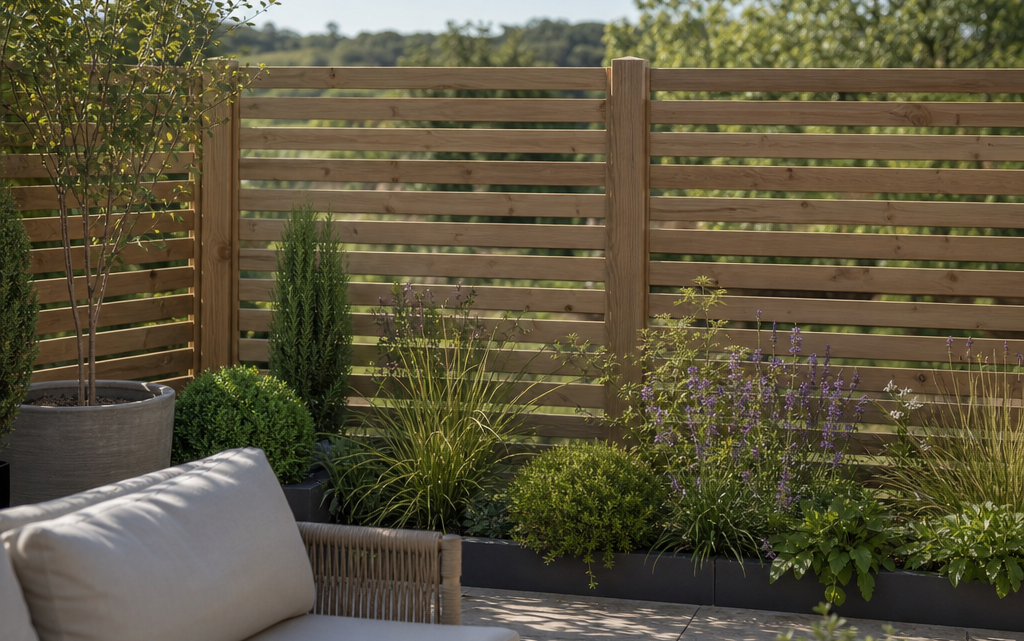
Many gardens need privacy without feeling boxed in. You may want to stop people seeing straight into a patio, kitchen window or hot tub area, but you may also rely on the same boundary for afternoon light, a view of planting, or a sense of space. Semi-open timber boundary panels can help you strike that balance. With solid boarding lower down and slatted or trellis sections higher up, they can screen where it matters while allowing light, air and glimpses of greenery through the top.
Inhaltsverzeichnis
Balancing Privacy and Light with Semi-Open Garden Fence Panels
A fully solid fence can be useful where you need maximum screening, but it can also make a small garden feel narrow and shaded. At the other extreme, open trellis may look attractive but offer too little privacy on its own. Semi-open timber panels sit between these options. They are particularly useful where you want to soften a boundary, filter views rather than block them completely, or create a more decorative backdrop to planting.
The key is to decide what you need to hide, what you want to keep, and how the boundary will perform throughout the day. A panel that works well at midday may feel too exposed in the evening when neighbours’ indoor lights are on. Likewise, a fence that gives privacy in summer may feel much more open in winter if you rely on deciduous climbers. Good design starts with observing the site before you choose the panel.
When Semi-Open Timber Panels Work Best
Semi-open panels are most effective where privacy is needed at sitting or standing height, but complete enclosure is not essential. They are often used along side boundaries, around patios, beside garden offices, behind outdoor dining areas, or to disguise bins, sheds and storage. They can also divide a long garden into zones without making each area feel cut off.
They are less suitable where you need a secure, opaque barrier from top to bottom, such as screening a very overlooked bathroom window at close range or enclosing a dog that reacts strongly to movement beyond the fence. In those cases, a more solid solution, possibly combined with planting, may be better.
Typical benefits
- Filtered privacy: the lower solid section blocks direct views while the open top reduces the sense of enclosure.
- Better daylight: slats or trellis allow some light through, which helps lawns, borders and seating areas feel brighter.
- Improved outlook: you can keep glimpses of sky, trees or planting rather than looking at a continuous wall of timber.
- Air movement: semi-open sections reduce the wind resistance compared with a fully solid panel, though posts and fixings must still be robust.
- Decorative value: horizontal boards, slatted toppers and trellis details can make a boundary look more considered.
Start by Mapping Views, Light and Use
Before buying panels, walk around the garden and look from both inside and outside the house. Sit where you normally sit. Stand at the kitchen sink. Look from upstairs windows. If possible, repeat this at different times of day. Privacy is not only about what someone can see from next door; it is about what you can see and feel when using the garden.
Mark the areas where you need screening. These are usually specific sightlines rather than the entire boundary. For example, a neighbour’s upstairs window may overlook one corner of a patio, but not the whole garden. A semi-open panel may be enough if you position it correctly, especially with planting in front.
Decision criteria to use on site
- Eye level: decide whether you need privacy when seated, standing, or both.
- Distance from the boundary: the closer your seating area is to the fence, the higher and denser the screening usually needs to be.
- Sun path: consider whether a solid fence would shade key planting beds, lawns or a breakfast terrace.
- Important views: protect views of mature trees, open sky, borrowed landscape or attractive planting.
- Neighbouring windows: assess whether views are from ground floor, first floor or raised decking.
- Wind exposure: in exposed gardens, avoid creating a rigid barrier without suitable posts and fixings.
Choosing the Right Balance of Solid and Open Sections
The most important design choice is how much of the panel should be solid. A common approach is to have a more private lower or central section with an open top. This works well because most intrusive views at garden level are direct horizontal views, while the top of the panel can admit light and soften the line of the boundary.
Horizontal boarding can make a garden feel wider and more contemporary. Vertical boarding often feels more traditional. Slatted toppers give a cleaner, modern look, while diamond or lattice trellis can suit cottage-style planting and climbing plants. The pattern affects the level of privacy: narrow gaps give more screening, while wider openings admit more light but reveal more movement beyond the fence.
Think in layers rather than one barrier
A semi-open panel rarely has to do all the work alone. The most successful schemes combine fencing with planting, furniture placement and changes in level. A shrub, pleached tree, raised planter or climber can interrupt a view without requiring a fully solid boundary. This layered approach often looks more natural and less defensive.
For example, if your patio is overlooked from the side, you might use a semi-open panel at the boundary, then add a large planter with evergreen shrubs in front. The fence gives structure and year-round definition; the planting softens the view and adds extra privacy where people actually sit.
Height, Planning and Neighbour Considerations
In many UK domestic gardens, fences and boundary treatments can usually be up to 2 metres high without planning permission, or up to 1 metre where they are next to a highway used by vehicles. However, rules can vary where properties are listed, in conservation areas, on open-plan estates, or where covenants apply. Always check your local planning authority guidance and your property documents before changing a boundary.
It is also sensible to speak to your neighbour before installing new panels, particularly if the style is changing or the fence is on a shared boundary. A semi-open top can be a diplomatic choice because it improves privacy without creating an oppressive wall. Agree who owns the boundary, who will maintain it, and which side will face which garden before work begins.
Using a Decorative Panel as a Practical Example
As a practical example of the type of product you might consider, the Forest 6′ x 6′ Kyoto Decorative Fence Panel is a 1.8m x 1.8m timber panel with horizontally mounted boards, a slatted top section, a rebated frame and mortise and tenon joints. It is pressure-treated, has a smooth-planed finish, uses PEFC-certified timber and is described as having a 15-year anti-rot guarantee. This kind of panel illustrates the design principle well: a more enclosed body for privacy, with an open upper detail to reduce visual weight and admit some light.
The important point is not to choose a panel because it looks attractive in isolation, but because its proportions, openness and construction suit your boundary. A 1.8m panel may be right for a side boundary beside a patio, but too tall for an internal garden divider, or not tall enough where you are overlooked from above. Always judge the panel against your actual sightlines.
Practical Steps for Planning Your Fence Layout
Once you have decided that semi-open panels are appropriate, plan the run carefully. A fence is a long-term feature, and small errors in alignment, height or post spacing become very visible once the panels are installed.
Step 1: Survey the boundary
Check whether the line is straight, sloping, uneven or obstructed by roots, old concrete, drains or level changes. Measure the total length and identify where full panels will fit. If the run does not divide neatly into standard panel widths, decide where a cut panel or bespoke infill will look least noticeable.
Step 2: Decide the finished height
Measure height from the finished ground level on your side, but remember that neighbouring ground levels may differ. If your neighbour’s garden is higher, a 1.8m fence may give less privacy than expected. If your garden is higher, your fence may feel more dominant from their side.
Step 3: Choose posts and gravel boards
Timber panels should be kept clear of damp soil where possible. Gravel boards can protect the bottom edge and make it easier to deal with uneven ground. Concrete posts are durable and easy to replace panels within, while timber posts give a warmer look but need careful installation and protection. The right choice depends on exposure, budget and the style of the garden.
Step 4: Set out before digging
Use string lines and marker pegs to confirm the alignment. Check gate positions, access for maintenance, and whether any posts would clash with existing paving, edging or planting. If a panel will screen a seating area, place a temporary screen or sheet at the proposed height to test the effect before committing.
Step 5: Plan planting at the same time
Do not treat planting as an afterthought. Decide where climbers, shrubs or trees will go before the fence is installed. This helps you leave enough bed depth, avoid damaging new posts later, and choose panels that suit the planting style.
Checklist: Before You Buy Semi-Open Panels
- Have you identified the exact sightlines you want to screen?
- Do you know whether privacy is needed when seated, standing, or both?
- Have you checked how sunlight moves across the boundary during the day?
- Will the panel height comply with local planning rules and any covenants?
- Have you spoken to your neighbour if the boundary is shared or prominent?
- Is the panel style consistent with your house, paving and planting?
- Are posts, fixings and gravel boards suitable for the site conditions?
- Will the lower edge be protected from constant ground moisture?
- Can you maintain both sides of the fence if treatment or cleaning is needed?
- Have you allowed for waste, cuts, corners, gates and changes in level?
Designing with Daylight in Mind
Daylight is often overlooked until after a fence has been installed. A solid boundary can cast shade over borders and reduce reflected light into rooms, especially in narrow gardens. Semi-open panels help, but they are not transparent. The amount of light retained depends on the orientation of the boundary, the gap pattern and the height of nearby buildings or trees.
North-facing boundaries are often less sensitive because they cast less shade into the garden. South-facing boundaries can be more significant because a tall fence may shade the neighbour’s side or parts of your own garden depending on layout. East-facing panels affect morning light, while west-facing panels affect afternoon and evening light, which is often when patios are used.
If you grow sun-loving plants along a boundary, avoid making it too enclosed. Use open trellis sections, lighter-toned finishes where appropriate, and planting that tolerates the resulting light levels. For shady boundaries, choose ferns, hellebores, hydrangeas, sarcococca, ivy or other shade-tolerant plants rather than fighting the conditions.
Protecting Outlook Without Sacrificing Privacy
Outlook matters because you experience the fence every day from inside and outside the house. A boundary that gives privacy but removes every sense of depth can make a garden feel smaller. Semi-open panels can preserve a connection with sky and foliage, particularly when the open section is at the top.
To improve outlook, avoid running one uninterrupted style along every boundary unless the garden is large enough to absorb it. You might use more private panels near the patio, then lighter trellis or planting further down the garden. This creates variety and prevents the space feeling like a corridor.
Colour also affects outlook. Dark stains can make planting stand out and may cause the fence to recede visually. Pale finishes reflect more light but can draw attention to the boundary. Natural timber tones sit comfortably in many gardens, though they will weather unless maintained or designed to age naturally.
Common Practical Mistakes to Avoid
Choosing maximum height without testing the feel
A high fence can solve one problem and create another. If you install the tallest option everywhere, you may lose light, airflow and a sense of openness. Test height with a temporary screen before you buy.
Ignoring level changes
On sloping ground, panels may need to step or follow the gradient. Stepped panels can leave triangular gaps at the base unless gravel boards or infill pieces are planned. A neat set-out is essential for a professional result.
Relying on trellis for instant privacy
Trellis and slatted tops filter views; they do not block them completely. If you need immediate screening, combine them with denser lower panels, evergreen planting or carefully positioned screens.
Planting climbers too close to the posts
Climbers can add privacy and soften timber, but vigorous plants may trap moisture, strain trellis or make maintenance difficult. Leave space for air movement and choose plants with a suitable mature size.
Forgetting maintenance access
Even pressure-treated timber benefits from periodic inspection and cleaning. If the fence is hard against dense planting or a shed, you may not notice damage, rot risks or loose fixings until problems become more serious.
Mixing too many panel styles
Variety can be useful, but too many different patterns can look untidy. If you need different levels of privacy, keep one consistent material or colour so the design still feels coherent.
Maintenance and Longevity
Timber is a natural material and will respond to weather. Pressure treatment helps protect against rot, but installation details still matter. Keep panels out of direct soil contact, clear debris from the base, and avoid allowing sprinklers or overflowing gutters to wet the same area repeatedly.
Inspect the fence after storms and at the start of spring. Look for loose fixings, leaning posts, damaged slats, trapped vegetation and areas where water sits. If you apply a decorative stain or preservative, follow the manufacturer’s guidance and make sure the timber is clean and dry before treatment.
Good maintenance is not only about lifespan. A clean, upright, well-supported semi-open fence looks intentional and enhances the garden. A neglected one can quickly make the whole space feel tired.
Short FAQ
Do semi-open fence panels give enough privacy?
They can give good privacy where direct views are mainly at lower or middle height. The open section will still allow some visibility, so they are best used where you want filtered screening rather than a completely opaque barrier.
Are slatted or trellis-topped panels better for light?
Both can admit more light than a fully solid panel. The result depends on the size, angle and spacing of the openings. Wider gaps generally allow more light and air, but also reduce privacy.
Can I grow climbers on semi-open panels?
Often, yes, especially where there is a trellis or slatted section, but check that the panel is suitable for the weight of the chosen plant. Avoid overly vigorous climbers unless the structure is strong enough and you can prune regularly.
Do I need planning permission for a 1.8m garden fence?
In many UK gardens, a 1.8m fence is within the usual permitted height, but there are exceptions. Check local rules, especially near highways, in conservation areas, at listed properties or where estate covenants apply.
Which side of the panel should face my neighbour?
There is no universal rule unless your deeds, agreement or local conditions specify it. Discuss it with your neighbour before installation. Many people choose to face the more finished side outward, but consistency and agreement matter most.
Conclusion
Semi-open timber boundary panels are a practical way to balance privacy, daylight and outlook. They work best when you design around real sightlines rather than simply enclosing the whole garden. Consider where you sit, where light comes from, what you want to screen, and what views you want to keep.
Choose panel height, openness, posts and planting as one combined system. Check planning constraints, discuss shared boundaries, and avoid common mistakes such as over-screening, ignoring slopes or relying on trellis for complete privacy. With careful planning, semi-open panels can make a garden feel more private without making it feel smaller, darker or disconnected from its surroundings.