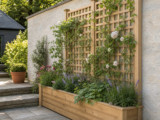
Arranging Geometric Timber Planters in Patio and Garden Spaces

You have a paved patio, a courtyard, a roof terrace or a hard-landscaped corner of the garden, and it feels useful but rather flat. There may be good paving, a seating area and perhaps a path to the back gate, yet the space lacks softness, height and seasonal interest. Grouped timber planters are one of the most practical ways to change that without lifting slabs, building new beds or committing to permanent structural work.
Geometric timber planters are especially useful in hard-landscaped spaces because their clean shapes work well against paving, walls, fences and contemporary garden furniture. When arranged thoughtfully, they can define zones, frame views, soften edges and create planting depth where there is no open soil. The key is to treat them as part of the garden design, not simply as containers placed wherever there is a gap.
Inhaltsverzeichnis
Why grouped timber planters work well on patios and paved gardens
Hard landscaping often brings order and durability, but it can also make a garden feel stark. Timber planters introduce a warmer material and allow you to add planting in a controlled, movable way. This is particularly helpful if you are renting, redesigning in stages, or dealing with awkward surfaces such as concrete, old paving or compacted sub-base.
Using planters in groups is usually more effective than scattering individual containers around the space. A group has visual weight, feels intentional and can be read as a small planting bed. It also gives you more flexibility with planting combinations: you can place structural evergreens in one planter, seasonal colour in another and trailing plants in a third, while still creating one coherent display.
Start with the job you want the planters to do
Before choosing a position, decide what problem the planters are solving. This will guide the shape, layout, spacing and planting style.
Common uses for grouped planters
- Softening paving: Place planters where large areas of stone, concrete or porcelain feel visually hard.
- Defining a seating area: Use a group to mark the edge of a dining or lounge space without building a wall.
- Creating privacy: Position taller planting where you want to screen neighbours, bins or a car parking area.
- Adding a focal point: Arrange geometric planters at the end of a path, beside steps or in front of a blank wall.
- Improving circulation: Use containers to subtly guide movement and stop people cutting across planted or gravel areas.
- Bringing planting closer to the house: Place pots where they can be seen from kitchen, dining or living room windows.
Once you know the purpose, the layout becomes much easier. A group intended to screen a boundary will be arranged differently from one designed to decorate a corner beside a bistro table.
Choosing positions in a hard-landscaped space
Planters are movable, but they are still heavy once filled with compost, plants and water. Spend time testing positions before planting them fully. Use empty planters, cardboard templates or even garden chairs to mark out the likely footprint.
Check access and movement
A patio needs to remain practical. Leave enough space for doors to open, chairs to be pulled out, children to move safely and wheelbarrows or bins to pass through if needed. As a guide, keep main routes clear and avoid placing planters where they create a narrow pinch point between furniture and a wall.
In smaller spaces, it is often better to group planters tightly in one or two deliberate areas rather than placing one on every spare slab. This keeps the garden usable and prevents it feeling cluttered.
Consider sightlines from indoors
Hard-landscaped gardens are often viewed from inside the house as much as they are used outside. Look out from the rooms you use most and decide where planting would improve the view. A grouped arrangement in the right place can turn a plain fence or empty corner into a composed scene.
Account for sun, shade and wind
Patios next to walls can be warmer and drier than open areas, while north-facing courtyards may stay cool and damp. Wind can also be stronger around corners and between buildings. Choose the planter position first, then choose plants that suit that microclimate. Do not rely on watering alone to compensate for a plant being in the wrong conditions.
Arranging geometric timber planters effectively
Geometric planters, including hexagonal, square and rectangular styles, can be arranged in several ways. The right approach depends on whether you want a formal, relaxed or contemporary effect.
Use odd numbers for a natural grouping
Groups of three often look balanced without appearing too rigid. A trio allows you to create variation in planting height and texture while keeping the arrangement simple. Place one planter slightly forward and two behind, or arrange them in a loose triangle. This works well in corners, beside steps and near seating areas.
Align with paving joints for a formal look
If your patio has strong grid lines, such as large-format paving or setts, align the planters with the paving joints. This gives a neat, architectural result. It is especially effective with square or rectangular planters, but hexagonal planters can also look striking when their sides relate neatly to the surrounding paving.
Stagger planters for a softer effect
A staggered arrangement breaks up straight lines and feels more relaxed. This is useful where you want to soften a hard boundary or make a courtyard feel more planted. Avoid making the spacing too random; the planters should still look connected. Repeating one plant, colour or material across the group will help tie them together.
Create a mini island bed
On a larger patio, grouped timber planters can form an island of planting away from the edges. This works particularly well if the patio feels like one large, empty surface. Keep the group away from busy walking routes and make sure it can be viewed from more than one side.
Decision checklist before you place your planters
- What is the main purpose: screening, softening, zoning, colour or a focal point?
- Can doors, gates, chairs and access routes still work comfortably?
- Will the planters be visible from inside the house?
- Does the chosen spot suit the plants you want to grow?
- Is the surface level and stable enough for filled planters?
- Can excess water drain away without staining paving or pooling by walls?
- Will the arrangement look intentional from several viewing angles?
- Is there space to reach the planters for watering, pruning and seasonal changes?
Using a set of planters as a practical starting point
A matching set can make arrangement easier because the planters automatically relate to one another. For example, a set of three hexagonal timber planters gives you a ready-made grouping for a patio corner, the edge of a seating space or a small paved garden. The geometric shape creates interest, while the repeated material keeps the display visually calm.
As a practical example, the Forest York Hexagonal Wooden Garden Planter 3’x1’8 (0.9×0.5m) – Set of 3 is a set of three wooden planters with a hexagonal design. The planters are described as pressure treated, raised off the ground, stackable and supplied with no assembly required. They are also made from PEFC certified timber and carry a 15-year manufacturer’s guarantee against rot and fungal decay. Details like these are useful to consider when comparing planter sets for exposed patios, although the overall layout and planting choices will have the greatest effect on the finished garden.
Planting design for grouped timber planters
The arrangement of the planters is only half the design. The planting itself should reinforce the effect you want. In hard-landscaped spaces, planting needs to work harder because there may be fewer surrounding beds to provide context.
Use the thriller, filler and spiller approach
A simple method is to combine three planting roles:
- Thrillers: Upright or architectural plants that provide height, such as compact grasses, small shrubs or clipped evergreens.
- Fillers: Mounding plants that add body, such as hardy geraniums, heucheras, salvias or seasonal bedding.
- Spillers: Trailing plants that soften the planter edges, such as ivy, creeping thyme, trailing violas or bacopa.
You do not need all three roles in every planter, but across a group they help create a layered composition. In a set of three, one planter might hold the tallest feature plant, while the other two provide texture, flowers or trailing foliage.
Repeat plants for cohesion
Repetition is especially important with grouped containers. If every planter contains a completely different mix, the result can feel busy. Repeat at least one element across the group: a grass, a foliage colour, a flower shade or a trailing plant. This makes the planters read as one designed feature.
Choose plants for year-round structure
Patios are often seen throughout the year, so avoid relying only on summer bedding. Include some evergreen structure or plants with winter interest. Small shrubs, evergreen herbs, compact grasses and hardy perennials can provide a framework, with seasonal additions changed as needed.
Drainage and surface protection
Drainage is one of the most important practical issues when placing planters on paving. Plants dislike waterlogged compost, while paving can be marked by standing water, compost run-off or tannins from organic matter.
Check that containers can drain freely and that water will not collect against a house wall, under a door threshold or in a low point on the patio. If necessary, use suitable pot feet or risers to encourage airflow beneath containers and allow water to escape. Avoid blocking drainage holes with plastic sheeting unless you have allowed for proper water movement.
On pale or porous paving, be particularly careful. Compost and fertiliser can stain some surfaces. Consider using saucers only where appropriate, as they can prevent staining but may also hold too much water in wet weather. The best solution depends on the paving type, exposure and the plants you are growing.
Scale, proportion and spacing
A common mistake is choosing planters that are too small for the area. Tiny containers dotted around a large patio can look temporary and fussy. Larger or grouped planters usually feel more confident and are easier to integrate with furniture and architecture.
When judging scale, compare the planters with nearby features: a dining table, bench, low wall, steps or door. The group should feel substantial enough to belong in the space, but not so large that it dominates movement. If your patio is compact, choose one strong group rather than several competing clusters.
Spacing between planters also matters. If the containers are too far apart, they stop reading as a group. If they are too tightly packed, maintenance becomes awkward and airflow may be poor around dense planting. Aim for enough separation to see each shape, while keeping the group close enough to feel intentional.
Common mistakes to avoid
Placing planters after the furniture
If you only add planters once all the furniture is in place, they may end up squeezed into leftover corners. Instead, plan the seating, routes and planting together. A well-placed planter group can improve the furniture layout by creating enclosure and shelter.
Ignoring maintenance access
Planters need watering, feeding, deadheading, pruning and occasional replanting. Do not put them where you cannot reach the back of the group. Leave enough room to work comfortably, especially if the planters sit against a fence or wall.
Using too many unrelated styles
A patio can quickly look untidy if it contains several different planter materials, shapes and colours. Timber combines well with many garden styles, but try to keep a limited palette. If you mix shapes, repeat the timber finish or planting style to keep the design coherent.
Forgetting the mature size of plants
Plants that look modest at planting time may soon overwhelm a container or block a path. Check mature height and spread before planting. In grouped planters, allow each plant enough space to develop without smothering its neighbours.
Letting the group become visually flat
If every planter contains plants of the same height, the display can look static. Vary the height using upright plants, mounding plants and trailing edges. Even subtle variation will make the group feel more natural and engaging.
Practical arrangement ideas
For a small courtyard
Place three planters in a corner, with the tallest planting at the back and softer trailing plants at the front. Keep the rest of the floor clear to maximise usable space. A restrained planting palette, such as evergreen foliage with one seasonal accent colour, will stop the courtyard feeling crowded.
For a dining patio
Use a planter group to define one side of the dining area. Avoid placing scented or bee-attracting flowers immediately beside plates if that may be inconvenient in summer. Instead, use foliage, grasses or herbs slightly away from the table edge.
For a long, narrow paved garden
Stagger groups along one side to slow the eye and reduce the tunnel effect. Keep the opposite side clearer for access. Repeating the same planter shape or planting theme will make the layout feel deliberate rather than cramped.
For a contemporary terrace
Use geometric planters in a controlled arrangement, aligned with paving or architectural lines. Choose a limited range of plants with strong form, such as clipped shrubs, ornamental grasses or foliage-led perennials. The result should be simple, structured and calm.
Seasonal care and adjustment
One advantage of grouped planters is that they can evolve. In spring, you might add bulbs and early perennials. In summer, you can introduce long-flowering annuals or Mediterranean-style herbs in sunny positions. In autumn, grasses, heucheras and late-flowering perennials can extend interest, while winter displays may rely on evergreens, stems and structure.
Review the arrangement at least twice a year. Move empty or lightweight planters before replanting if the layout is not working. Once filled, make changes carefully and safely, as timber planters can become very heavy. If a position is too exposed, too shady or inconvenient for watering, it is better to adjust the design than to struggle with poor plant performance.
FAQ
How many planters should I group together?
Three is a useful starting point because it creates balance without looking too formal. Larger patios may suit groups of five or more, but keep the arrangement coherent by repeating the same material, shape or planting theme.
Should planters match exactly?
They do not have to, but matching planters are easier to arrange successfully. If you mix different shapes, keep another element consistent, such as timber finish, plant palette or overall height.
Can timber planters sit directly on paving?
They can often be used on paved areas, but you should consider drainage, airflow and surface staining. Raised designs or suitable supports can help reduce damp contact and allow water to move away.
What plants are best for patio planters?
Choose plants that suit the light and exposure of the position. For year-round value, combine structural evergreens or grasses with seasonal flowers, herbs or trailing plants. Avoid plants that will quickly outgrow the container.
How do I stop grouped planters looking cluttered?
Limit the number of materials, repeat plants across the group and leave enough clear paving around the arrangement. A strong cluster in one place usually looks better than many small pots spread thinly around the patio.
Conclusion
Grouped timber planters can transform a hard-landscaped garden by adding warmth, structure and planting where traditional beds are not possible. The most successful arrangements start with a clear purpose, respect access and drainage, and use repetition to create a unified design.
Whether you are working with a small courtyard, a family patio or a contemporary terrace, treat geometric planters as design elements rather than afterthoughts. Position them carefully, plant them with structure and seasonal interest, and review the layout as the garden develops. With a considered approach, a simple group of timber planters can make a paved space feel greener, more comfortable and much more complete.