What Tongue-and-Groove Construction Means for a Compact Timber Tool Store
You are comparing compact timber tool stores because the lawn edging shears, fork, rake and cordless strimmer no longer fit neatly in the garage or back porch. A slim timber store looks like the right answer: it can sit against a fence, beside a path or on a patio edge without taking over the garden. Then you notice the phrase “tongue-and-groove construction” in the specification and wonder whether it is genuinely important or simply a sales term.
For a compact tool store, tongue-and-groove construction can make a real difference to strength, weather resistance and day-to-day usability. However, it is not the only factor that matters. You also need to consider board thickness, framing, roof covering, floor construction, treatment, base preparation and how the door is secured. This guide explains what tongue-and-groove means in practical terms, how to assess it when buying, and what mistakes to avoid before you commit to a small timber storage building.
Inhaltsverzeichnis
What tongue-and-groove construction actually means
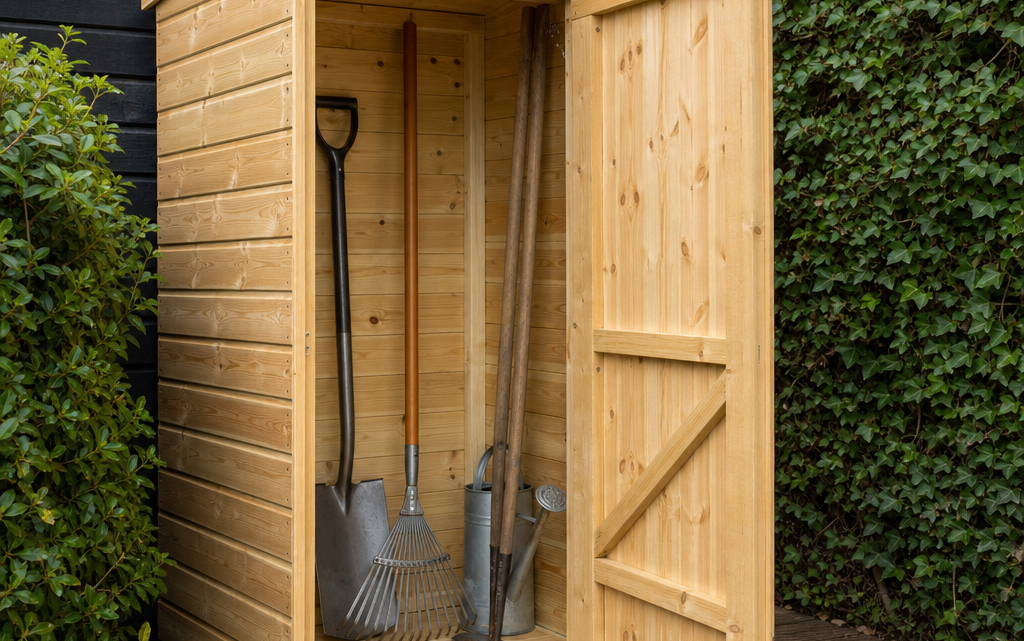
Tongue-and-groove boards are machined so that one long edge has a projecting “tongue” and the other has a matching recessed “groove”. When the boards are fitted together, the tongue of one board slots into the groove of the next. This creates an interlocking surface rather than a simple overlap or butt joint.
In a timber tool store, tongue-and-groove may be used for the wall cladding, the floor, the roof boards, or all three. The specification should state clearly where it is used. A store with tongue-and-groove cladding only is not the same as one with tongue-and-groove walls, floor and roof.
Why it matters in a compact tool store
Small tool stores are often narrow and may be placed in exposed positions, such as along a fence line or beside a driveway. Because they have less internal volume and fewer structural elements than larger sheds, the quality of the panels, frame and fixings becomes especially important. Tongue-and-groove boards help by spreading loads across adjacent boards and reducing the number of open gaps through which rain or draughts can enter.
For tools, this matters because damp is one of the biggest causes of deterioration. Spades, forks, secateurs, saws and power-tool accessories can all suffer from rust, swollen handles, mouldy fabric cases or damaged packaging if the store allows too much moisture inside.
Tongue-and-groove versus overlap cladding
Overlap cladding is made from boards that lie over one another like scales. It is often cheaper and can be perfectly adequate for light-duty storage, but it is usually less rigid and less precise than tongue-and-groove. In strong wind or driving rain, overlap boards may move slightly, and the gaps between boards can be more noticeable.
Tongue-and-groove cladding usually gives a neater, flatter appearance. It is also generally better suited to a premium compact tool store where you want a more finished look close to the house or patio. That said, the quality depends on the thickness of the boards, the machining, the supporting frame and how well the building is assembled.
Do not judge by the term alone
“Tongue-and-groove” is useful information, but it is not a complete buying decision. A thin tongue-and-groove board fixed to a weak frame may not perform as well as a better-specified structure. Always check the full construction details, not just the headline phrase.
Key decision criteria before you buy
When assessing tongue-and-groove construction in a compact timber tool store, use the following criteria to make a practical comparison.
1. Board thickness
Board thickness affects rigidity, impact resistance and how solid the store feels. For example, a specification that refers to 12mm tongue-and-groove cladding gives you a clearer basis for comparison than a listing that simply says “timber cladding”. Some manufacturers also state that measurements are nominal, meaning the quoted size may be before machining. This can lead to small variations in the finished board thickness.
Do not assume that all tongue-and-groove boards are the same. If one model has thicker cladding than another, it may feel stronger and may be less prone to flexing, provided the frame is also adequate.
2. Frame size and construction
The frame is the skeleton of the store. Tongue-and-groove cladding fixed to a robust frame will usually perform better than the same cladding attached to a light frame. Look for stated framing dimensions and consider whether they sound proportionate for the size of the building.
For a narrow tool store, the frame also helps keep the long walls straight. This matters if the door is fitted on one side, if the building sits in a breezy position, or if you will be moving long-handled tools in and out frequently.
3. Floor construction
A compact tool store is often used for heavy, narrow items: bags of compost, garden chemicals in boxes, toolboxes, pressure-washer accessories, metal rakes and possibly a small mower. The floor therefore matters just as much as the walls.
A tongue-and-groove timber floor is usually preferable to a very thin sheet material floor if you are storing heavier items. However, the floor still needs proper support and a sound base beneath it. Even good boards can warp or rot if the store sits directly on wet ground.
4. Roof boards and roof covering
Rain protection depends on both the roof boards and the outer covering. Tongue-and-groove roof boards can add rigidity and give the roof a more solid feel, but they still require a waterproof covering such as roofing felt, supplied and fitted correctly.
Check whether the roof covering is included, how it is fixed and whether it will need periodic inspection. Felt can be damaged by overhanging branches, poor installation or weathering over time.
5. Treatment and maintenance requirements
Timber tool stores are not maintenance-free. Dip-treated timber normally requires prompt re-treatment after assembly and then regular re-treatment thereafter, according to the supplier’s guidance. Pressure-treated timber can offer improved resistance to rot, but it may still need waterproofing or maintenance to preserve performance and appearance.
When comparing prices, include the cost of preservative, waterproofing treatment, brushes, rollers and your own time. A cheaper store may not be cheaper over several years if it needs more frequent care.
How to inspect the specification properly
Before choosing a compact timber tool store, read the specification as if you were checking a building component, not just a garden accessory. A useful listing should tell you the cladding type, cladding thickness, frame size, floor material, roof material, roof covering, external dimensions, treatment type, door style and locking arrangement.
If any of these details are missing, ask the retailer before buying. Lack of information does not always mean poor quality, but it does make comparison harder.
A practical example of a specification
As a practical example, you may see a slimline timber tool store described with 12mm tongue-and-groove cladding, a 38mm x 50mm frame, a 12mm tongue-and-groove floor and a 12mm tongue-and-groove roof with a felt covering. That combination tells you that the interlocking board construction is not limited to the walls; it is also used in the floor and roof. If the same specification also gives the overall dimensions, door details, treatment requirements and guarantee period, you have a much clearer basis for judging suitability.
Remember, though, that one example is not a universal benchmark. You should use these details to understand what to look for, then compare them with your own site conditions, storage needs and budget.
Checklist: assessing a compact tongue-and-groove tool store
Use this checklist before you order. It will help you avoid being swayed by appearance alone.
- Confirm where tongue-and-groove is used: walls only, or walls, floor and roof?
- Check board thickness: look for a stated measurement and note whether it is nominal.
- Check frame dimensions: a stronger frame supports the boards and helps the store keep its shape.
- Assess the roof covering: confirm whether felt or another waterproof layer is included.
- Review the floor: consider whether it is suitable for heavy tools and garden equipment.
- Plan the base: choose a level, well-drained, firm base before installation.
- Check treatment requirements: note whether the timber is dip-treated or pressure-treated and what maintenance is required.
- Measure the site carefully: allow space for the door to open and for maintenance access around the store.
- Consider security: check the lock, hinges, door frame and whether the contents are visible from outside.
- Think about ventilation: avoid trapping damp air inside with wet tools and sealed storage boxes.
Practical steps before installation
Step 1: Measure the tools, not just the garden
A compact tool store must fit both the site and the contents. Measure the length of your longest tools, including rakes, brooms, hoes and extendable loppers. If you plan to store a mower, pressure washer or garden vacuum, measure its width and height as stored, not just its working size.
Also think about access. A store may have enough internal length, but if the door is too awkwardly positioned, you may struggle to manoeuvre items in and out.
Step 2: Choose a suitable base
Tongue-and-groove construction cannot compensate for a poor base. If the building is twisted, leaning or sitting in water, the boards and door can become stressed. Doors may catch, joints may open and the lower timbers may deteriorate faster.
A good base should be level, firm and free-draining. Options may include paving slabs, a concrete pad, a suitable timber frame on supports, or a proprietary shed base system, depending on the site and manufacturer’s instructions. The key point is that the store must be supported evenly and kept away from prolonged ground moisture.
Step 3: Plan water run-off
Look at where roof water will go. A compact store placed tight against a wall or fence can create a damp strip if rainwater has nowhere to drain. Avoid positioning the store where water from a house roof, garage, gutter overflow or neighbouring structure will pour onto it.
If the roof has a pent design, confirm which way the slope runs and ensure it sheds water away from vulnerable areas where possible.
Step 4: Treat and seal at the right time
If the supplier instructs you to re-treat the timber within a set period after assembly, do not delay. Pay particular attention to end grain, lower edges, door edges and any cut or drilled areas. These points absorb moisture more readily than flat board faces.
Use a treatment compatible with the original timber treatment and follow the instructions for dry weather, drying times and number of coats.
Common practical mistakes to avoid
Assuming tongue-and-groove means waterproof
Tongue-and-groove boards help reduce gaps, but they do not make a timber store waterproof in the way a sealed plastic container is waterproof. Rain protection depends on the roof covering, correct assembly, good treatment, sound joints and ongoing maintenance.
Ignoring the base
Many problems blamed on timber quality are actually caused by poor siting. If the base is uneven, the frame can twist. If the store sits in standing water, rot risk increases. Prepare the base before the delivery date, not after the panels arrive.
Not allowing maintenance access
A slim store is often pushed tightly into a gap. This may save space, but it can make it difficult to apply treatment, inspect the roof felt or clear leaves from behind the building. Leave enough room to work safely around the store, especially on the sides most exposed to rain.
Overloading the walls
Tongue-and-groove cladding adds rigidity, but the cladding is not designed to carry unlimited weight. If you want to hang heavy tools, shelves or brackets, fix into suitable framing where possible and follow the manufacturer’s guidance. Avoid concentrating heavy loads on a small section of wall board.
Forgetting ventilation and dry storage habits
Putting wet tools, damp gloves and open bags of compost into a small timber store increases humidity. Even a well-built store can become damp inside if moisture is constantly introduced and never allowed to escape. Wipe tools down, avoid storing wet fabric items, and consider simple airflow measures where appropriate.
Security considerations for small tool stores
A compact tool store can contain surprisingly valuable items: cordless tools, batteries, hedge trimmers, secateurs, saws and specialist gardening equipment. Construction quality is only one part of security. Look at the door, hinges, lock and the store’s location.
A key-operated lock is useful, but also consider whether the door frame feels solid and whether hinges or fixings are exposed. Position the store where it is not hidden from view if possible, while still being convenient for everyday use. Avoid leaving expensive tools visible through windows if the store has any glazing.
For higher-value contents, you may also want to use internal anchors, lockable tool chests or additional security measures, provided they are compatible with the building and do not damage the structure.
Appearance and finish
Tongue-and-groove tool stores often have a cleaner, more refined appearance than basic overlap models. A smooth-planed finish can look particularly neat near a patio, pathway or house wall. However, appearance should be balanced with maintenance. A smart timber finish will only stay attractive if it is cleaned, treated and inspected regularly.
Choose a treatment colour that suits the garden and check whether it offers weather protection as well as colour. Decorative stains vary, so read the tin carefully rather than assuming all products perform the same function.
Short FAQ
Is tongue-and-groove always worth paying extra for?
It is often worth considering if you want a more rigid, neater and better-sealed compact timber tool store. However, value depends on the full specification, including board thickness, frame, roof, floor and treatment. Do not pay extra for the phrase alone without checking the details.
Does a tongue-and-groove shed still need treatment?
Yes. Tongue-and-groove construction does not remove the need for timber treatment. Follow the supplier’s instructions for initial treatment, re-treatment and waterproofing. This is especially important for dip-treated timber and for exposed garden positions.
Can I place a compact timber tool store directly on soil?
You should not normally place it directly on soil. Soil holds moisture and can cause the lower timbers to deteriorate more quickly. Use a level, stable, free-draining base that supports the structure evenly.
What is more important: wall thickness or frame size?
Both matter. Thicker boards can improve rigidity and durability, but they need a suitable frame to support them. A strong frame with poor cladding, or good cladding on a weak frame, is not ideal. Assess the construction as a complete system.
Will tongue-and-groove stop condensation?
No. Condensation is caused by moisture in the air and temperature changes. Tongue-and-groove construction can reduce draughts and gaps, but you still need sensible storage habits, ventilation and dry contents to reduce internal moisture.
Conclusion
Tongue-and-groove construction is a meaningful feature in a compact timber tool store, especially when it is used in the walls, floor and roof and supported by a robust frame. It can improve strength, appearance and weather resistance compared with more basic construction methods. However, it should never be assessed in isolation.
Before buying, check the board thickness, frame dimensions, roof covering, floor specification, treatment requirements, door security and base needs. Prepare the site properly, allow for maintenance access and follow the timber treatment instructions from the start. If you make your decision on the complete specification rather than the headline wording, you are far more likely to choose a compact tool store that keeps your garden equipment organised, accessible and better protected for everyday use.