Ventilation and Shade Planning for Compact Aluminium Greenhouses
A compact aluminium greenhouse can change from pleasantly warm to uncomfortably hot in less than an hour on a bright spring or summer day. You may set out healthy tomato plants in the morning, only to return at lunchtime to find wilted leaves, dry compost and condensation trapped in the corners. The smaller the greenhouse, the faster this happens, because there is less internal air volume to buffer sudden temperature changes.
Good ventilation, shading and heat control are therefore not optional extras; they are part of successful greenhouse growing. This guide explains how to plan them for compact aluminium greenhouses, with practical decisions you can apply before buying, while installing, or when improving a greenhouse you already use.
Inhaltsverzeichnis
Why compact aluminium greenhouses need careful climate control
Aluminium greenhouses are popular because they are durable, low maintenance and relatively slim-framed, allowing good light transmission. However, aluminium conducts heat readily, and compact structures have limited internal air space. That means temperatures can rise quickly in sunshine and fall quickly after sunset.
In the UK, the challenge is not simply “keeping the greenhouse warm”. For much of the growing season, your main tasks are to remove excess heat, prevent stagnant humid air and reduce direct sun when plants are under stress. In winter and early spring, the balance changes: you still need air movement, but you must avoid chilling seedlings or encouraging draughts.
Start with the site and orientation
Ventilation and shading are much easier to manage if the greenhouse is correctly positioned. Before you think about vents, blinds or automatic openers, look carefully at the site.
Choose a position with airflow, not exposure
A greenhouse should not be squeezed tightly between fences, walls or dense shrubs. You need air movement around the structure so warm air can escape and fresh air can enter. At the same time, avoid very exposed positions where strong winds will rattle glazing, force vents open or make doors difficult to manage.
A sheltered but open part of the garden is usually best. If you have no choice but to use a windy site, make sure the frame is firmly fixed to a suitable base and consider windbreak planting at a sensible distance, rather than placing the greenhouse immediately behind a solid barrier.
Think about sun throughout the day
For many UK gardens, a greenhouse receiving morning and early afternoon sun is easier to manage than one that bakes in uninterrupted late afternoon sun. South-facing sites maximise light, but they also increase the need for summer shading and regular ventilation. East or west-facing aspects may be perfectly workable for general growing, especially in small spaces.
Avoid placing the greenhouse under trees. Overhanging branches cause dripping, shade at the wrong times, falling leaves in gutters and potential damage during storms. Dappled shade may seem useful in summer, but it is unreliable and often creates maintenance problems.
Understand how greenhouse ventilation works
Effective ventilation is about controlled air exchange. Warm air rises and should leave through high vents, while cooler air enters lower down through a door, side vent or louvre. This creates a natural flow without relying on fans.
Roof vents remove rising hot air
Roof vents are especially important because the hottest air collects near the ridge. In a compact greenhouse, even one or two roof vents can make a noticeable difference, provided they are opened early enough. Waiting until the greenhouse is already hot means your plants have already been stressed.
As a practical rule, open roof vents on bright mild mornings before the interior temperature climbs sharply. In changeable weather, open them partially rather than fully. Automatic vent openers are useful because they respond to temperature even when you are away from home.
Low-level ventilation completes the airflow
Roof ventilation works best when cooler replacement air can enter from below. A sliding door left slightly open can help, but it is not always ideal because it may admit pests, pets or strong draughts. A louvre window or low-level side vent is often a better controlled option, especially in warm weather.
For compact greenhouses, a combination of roof vents and at least one low-level opening is usually more effective than relying on the door alone. This matters particularly for tomatoes, cucumbers, chillies and young seedlings, which suffer when humidity and heat build up together.
Decision criteria for choosing ventilation options
When planning ventilation, do not simply count the number of vents. Consider how you will use the greenhouse and how often you can attend to it.
Ask yourself these questions
- Will you be at home during the day? If not, automatic roof vent openers are highly practical.
- Will you grow heat-sensitive seedlings? You need reliable shading and gentle airflow, not just emergency door opening.
- Will you grow tomatoes or cucumbers? You need warm conditions but must avoid excessive humidity and still air.
- Is the greenhouse in full sun? Plan for summer shading before the first heatwave.
- Is the site windy? Vent openings must be secure and adjustable to avoid damage.
- Do you use staging heavily? Dense staging and pots can block air movement unless arranged carefully.
Using a compact 6 x 10 aluminium greenhouse as an example
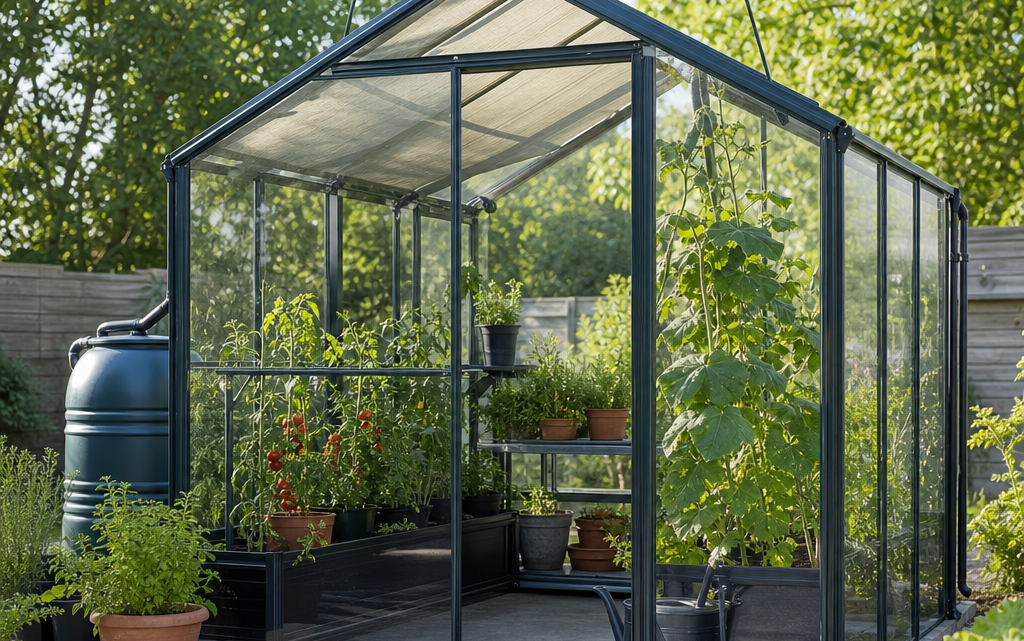
To put the principles into context, consider a compact aluminium greenhouse of around 1.93m wide by 3.19m deep, with a base area of about 6.2m², eaves height of 1.22m and ridge height of 1.96m. This is a practical size for a small garden and large enough for tomatoes, seed trays and a potting area, but it still warms quickly because the internal volume is modest.
In this kind of greenhouse, two roof vents provide an important starting point for heat release. If you regularly leave the greenhouse unattended during warm days, automatic openers can make management easier. A low-level louvre can also improve cross-flow by allowing cooler air to enter while warm air exits above. The door can provide extra ventilation in hot weather, but it should not be the only planned air inlet.
The example also shows why glazing choice affects heat control. Standard horticultural glass gives high light levels, while twinwall polycarbonate can provide insulation and a more diffused light effect. Toughened safety glass may be preferred where safety and durability are priorities. The right choice depends on your garden, the users of the space and the crops you intend to grow.
Plan shading before plants start to suffer
Shading is not a sign that your greenhouse is in the wrong place. It is a normal part of summer management. The aim is to reduce harsh, direct sunlight and lower leaf temperature, not to make the greenhouse dark.
External shading is usually most effective
External shade prevents some solar heat from entering the greenhouse in the first place. Shade netting fixed over the roof and sunny side is a common solution. It can be added seasonally and removed when light levels fall in autumn.
External shading must be fitted securely. Loose netting can flap in the wind, damage vents or catch on glazing clips. Allow roof vents to open freely and avoid tying shade material in a way that prevents ventilation.
Internal shading is convenient but less cooling
Internal blinds, fleece or shading fabric are easier to adjust and less exposed to weather, but they allow heat to pass through the glazing first. They reduce light intensity around the plants, but they do not cool the structure as effectively as external shading.
Internal shading can still be useful where external fixing is impractical, or where you only need partial shade for seedlings, leafy crops or newly potted plants. Keep materials clear of heaters, and do not allow them to trap damp air against the glazing.
Shade paint can work, but it is less flexible
Greenhouse shading paint or wash can reduce glare and heat over summer. It is useful for exposed sites, but it is less adjustable than netting or blinds. If applied too heavily, it can reduce light more than intended, particularly during dull spells. Choose a product designed for greenhouse use and follow the instructions for application and removal.
Practical temperature targets
You do not need laboratory precision, but a maximum-minimum thermometer is one of the most useful greenhouse tools you can buy. Place it at plant height, out of direct sun, rather than high in the roof where readings may be misleading.
As a general guide, many greenhouse crops grow well in the range of about 18°C to 24°C during the day. Temperatures above 27°C to 30°C can start to cause stress, especially if roots are dry or humidity is high. Seedlings can scorch or collapse quickly in direct sun. Night temperatures depend on the crop: tender plants usually need protection from cold, while hardy seedlings tolerate lower temperatures.
Use your thermometer to learn how your greenhouse behaves. After a few weeks, you will know whether it overheats by mid-morning, cools sharply at dusk or stays humid overnight.
Heat control through watering and layout
Ventilation and shading are the main tools, but your internal layout also affects temperature and plant stress.
Water early and consistently
Dry compost heats up quickly and plants with dry roots cannot cool themselves through transpiration. Water early in the morning so plants enter the warmest part of the day well hydrated. Avoid routinely soaking the floor late in the evening, as this can raise overnight humidity and encourage disease.
During heatwaves, check pots more than once a day. Small pots on upper staging dry especially fast. If you use grow bags, remember that they can heat up and dry out more quickly than open soil borders.
Use staging without blocking airflow
Staging makes compact greenhouses much more useful, but it can obstruct air movement if packed too tightly. Slatted staging helps air circulate around trays and pots. Leave gaps between plants and avoid creating a solid wall of foliage along the sides.
Tall crops such as tomatoes should be tied and pruned so that air can move around them. Remove lower leaves when appropriate, especially once plants are established, to improve airflow and reduce humidity near the compost surface.
Checklist: ventilation and shade planning
- Place the greenhouse on a firm, level base in a bright but manageable position.
- Ensure there is space around the greenhouse for air movement and maintenance.
- Use roof vents to release rising hot air.
- Add or use a low-level inlet, such as a louvre or partly opened door, to improve airflow.
- Consider automatic vent openers if you cannot monitor the greenhouse during the day.
- Install a maximum-minimum thermometer at plant height.
- Plan external shading for summer before hot weather arrives.
- Keep vents free to open when shade netting or blinds are fitted.
- Arrange staging and pots so air can circulate.
- Water early in the day and check small pots frequently in hot weather.
- Reduce humidity overnight by avoiding unnecessary late soaking.
- Review performance after the first warm spell and adjust your set-up.
Seasonal ventilation strategy
Spring
Spring is the season of sudden changes. A greenhouse can be cold overnight and hot by lunchtime. Open vents on bright days, but close them before temperatures fall in the evening. Seedlings may need fleece overnight and ventilation during the day. This is where automatic openers and regular thermometer checks are particularly helpful.
Summer
Summer management focuses on preventing overheating. Use shading, open vents early, provide low-level airflow and keep plants evenly watered. In very hot periods, the door may need to remain open during the day, provided it is safe to do so and pests are managed. Avoid cramming in too many plants, as dense foliage raises humidity and reduces air movement.
Autumn
As light levels fall, gradually remove shading so plants receive enough sun. Ventilate during mild days to reduce condensation, but avoid leaving openings wide at night unless temperatures are suitable. Clean glazing and clear gutters so the greenhouse enters winter in good condition.
Winter
Winter ventilation is still necessary, but it should be brief and controlled. Open vents or the door for short periods on dry, mild days to reduce stale air and condensation. If you use a greenhouse heater, do not waste heat through unnecessary ventilation, but do not seal the greenhouse so tightly that damp air persists.
Common practical mistakes to avoid
Waiting until plants wilt before ventilating
Ventilation is preventative. If leaves are already wilting, the greenhouse has been too hot or the roots too dry for some time. Open vents before temperatures peak, especially on sunny mornings.
Relying only on the door
An open door helps, but it does not remove hot air trapped near the ridge as efficiently as roof vents. It can also create a strong draught at plant level while leaving warm air above. Use high and low openings together wherever possible.
Adding shade too late
Shade netting bought after a heatwave has already damaged plants is not much comfort. Have your summer shading ready in advance, even if you only fit it when conditions demand.
Blocking vents with netting or staging
Shading and staging should support ventilation, not obstruct it. Check that roof vents open fully after any shade material is fitted. Keep tall plants and hanging items away from moving vent mechanisms.
Creating excessive humidity
Many gardeners try to cool a greenhouse by wetting everything repeatedly. Damping down can be useful in hot, dry conditions, but overdoing it, especially late in the day, can encourage mould, botrytis and fungal problems. Combine moisture with airflow.
Ignoring night-time temperature drops
Opening everything on a hot afternoon and forgetting to close vents later can chill tender plants overnight. This is particularly risky in spring. Build a routine: open early, check again mid-afternoon, and close or reduce ventilation in the evening when needed.
Improving an existing compact greenhouse
If you already have a greenhouse that overheats, start with measurement rather than guesswork. Fit a maximum-minimum thermometer and record temperatures for a week. Note the weather, which vents were open and how the plants responded.
Next, improve the simplest weaknesses first. If roof vents are rarely opened because you are away, fit automatic openers where compatible. If hot air escapes but there is no low-level inlet, consider a louvre or a controlled door gap. If the greenhouse is in full sun, fit seasonal external shading. If plants are crowded, reduce numbers or reorganise staging.
Small changes often make a large difference in compact structures. Better airflow, 20% less overcrowding and timely shade can be more effective than buying equipment you do not use consistently.
FAQ
How many vents does a compact greenhouse need?
There is no single number that suits every greenhouse, but you should aim for high-level ventilation to release hot air and low-level ventilation to bring in cooler air. Two roof vents can be a useful starting point in a small 6 x 10 style greenhouse, especially if supported by a door opening or louvre.
Are automatic vent openers worth it?
Yes, if you are not always available to open and close vents. They are particularly useful in spring and summer when temperatures change quickly. They do not replace all management, but they reduce the risk of severe overheating when you are out.
Should I choose glass or polycarbonate for heat control?
Glass gives excellent clarity and high light levels. Twinwall polycarbonate can offer insulation and diffuse light, which may help reduce harsh direct sun. Toughened glass is often chosen for safety and durability. Your choice should consider safety, appearance, light, insulation and budget.
When should I put shading on my greenhouse?
Fit shading when sunny conditions regularly push temperatures beyond comfortable growing levels, often from late spring into summer. Do not wait for plants to scorch. Remove or reduce shading in autumn as light levels decline.
Is condensation a ventilation problem?
Often, yes. Some condensation is normal, especially in cooler months, but persistent wet glass and damp foliage suggest poor airflow or excessive humidity. Ventilate briefly on suitable days, avoid late overwatering and improve spacing between plants.
Conclusion
Managing ventilation, shading and heat in a compact aluminium greenhouse is about planning ahead rather than reacting to emergencies. Use roof vents to release hot air, provide a low-level air inlet, monitor temperatures at plant height and prepare seasonal shading before summer heat builds. Arrange staging and plants so air can circulate, and adjust your routine through the seasons.
A small greenhouse can be extremely productive, but it needs active climate management. With sensible siting, reliable ventilation and timely shade, you can keep conditions steadier, reduce plant stress and make better use of every square metre of growing space.