Planning a Raised Timber Trough Planter for Herbs and Salad Crops
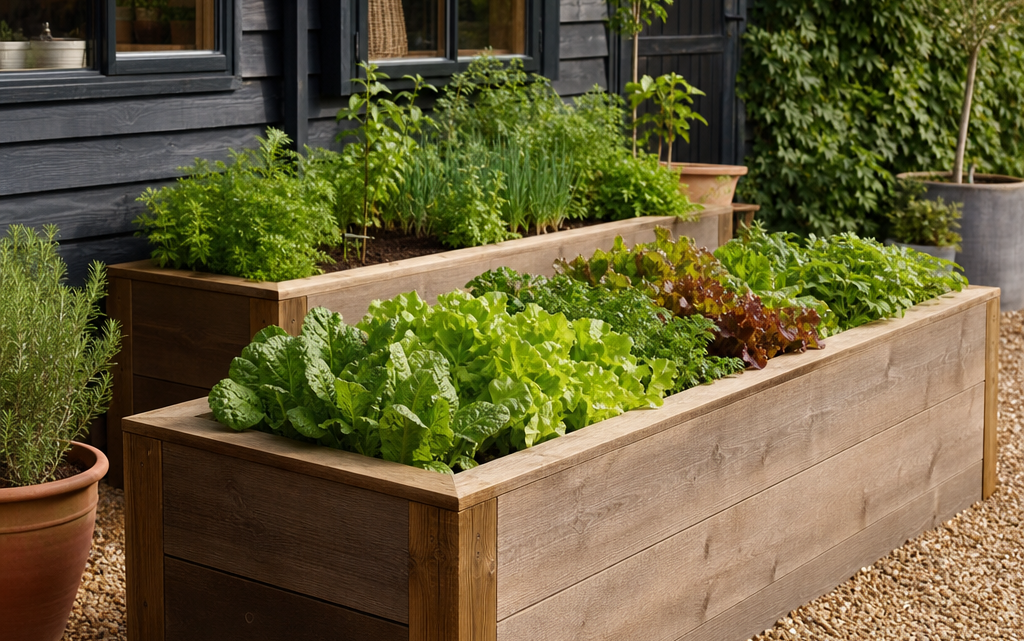
If you want to step outside the back door and pick a handful of parsley, lettuce leaves or chives for dinner, a raised timber trough planter can be one of the most practical additions to a garden, patio or small courtyard. It brings edible crops up to a comfortable working height, keeps them close to the kitchen and can make productive use of a sunny spot that would otherwise be bare paving or an awkward strip beside a path.
Good results, however, depend on more than simply buying a planter and filling it with compost. Herbs and salad crops need the right light, drainage, access and growing depth. The trough also needs to be positioned where it will be easy to water, harvest and maintain throughout the year. This guide explains how to plan and position a raised timber trough planter so that it works as a practical mini kitchen garden rather than just a decorative container.
Inhaltsverzeichnis
Start with what you want to grow
The best position and size for your planter depend on the crops you intend to grow. Herbs and salad leaves are generally well suited to trough planters because many are compact, quick to harvest and do not need the same root space as large vegetables. Even so, different crops have different needs.
Good crops for a raised timber trough
For a reliable edible display, focus on crops that give repeated pickings and tolerate container growing. Suitable choices include:
- Cut-and-come-again salad leaves, such as loose-leaf lettuce, rocket, mizuna and mustard leaves.
- Soft herbs, including parsley, coriander, dill, chervil and basil in warm months.
- Hardy perennial herbs, such as chives, thyme, oregano, sage and winter savory.
- Compact vegetables, including radishes, spring onions, baby beetroot and small varieties of spinach.
- Trailing or compact strawberries, if the planter receives enough sun.
Avoid overloading a trough with thirsty, hungry crops such as courgettes, large tomatoes or sweetcorn unless the planter is particularly deep and wide. These plants can dominate the space, dry out quickly and make the trough harder to manage.
Choose the right position before you assemble or fill it
A timber trough can become heavy once filled with compost and watered. It is far easier to make the right decision before assembly or filling than to move it afterwards. Take time to observe your garden at different times of day, especially in spring and summer when edible crops are growing fastest.
Prioritise sunlight
Most salad crops and herbs perform best with good light. As a general rule, aim for at least 4 to 6 hours of direct sun in the growing season. Leafy salads can tolerate some light shade, especially in hot weather, but Mediterranean herbs such as thyme, sage and oregano need a sunnier, freer-draining position.
If you have a choice, morning sun with some afternoon shade can be excellent for salad leaves because it reduces scorching and slows bolting in dry spells. A south-facing patio may be ideal for herbs but can make lettuce and coriander run to seed quickly unless you water consistently and provide seasonal shade.
Keep it close to the kitchen
Edible planters are most useful when they are convenient. A position near the kitchen door, along a path to the back gate or beneath a kitchen window makes it more likely that you will harvest regularly and notice when watering is needed. If the trough is hidden at the far end of the garden, it may be neglected during busy weeks.
Convenience matters particularly with herbs. You are more likely to use fresh chives, parsley or basil if you can reach them while cooking, rather than putting on boots and walking across a wet lawn.
Check access around the planter
Make sure you can reach the whole growing area comfortably. If the trough will be against a wall or fence, you need to reach from the front only, so avoid making the planting area too deep for your arm span. If it will be accessible from all sides, you have more flexibility.
Leave enough space for a watering can, harvesting bowl and, where relevant, a wheelchair, walking frame or garden trolley. Do not block narrow paths or create a trip hazard beside steps, doorways or washing lines.
Assess the surface and drainage
Raised troughs are often placed on patios, decking, gravel, balconies or compacted areas beside the house. Each surface has practical implications.
Patios and paving
Paving is usually stable and convenient, but you must consider drainage. Water should be able to leave the planter without pooling around its base or staining the surface. If the trough stands off the ground, this can help airflow and reduce direct contact with damp paving, but water still needs somewhere to go.
Place the planter where overflow will not run towards air bricks, door thresholds or walls. If necessary, use pot feet, a drainage tray with caution, or position it over a gravel strip. Avoid permanently trapping water beneath timber or against the house wall.
Decking
Decking can support smaller troughs, but weight is the key issue. Compost, water and timber together can be surprisingly heavy. If you are using a trough on decking, check the structure is sound and spread the load where possible. Avoid placing a heavy planter on old, rotten or flexing boards.
Balconies and roof terraces
For balconies, weight, wind and building rules are critical. You must check load limits and any lease or management restrictions before adding a filled trough. Wind exposure can dry crops rapidly and may make tall plants unstable. In exposed positions, choose lower-growing crops and secure the planter if appropriate.
Use product details as a comparison point, not the whole plan
A specific planter, such as the Forest Kitchen Garden Trough Planter 3’x3′ (0.7x1m), can be a useful practical example when comparing options. It is described as a timber trough made from pressure-treated, smooth-planed European softwood, supplied flat-packed with fixings and instructions, and with a 15-year anti-rot warranty. It also stands off the ground, which may help reduce direct contact with damp surfaces and can make access harder for some ground-level pests.
Those details are useful, but they do not replace your own site planning. Before choosing any trough, confirm the exact external and internal dimensions, the planting depth, drainage arrangement and finished height. The stated size in a product name is not always enough to determine how much compost you need or how many plants it will comfortably hold. If specifications such as wall thickness or exact floor area are not provided, ask the supplier or measure the product before buying compost and plants.
Decide the height and working position
One of the main advantages of a raised timber trough is easier access. The right height reduces bending and makes regular picking more pleasant. However, height also affects watering, exposure and stability.
Comfort for regular use
If you have back or knee problems, choose a trough that brings the growing surface within easy reach without needing to crouch. For most people, a planter around waist height is comfortable for light tasks such as harvesting herbs, while a lower trough may still be acceptable for occasional sowing and thinning.
Try mimicking the height with a table, box or garden chair before you buy. Stand where the planter will go and check whether you can comfortably reach the centre. This is particularly important if the planter will sit against a wall, because you will not be able to access it from the back.
Stability and wind
A raised planter should feel stable once assembled and filled. Tall, narrow units can be more vulnerable to knocks or wind, especially on exposed patios. Avoid placing a trough where children may climb on it, where it could be hit by opening gates, or where strong gusts funnel between buildings.
Plan the compost and drainage layer properly
Edible crops in containers depend entirely on the growing medium you provide. Garden soil alone is usually too heavy, may drain poorly and can compact in a trough. A good peat-free multi-purpose compost is suitable for many salads and annual herbs, while Mediterranean herbs benefit from added grit or a specialist free-draining mix.
Check whether the trough has drainage holes or gaps as supplied. Edible planters must not hold stagnant water around plant roots. If lining the inside to protect timber and retain compost, do not accidentally block drainage. A permeable membrane can help keep compost in place while allowing water through, but impermeable plastic must be pierced adequately if used.
Allow for settling
Compost settles after watering. Fill the trough, water it thoroughly, then top up before sowing or planting. Leave a small gap below the rim so water does not immediately wash compost out. This also makes watering easier during dry weather.
Work out planting density
It is tempting to pack a trough tightly for an instant lush effect, but overcrowding is one of the quickest ways to reduce productivity. Plants compete for light, water and nutrients, and poor airflow can encourage mildew or rotting leaves.
For salads, sow short rows or small patches and thin seedlings as they grow. For herbs, allow each plant enough room to develop. A small thyme plant may look lost at first but will spread, while parsley and coriander need space for leafy growth. Keep vigorous herbs such as mint in a separate pot rather than planting them directly into a mixed trough, as they can overwhelm other crops.
Practical checklist before you commit
Use this checklist before you assemble, fill or plant your raised timber trough:
- Have you observed the site for sunlight at different times of day?
- Can you reach the whole planting area comfortably?
- Is the surface level, stable and able to take the filled weight?
- Will excess water drain away safely from walls, doors and air bricks?
- Is the planter close enough to the kitchen to be used regularly?
- Have you checked the exact dimensions and planting depth?
- Do you know how much compost you need, allowing for settling?
- Are the crops you want suitable for container growing?
- Have you allowed space for watering, harvesting and maintenance?
- Will the position still work in summer heat and winter wet?
Think seasonally
A productive trough changes through the year. In early spring, you might sow hardy salad leaves, parsley and spring onions. In late spring and summer, basil, coriander, lettuce, rocket and edible flowers can be added. In autumn, switch to hardy leaves, chives and overwintering herbs.
Plan for succession rather than planting everything at once. Sow small amounts every two or three weeks so you have a steady supply rather than a glut followed by bare compost. When a crop finishes, remove old roots, refresh the top layer of compost and replant.
Watering and feeding considerations
Raised troughs dry out faster than open ground, particularly in warm or windy weather. Place the trough where watering is easy, ideally within reach of an outdoor tap or where carrying a watering can is not a chore.
Water deeply rather than sprinkling lightly. Check moisture by pushing a finger into the compost; the surface can look dry while the lower layer remains damp, or the reverse can happen after brief rain. Salad leaves need consistent moisture to stay tender. Basil and coriander also suffer if repeatedly allowed to wilt.
Most multi-purpose compost contains enough nutrients for the first few weeks. After that, leafy crops may benefit from occasional liquid feeding, following the product instructions. Do not overfeed Mediterranean herbs, as rich, wet conditions can produce soft growth with weaker flavour.
Common practical mistakes to avoid
Putting the trough in deep shade
A shady corner may look tidy, but most edible crops will become thin, pale and unproductive without enough light. If shade is unavoidable, focus on tolerant leaves such as parsley, chervil, sorrel and some lettuces, and accept slower growth.
Forgetting the filled weight
An empty timber planter may be easy to move, but once filled with damp compost it can be very heavy. Choose the final position first, especially on decking, balconies or delicate paving.
Blocking drainage with a liner
Lining a timber trough can be useful, but only if water can escape. A waterproof liner with no holes can turn the planter into a trough of stagnant compost, causing root problems and plant failure.
Mixing incompatible herbs
Basil, parsley and coriander prefer more moisture than thyme, sage and oregano. You can grow them together for a short season, but it is often easier to group plants with similar watering needs. Keep mint separate.
Planting too much, too soon
A newly planted trough can look sparse, but crops fill out quickly. Overplanting leads to stress, poor airflow and more watering. Follow spacing guidance and harvest regularly.
FAQ
Can I place a raised timber trough directly under a kitchen window?
Yes, provided the area receives enough light and water can drain away safely. Make sure the trough does not block air bricks, vents or access for cleaning windows. Also check that roof overhangs do not prevent rain from reaching the plants, as sheltered planters often need more watering than expected.
Do I need to treat pressure-treated timber before using it?
Many pressure-treated timber garden products are supplied for outdoor use without immediate additional treatment. Follow the manufacturer’s guidance for the specific planter. If you choose to apply any finish, use one suitable for the intended use and avoid contaminating the growing medium.
What compost should I use for herbs and salad crops?
A good peat-free multi-purpose compost suits most salad leaves and annual herbs. For Mediterranean herbs, improve drainage with grit or use a freer-draining mix. Avoid heavy garden soil in a trough unless blended carefully, as it can compact and drain poorly.
How often will I need to water?
There is no fixed schedule. In cool, damp weather you may water only occasionally; in hot or windy spells, daily watering may be needed. Check the compost regularly and water thoroughly when the root zone begins to dry.
Can I grow vegetables as well as herbs?
Yes, if you choose compact crops. Radishes, spring onions, baby beetroot, spinach and loose-leaf salads are good candidates. Large, hungry crops need more space, depth and feeding, so they are usually better grown in bigger containers or open ground.
Conclusion
A raised timber trough planter can turn a small, sunny area into a useful source of fresh herbs and salad crops, but success depends on careful planning. Choose a position with suitable light, safe drainage, comfortable access and enough convenience that you will actually use it. Check dimensions and planting depth before buying compost or plants, and group crops according to their needs.
By treating the planter as a working part of your kitchen garden rather than a decorative afterthought, you can create a productive, attractive and manageable growing space just a few steps from your door.