
Encouraging Safe Role Play in a Wooden Garden Playhouse
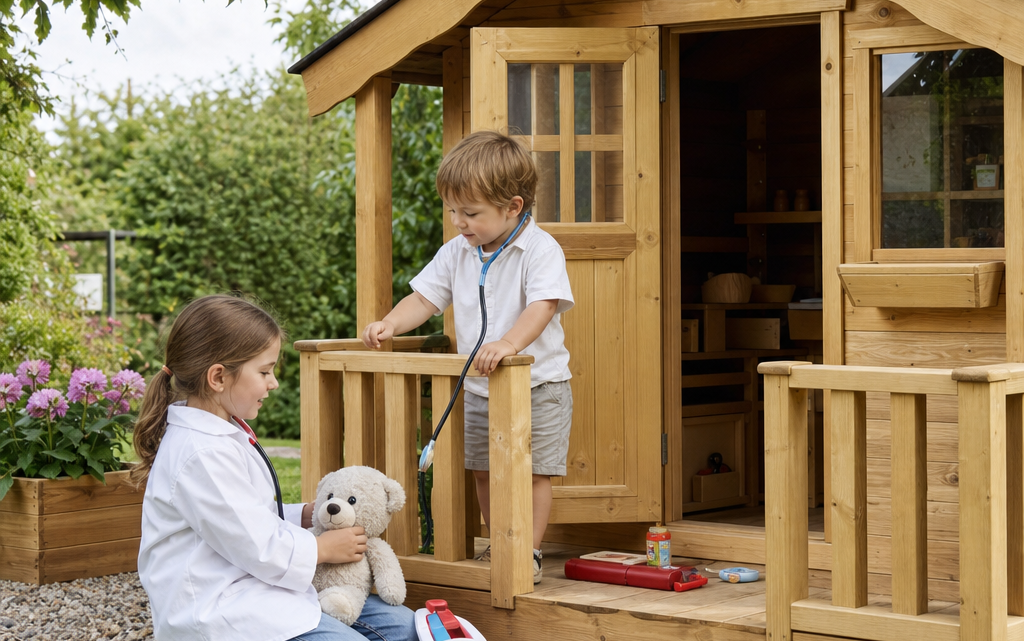
It is a Saturday morning, the garden is dry, and the children have decided that the playhouse is no longer just a playhouse. Today it is a woodland ranger station, tomorrow it may be a café, a spaceship, a pet rescue centre or a secret lookout. A timber garden playhouse can give children a defined space where their imagination feels real, but the best role play still needs a few sensible boundaries. With a little planning, you can encourage energetic, creative games while reducing avoidable bumps, disputes and risky behaviour.
This article explains how to design safe, imaginative play routines around a wooden garden playhouse. It focuses on practical decisions you can make at home: where the playhouse sits, how children enter and exit, what props are suitable, how to set rules without spoiling the fun, and how to adapt play for different ages. A timber model such as the 6′ x 4′ Shire Command Post Children’s Wooden Garden Playhouse is used only as a practical example of the sort of features you may be working with, such as windows, observation points, a crawl-entry door and timber construction.
Inhaltsverzeichnis
Start with the space, not the story
Children often begin with the theme: pirates, spies, vets, explorers or shopkeepers. Adults should begin with the space. Before you suggest any role play routine, look at the playhouse as part of the whole garden. The safest imaginative games are those that match the available space, the children’s ages and the physical design of the playhouse.
Ask yourself how children will approach the playhouse, where they will run, where adults can supervise from, and whether there are trip hazards nearby. A playhouse that is perfect for quiet den-building may not be suitable for chase games if it is close to a patio edge, washing line, greenhouse, pond, barbecue area or garden tools. If the playhouse has a small entrance, opening ports or fixed windows, role play should use these features sensibly rather than encouraging climbing, squeezing or leaning out too far.
Key decision criteria before you plan games
- Age and ability: younger children need simpler rules, fewer props and closer supervision. Mixed-age groups need games where older children do not dominate or pressure younger ones.
- Number of children: a small timber playhouse can become crowded quickly. Limit how many children are inside at one time, especially during active games.
- Entry and exit: check that children can get in and out comfortably and that no one is blocking the doorway during play.
- Visibility: you should be able to see or hear enough to supervise without constantly interrupting.
- Weather: wet grass, high winds, strong sun and cold conditions all affect how safely children can use an outdoor playhouse.
- Prop safety: choose soft, light, age-appropriate items and avoid anything sharp, heavy, breakable or likely to encourage rough play.
Create simple house rules children can remember
Rules work best when they are short, positive and linked to the play. Rather than saying “don’t do that” repeatedly, turn the rules into part of the routine. For example, if the playhouse is a ranger station, the first job of the rangers is to do a “safety patrol”. If it is a café, staff must keep the “walkways” clear. If it is a space station, astronauts must use the “airlock” one at a time.
For most families, five rules are enough:
- Walk near the playhouse; save running for the open lawn.
- One child at the doorway at a time.
- No climbing on the roof, windows, walls or ports.
- Keep hands, faces and props inside unless an adult has agreed the game.
- Stop immediately if someone says “pause” or “I don’t like that”.
Make the rules visible if children are old enough to read. A small laminated sign, chalkboard or picture chart can help. For younger children, use symbols: feet for walking, a door for taking turns, and a hand for stopping.
Design role play routines with a beginning, middle and end
Open-ended play is valuable, but a light routine helps keep it safe. A routine does not mean controlling every detail. It simply gives children a structure that prevents the game from becoming chaotic. Think of it as a flexible script: set up, play, reset.
1. The set-up stage
Before the game starts, agree the theme and roles. For example, in a “rescue base” game, one child may be the dispatcher, another the rescuer and another the patient’s helper. In a “lookout post” game, one child watches, one records sightings and one delivers messages. This reduces pushing and arguing because everyone has a purpose.
Use a quick safety check as part of the story. The children can check that the “station floor” is clear, the “communications desk” is tidy and the “entry hatch” is not blocked. You can supervise this in under a minute.
2. The play stage
During the main game, encourage movement patterns that suit the garden. If the playhouse has observation points or windows, use them for spotting birds, counting garden objects, watching for “deliveries” or sending pretend messages. Avoid games where children are expected to lean out, throw hard objects, jump from the doorway or defend the playhouse aggressively.
If you include water play, keep it gentle and controlled. Water pistols or similar toys can quickly turn a calm game into chasing, slipping or upset. Set a clear zone, avoid spraying faces, and stop the game if the ground becomes slippery.
3. The reset stage
At the end, children should put props back, check nothing is trapped in the door area, and leave the playhouse ready for next time. This matters because clutter inside a small timber structure can become a trip hazard. Treat tidying as part of the role play: the shop closes, the station signs off, or the animal clinic prepares for tomorrow.
Choose themes that encourage cooperation rather than conflict
Many children enjoy adventure themes, but not all adventure needs to involve “battles” or “enemies”. You can keep the excitement while steering the play towards teamwork, problem-solving and storytelling. This is especially useful if the playhouse design suggests a lookout, post or den.
Safer imaginative themes to try
- Wildlife watch: children use windows or observation points to spot birds, insects and changing weather, then record findings in a notebook.
- Garden café: the playhouse becomes a serving hatch for pretend drinks, menus and leaf “salads”, using soft or lightweight props.
- Post office: children deliver drawings, notes or pretend parcels around the garden using a clear walking route.
- Ranger station: children patrol the garden, check imaginary maps and report fallen leaves, muddy patches or “lost” toys.
- Repair workshop: soft toy vehicles, cardboard tools and pretend checklists help children practise sequencing and conversation.
- Story studio: children act out a book, make tickets and perform a short show from inside or just outside the playhouse.
These themes work well because they give children jobs to do. They involve talking, taking turns, observing and organising rather than pushing, guarding or excluding others.
Use the playhouse features sensibly
A timber playhouse may include fixed windows, opening sections, a small door, timber flooring and a felted roof. These are useful features, but they should guide how you set up play. For instance, windows are good for looking through, not for climbing through. A low or crawl-style door can make the playhouse feel like a secret den, but it also means children need to enter slowly and avoid blocking the entrance.
If your playhouse has opening ports or lookout points, give them a specific safe purpose. They can be used for puppet shows, pretend ticket sales, weather reports or nature spotting. Avoid encouraging children to poke long sticks, hard toys or faces through openings. If more than one child wants to use the same feature, introduce a timer or role rotation.
As a practical example, the Shire Command Post style includes three fixed windows, two opening observation points, shatterproof styrene glazing and a single crawl-entry door with a magnetic catch. Those details lend themselves to lookout, station and clubhouse games, but they also show why routines matter: children need to take turns at openings, keep the doorway clear and understand that the structure is for play inside and around, not for climbing on.
Make supervision feel supportive, not intrusive
Safe role play does not require you to stand over children constantly, but it does require active awareness. The level of supervision should depend on age, temperament, weather and the game being played. A group of calm older children running a pretend shop may need only occasional checks. Younger children, or children playing a fast-moving adventure game, need you nearby and engaged.
Try using “check-in points” rather than interrupting every few minutes. For example, agree that after each mission, delivery or café round, the children report back to you. This gives you a chance to assess whether the game is becoming too rough, whether anyone is being left out, and whether the playhouse is getting overcrowded.
Signs the game needs a reset
- Children are pushing at the doorway or trying to shut others out.
- Props are being thrown rather than handed or placed.
- Someone is repeatedly saying stop, no or pause.
- The game has moved onto climbing, jumping or leaning out.
- The floor area is cluttered with toys, bags or dressing-up clothes.
- The ground outside has become wet, muddy or slippery.
When you need to intervene, keep it calm and specific. Say, “The doorway is blocked, so we are resetting the station,” rather than “You are all being silly.” Then restart the game with fewer props, clearer roles or a quieter theme.
Prepare safe props and costumes
Props make role play richer, but they are also a common source of problems. Children do not need expensive accessories. In fact, simple items are often safer and more imaginative because they can be used in many ways.
Good prop choices
- Clipboards, notebooks, pencils and picture maps.
- Soft toy animals, fabric food, cardboard tickets and paper menus.
- Lightweight baskets, small cushions and fabric flags.
- Cardboard tubes used as pretend telescopes, provided they are not used for pushing or hitting.
- Dress-up items that do not trail on the ground or restrict vision.
Props to avoid or control carefully
- Sharp sticks, garden canes or metal tools.
- Heavy boxes that could trap fingers or toes.
- Glass, china or brittle plastic items.
- Long cords, ropes or scarves that could catch around necks or door areas.
- Small parts for very young children who may put items in their mouths.
Store props in a lightweight tub that can be removed easily. Avoid leaving fabric, paper or toys inside the playhouse for long periods, as they may become damp, dirty or attractive to insects. A simple “playhouse kit” that comes out for each session is easier to keep safe and clean.
Practical checklist before each play session
Use this quick checklist before children start a role play game. It should take only a few minutes, but it can prevent many common issues.
- Ground: Is the area around the playhouse free from slippery mud, loose toys, stones and garden equipment?
- Doorway: Can the door or entrance be used without obstruction?
- Interior: Is the floor clear enough for children to move, sit and turn around safely?
- Windows and openings: Are children clear that these are for looking, talking or pretend serving, not climbing?
- Weather: Is it dry and calm enough for the planned activity?
- Props: Are all props soft, light, suitable for the children’s ages and relevant to the game?
- Numbers: Have you set a limit for how many children can be inside at once?
- Rules: Have you repeated the stop word or pause rule?
- Supervision: Can you see or hear the children easily from where you will be?
- End plan: Do children know where props go when the game finishes?
Common practical mistakes to avoid
Letting the theme dictate unsafe behaviour
If the playhouse becomes a fort, castle or command centre, children may decide that guarding, attacking or chasing is part of the game. You can redirect this without banning the theme. Change “defending against enemies” into “protecting supplies from the weather”, “watching for wildlife” or “sending messages to base”. The story remains exciting, but the behaviour becomes safer.
Allowing too many children inside
A playhouse can feel bigger to a child than it is in practical terms. Too many children inside may lead to pushing, squashed fingers, arguments and blocked exits. Set a clear maximum and create outside roles so no one is excluded. For example, two children work inside the café while two are customers outside.
Using adult garden items as props
Real tools, plant labels, bamboo canes, buckets of water and furniture can seem harmless, but they may not be suitable for children’s role play. Keep a separate set of child-safe props and make it clear that shed or greenhouse items are not part of the game.
Forgetting maintenance and surface checks
A timber garden playhouse needs routine care in line with the manufacturer’s guidance. Dip-treated timber products may require annual retreatment to maintain anti-rot protection, and felt roofs, floors, glazing and fixings should be checked periodically. A well-maintained playhouse is not only longer lasting; it also gives you confidence that children are playing in a sound structure.
Ignoring emotional safety
Role play can become intense. Some children may be assigned the “baddie”, “prisoner” or “monster” and then feel upset or trapped in that role. Encourage rotating roles and agree that nobody has to play a part they dislike. The pause rule should apply to feelings as much as physical safety.
Adapt routines for different ages
For younger children, keep games short and concrete. A ten-minute café or animal rescue game may be enough. Use very few props and give simple jobs, such as “serve the tea”, “find the teddy” or “look for three red things in the garden”. Stay close and help with turn-taking.
For primary-age children, add more planning. They can draw maps, make signs, create tickets, write rules and invent missions. This is a good age to introduce responsibility: one child can be the safety checker, another the prop manager and another the storyteller.
For mixed-age groups, design roles that suit each child. An older child can be the narrator or organiser without controlling the whole game. A younger child can be the customer, explorer or assistant. Avoid games where speed, strength or shouting determine who “wins”.
FAQ
How many children should play inside a wooden playhouse at once?
It depends on the size of the playhouse, the children’s ages and the type of game. As a practical rule, keep numbers low enough that children can sit, turn around and leave without pushing. Use outside roles so that the play continues without overcrowding.
Are adventure and lookout games suitable?
Yes, if they are framed around observation, teamwork and communication rather than rough defending or chasing. Lookout games can involve nature spotting, weather reports, pretend maps and message delivery.
Should children be allowed to eat in the playhouse?
It is usually simpler to keep real food outside, especially if the playhouse is small. Crumbs and spills can attract insects and create cleaning issues. Pretend food is often a better choice for café or picnic games.
What should you do if children keep climbing on the playhouse?
Stop the game and reset the rules immediately. Explain that the roof, windows and walls are not climbing equipment. Offer an alternative activity, such as a ground-level obstacle route elsewhere in the garden, if they need more physical play.
How can you make role play safer without making it boring?
Build safety into the story. Use patrols, checklists, role badges, timers and missions. Children are more likely to accept boundaries when those boundaries feel like part of the game rather than a separate lecture.
Conclusion
A wooden garden playhouse can become a powerful setting for imaginative role play, but the safest games are deliberately shaped. Start by assessing the garden space and the playhouse features, then create simple rules, suitable themes and a repeatable routine. Choose props carefully, supervise according to age and activity, and reset the game whenever it becomes crowded, rough or emotionally uncomfortable.
Used thoughtfully, a timber playhouse is not just a structure in the garden. It can be a stage for storytelling, cooperation, confidence and problem-solving. Your role is to provide the boundaries that allow children’s imagination to grow safely within them.
