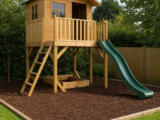
Safety checks for ladders, lofts and guardrails in children’s wooden playhouses
A raised wooden playhouse can quickly become the most popular part of the garden: children climb, crawl into loft spaces, lean over rails, carry toys up ladders and invent games that adults did not foresee. That is exactly why the ladder, loft edge and guardrails deserve more attention than the paint colour or the window style. Before you let children use a raised playhouse, and regularly throughout the year, you should check how they get up, how they move around at height and what prevents them from falling.
This guide explains how to assess ladder, loft and guardrail safety in children’s wooden playhouses. It is written for parents, carers and homeowners who want practical checks they can carry out themselves, while still recognising when a repair, replacement part or professional advice is needed.
Inhaltsverzeichnis
Why raised playhouse safety needs regular checks
Children use playhouses differently from adults. A ladder may be designed for access, but it may also become part of a game. A loft may be intended for quiet play, but children may jump, lean, push toys through gaps or try to climb over edges. Timber also changes over time: it swells and shrinks with the weather, fixings can loosen, and surfaces can become slippery with algae or mud.
A playhouse that was safe when first installed can become less safe if it is moved, placed on uneven ground, overloaded with toys or not maintained. Raised designs need particular attention because a small defect at height can have a bigger consequence than the same defect at ground level.
Start with the installation and the ground below
Before you inspect the ladder or loft, look at the whole structure. A raised playhouse, tower-style playhouse or two-storey model should be installed exactly as the manufacturer instructs. The building should sit level, square and stable, with no rocking when you apply gentle pressure from different sides.
Check the base and level
Use a spirit level on the floor and platform areas if you can access them safely. Doors and windows that have begun to stick can be a clue that the structure has shifted. Uneven ground can twist the frame, affecting ladder alignment, rail strength and the fit of loft components.
Decision criteria are simple: if the playhouse rocks, leans, twists noticeably, or the ladder no longer meets the platform or loft opening cleanly, stop children using it until the base and structure have been corrected.
Think about the fall zone
Children can fall from ladders, loft openings, platforms and entrances. Keep the area around access points clear of hard objects, pots, tools, bicycles, stones and garden furniture. Grass may be acceptable for some low-level play areas when well maintained, but compacted soil, paving, concrete and decking increase the risk of injury.
If the playhouse is raised or has an external platform, consider whether impact-absorbing surfacing is appropriate. Follow the manufacturer’s guidance and any safety information supplied with the playhouse. If you are unsure, err on the side of a softer, clearer landing area.
Assessing ladder safety
The ladder is often the highest-risk feature because children use it repeatedly and sometimes in a hurry. Inspect it before the first use, after bad weather, and whenever you notice wobbling, creaking or slipping.
Check attachment points first
Look where the ladder fixes to the playhouse or platform. Screws, bolts or brackets should be tight and seated properly, with no splitting around them. Timber around the fixing points should not be soft, cracked or pulled away.
If a fixing spins without tightening, if the timber is crushed, or if a rung moves when pulled by hand, do not treat it as a minor nuisance. Children put dynamic loads on ladders when climbing, bouncing or stepping sideways. Replace damaged fixings with the correct parts specified by the manufacturer, not random spare screws that happen to fit.
Inspect rungs and side rails
Run your hands carefully along the rungs and side rails. You are looking for splinters, splits, sharp edges, raised nail heads, loose knots and slippery contamination. Smooth-planed timber is useful, but it still needs checking as it weathers.
Each rung should feel firm under downward pressure. There should be no rotation, sagging or cracking. If a rung has split, do not glue it and hope for the best unless the manufacturer specifically allows that repair. A climbing component needs reliable strength.
Look at ladder angle and foot contact
A ladder that is too steep can feel like a climb; one that is too shallow can encourage running or jumping. You should not alter the intended angle by raising, packing or shifting the base unless the instructions allow it. The ladder feet should sit securely and evenly, not on loose stones, wet mud or a slope.
If the ladder has moved because the playhouse has settled, correct the installation rather than forcing the ladder into place. Misalignment can put extra stress on fixings and make climbing awkward.
Set rules for safe use
Even a sound ladder needs sensible rules. Teach children to face the ladder when climbing, use both hands, carry fewer toys, wait their turn and avoid pushing. If younger children cannot climb down confidently without help, they should not be using the loft or raised area unsupervised.
Checking loft areas inside wooden playhouses
A loft inside a two-storey playhouse creates extra play space, but it also creates an internal fall risk. You should assess the access opening, loft floor, edge protection, headroom and windows as a connected system rather than separate features.
Loft floor and support
Check the loft floor from above and below where possible. Look for sagging boards, damp patches, delamination, cracking or movement under weight. Do not overload the loft with heavy storage boxes, outdoor equipment or multiple older children if the playhouse is intended for lighter children’s play.
Use the manufacturer’s recommended age range, loading guidance and supervision advice. If the documentation is missing, contact the supplier or manufacturer rather than guessing. A loft that “feels solid” is not the same as one being used within its design limits.
Loft openings and edges
The area where the ladder meets the loft is critical. The opening must allow access without creating an easy fall path. Check that any guarding, side panels or edge boards are secure, smooth and positioned as designed.
Be wary of gaps that could trap a child’s head, neck, limbs or clothing. Also look for climbable features near the loft edge, such as loose toy boxes, chairs or added shelves. Children will use these as steps, even if that was not your intention.
Windows at loft level
Upper windows should be treated as potential fall and impact points. Check that glazing is intact, secure and made from the safety material stated by the manufacturer. If the upper window is intended to be fixed, do not modify it to open. A fixed upper window is often part of the safety design, particularly where a child could otherwise lean out at height.
Do not replace safety glazing with ordinary glass. If a panel cracks or becomes loose, obtain the correct replacement material.
Guardrails and raised platform checks
Guardrails are not decorative trim. They are a safety barrier, so you should inspect them as load-bearing components. This applies to raised external platforms, balconies, tower-style playhouses and internal loft edges.
What a good guardrail should do
A guardrail should discourage falls, resist normal child contact and avoid creating new hazards. It should not wobble when pushed by hand. Rails, balusters and panels should be firmly fixed, with no missing screws, protruding fasteners or rotten sections.
Openings should not allow a child to slip through or become trapped. Horizontal features can encourage climbing, so pay attention to whether children are using the rail as a ladder. If they are, supervision and layout changes may be needed, and you should check whether any accessories or nearby objects are making climbing easier.
Signs that a guardrail is unsafe
Stop use and repair or replace parts if you find loose posts, cracked rails, rot at the base of uprights, excessive flexing, missing sections, sharp splinters or fixings pulling through the timber. Staining or greying alone is not always a structural problem, but soft, crumbly or darkened timber around joints can indicate decay.
Never remove a rail to make access easier, and do not cut new openings into a raised platform without manufacturer approval. Changes to guarding can invalidate the intended safety design.
Practical example: applying checks to a two-storey wooden playhouse
As a practical example, a two-storey timber playhouse such as the 5’3×5’6 Shire Croft 2 Storey Kids Wooden Playhouse includes features that are directly relevant to these checks: ladder access to a loft area, a fixed loft window, lower opening windows, shatterproof glazing material, tongue and groove timber construction, framing, a boarded floor and compliance with BS EN 71-1:2014 safety standards as stated in the product information. Those details are useful because they tell you what should be present and how the playhouse is intended to be used.
However, certification and specification details do not remove the need for your own inspection. You still need to check that the ladder is secure, the loft floor has not deteriorated, the upper window remains fixed, the glazing is undamaged, and the timber has been maintained in line with the manufacturer’s instructions.
Ladder, loft and guardrail safety checklist
Use this checklist before first use, after installation, at the start of the main play season and after storms or long wet periods.
- Structure: The playhouse is level, stable and not rocking.
- Base: The ground or base is firm, even and suitable for the model.
- Fall area: The area below ladders, platforms and entrances is clear of hard objects.
- Ladder fixings: Screws, bolts or brackets are tight, with no splitting around them.
- Rungs: Rungs are firm, dry, smooth and free from cracks or rotation.
- Ladder feet: The ladder sits evenly and has not shifted or sunk.
- Loft floor: Boards feel solid, with no sagging, damp damage or loose sections.
- Loft edge: Any guarding or edge protection is secure and unaltered.
- Guardrails: Rails and posts do not wobble and have no missing or damaged parts.
- Windows: Safety glazing is intact; fixed upper windows have not been modified.
- Fasteners: No nails, screws or staples protrude where children may touch or climb.
- Timber condition: No soft rot, severe splitting, sharp splinters or loose knots are present.
- Rules: Children know to climb one at a time, use both hands and avoid pushing.
- Supervision: Younger children are supervised, especially near ladders and loft openings.
Maintenance that supports safety
Timber playhouses need maintenance for safety as well as appearance. Dip-treated products commonly require ongoing treatment to maintain anti-rot protection, and you should follow the manufacturer’s schedule. Annual retreatment is often a condition of long anti-rot guarantees, so keep records of what you apply and when.
Control damp and rot
Rot often begins where water sits: ladder feet, platform corners, lower wall boards, around windows, under roof edges and near fixings. Keep vegetation away from the structure so air can circulate. Do not let soil, wet leaves or bark pile up against timber.
If you find soft timber, press gently with a screwdriver or similar blunt tool. If the surface gives way, crumbles or feels spongy, that part needs attention before children continue using it. Painting over rot does not restore strength.
Keep surfaces grippy and clean
Wet timber, algae and mud can make steps and platforms slippery. Clean climbing surfaces with suitable products and avoid leaving playhouses shaded by overgrown planting if it keeps them permanently damp. Do not add glossy coatings to ladder rungs unless they are suitable for walked-on or climbed surfaces and do not create a slip hazard.
Tighten, but do not over-tighten
Seasonal movement can loosen fixings. Tighten them carefully, but avoid crushing the timber or stripping the hole. If a fixing will not grip, use the manufacturer’s recommended repair method or replacement part. Simply fitting a larger screw may split the wood or weaken the joint.
Common practical mistakes to avoid
Assuming “new” means “ready for rough use”
A new playhouse still needs checking after assembly. Flat-pack timber buildings rely on correct installation, square alignment and proper fixing. Go back over the ladder, loft and guarding after the first few days of play because early movement can reveal loose fixings.
Letting children use the ladder as storage
Skipping ropes, bags, toy tools and dressing-up items left on ladders create trip and slip hazards. Keep the access route clear and teach children that the ladder is not a shelf.
Adding furniture near loft edges
Small chairs, boxes and toy chests can become climbing aids. In a loft or raised platform, keep furniture low, light and away from edges and windows. Do not create a step that allows a child to climb over a rail or reach a window opening.
Modifying windows, rails or ladders
It can be tempting to alter a playhouse to make it more convenient: widening an access gap, moving a ladder, removing a rail or changing a fixed window. These changes can undermine the safety design. If you need an alteration, ask the manufacturer whether it is permitted and whether there is an approved accessory.
Ignoring small wobbles
A slight wobble in a rail or rung rarely improves by itself. Children’s repeated use tends to make it worse. Treat movement as an early warning sign, not as normal character in a wooden structure.
When to stop use immediately
You should prevent access to the playhouse until repairs are complete if you notice any of the following: a loose ladder rung, a detached ladder fixing, a cracked guardrail, rot in a support or rail, a sagging loft floor, broken glazing, a missing rail section, exposed sharp fixings, significant rocking of the structure, or any alteration that has left a gap at height.
Use a clear physical barrier if necessary. Telling children not to climb may not be enough, particularly when the playhouse is already part of their daily routine.
FAQ
How often should I check a raised wooden playhouse?
Carry out a quick visual check before regular use, especially in wet weather. Do a more detailed inspection monthly during heavy use, after storms, after winter, and whenever the playhouse has been moved or repaired.
Is compliance with BS EN 71-1 enough?
It is a helpful indication that the product has been designed with relevant toy safety requirements in mind, but it is not a substitute for correct installation, supervision and maintenance. Damage, poor assembly or later modifications can affect safety.
Can I replace a damaged ladder rung myself?
Only use a suitable replacement part and fixing method. Ideally, obtain guidance or parts from the manufacturer or supplier. A ladder rung is a structural climbing component, so an improvised repair may not be safe.
Should children wear shoes in a playhouse with a ladder?
Footwear with good grip is usually safer than socks, bare muddy feet or slippery dressing-up shoes. Avoid loose sandals or footwear that can catch on rungs.
What should I do if the upper window is fixed?
Leave it fixed. If the manufacturer designed the loft window not to open, that is likely to support safe use at height. Do not modify it for ventilation; use the intended lower openings and follow the product guidance.
Conclusion
Ladders, lofts and guardrails are the key safety features in raised children’s wooden playhouses. Your checks should focus on stability, secure fixings, sound timber, safe access, protected edges and unmodified windows or rails. Use the manufacturer’s instructions as your starting point, keep the fall area clear, maintain the timber properly and act quickly when something moves, cracks or softens.
A well-maintained playhouse can provide years of imaginative outdoor play, but safety depends on regular, practical attention. If in doubt, stop use first and investigate before children climb again.