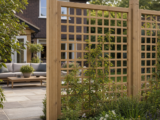
Lattice spacing and garden trellis design for climbers and boundaries

You may be looking at a bare fence, an exposed seating area or a narrow side return and wondering whether a square-lattice timber trellis will make it feel more private without turning the garden into a walled-in space. The right trellis can soften a boundary, support climbers and add height, but the spacing of the lattice, the strength of the frame and the planting choice all need to work together. If the gaps are too wide, you may not gain enough screening. If they are too tight, vigorous climbers can become difficult to manage and the boundary may feel heavy.
This guide explains how to match square-lattice timber trellis to climbing plants, privacy needs and boundary style. It focuses on practical decisions: where to use trellis, what lattice spacing means in real gardens, how to choose suitable climbers, and how to avoid common installation and maintenance problems.
Inhaltsverzeichnis
What square-lattice trellis is best at
Square or rectangular lattice trellis is one of the most flexible forms of garden screening. It can be used on top of a fence, between posts, against a wall, over a low boundary or as a decorative support for plants. Unlike a solid fence panel, it lets light and air through, so it is useful where you want some separation without making the space feel enclosed.
It is particularly effective for:
- raising the visual height of an existing fence without creating a completely solid barrier;
- training climbing plants along a boundary;
- screening bins, sheds, compost areas or awkward corners;
- dividing a garden into zones, such as dining, lawn and vegetable areas;
- softening hard landscaping, brick walls and plain fencing;
- creating a semi-private backdrop around patios and seating spaces.
The key point is that trellis is not just a decorative add-on. Its spacing, height and strength determine how well it performs once plants begin to grow through it.
How lattice spacing affects privacy and plant support
Lattice spacing is the size of the openings between the timber strips. In square-lattice trellis, these openings may be small and close-set, or larger and more open. Neither is automatically better; the right choice depends on what you expect the trellis to do.
Wider spacing: lighter, more open and good for vigorous climbers
Wider openings allow more light through and suit relaxed boundary treatments. They are useful when you want to guide plants rather than hide a view immediately. Larger gaps also make it easier to weave stems through the trellis and to prune growth from both sides.
This type of spacing works well for many climbing roses, honeysuckle, clematis, jasmine and annual climbers, provided the timber structure is strong enough for the mature plant. Wider lattice is also a good choice above a fence, where the purpose is to break up the outline and add green growth rather than form a dense privacy screen from day one.
Closer spacing: more screening but more maintenance
Closer lattice spacing provides more visual obstruction even before plants establish. It can be useful near seating areas, along overlooked boundaries or around service areas. However, close lattice can trap more foliage and make pruning fiddlier. If you plant a vigorous climber through tight openings, it may bind itself into the panel and become difficult to renovate later.
For privacy, remember that the plant is often doing most of the screening, not the timber. A trellis with medium or wide openings can still become highly private when paired with evergreen climbers or dense seasonal growth.
Decide what level of privacy you really need
Before buying or installing trellis, stand in the garden and check the actual lines of sight. Privacy is rarely needed equally along a whole boundary. You may only need to screen a neighbour’s upstairs window, a gap above a fence, a view into a patio, or a short run near a gate.
Ask yourself:
- Do you need privacy all year or mainly in summer?
- Are you screening people at ground level or views from above?
- Do you want complete screening, dappled screening or simply a softer boundary?
- Will the trellis be seen from both sides?
- How much light can you afford to lose?
If you need year-round privacy, choose evergreen or semi-evergreen plants and consider whether the trellis height is adequate. If privacy is only needed during outdoor dining months, deciduous climbers may be enough and often give a lighter, more natural effect.
Match trellis height to the boundary style
Trellis should look intentional, not like an afterthought. A low strip of trellis along the top of a fence can be elegant, especially where it repeats the same line along the boundary. Taller trellis sections can frame a seating area or create a feature wall for planting, but they need proper support and careful positioning.
On top of an existing fence
A narrow trellis fixed above a fence is a common way to add height and plant support. It can make a plain fence feel lighter at the top and is often more attractive than extending the fence with a solid panel. It is particularly useful where you want climbing plants to spill over or where you want to interrupt a direct view without blocking all light.
Check the condition of the existing fence posts before adding anything. Trellis may look light, but wind passing through plants can place extra strain on old posts, especially once foliage thickens.
As an infill between posts
Trellis used between posts can create a decorative boundary, a garden divider or a support for climbers. This works well where you want airflow and a sense of openness. For a more formal look, align the top edges carefully and use consistent spacing between posts.
Against a wall
When using trellis against brick or masonry, leave a small air gap behind it. This helps airflow around plants and makes it easier to tie stems in. It also reduces the chance of wet foliage being held tightly against the wall for long periods.
Choosing climbers for square-lattice trellis
The best climber is not simply the one you like most in flower. You need to consider mature size, growth habit, pruning needs and how the plant attaches itself.
Twining climbers
Plants such as honeysuckle, jasmine and some clematis naturally twist around supports. They usually work well with square-lattice trellis because their stems can be guided through or tied to the framework. They are good choices for softening boundaries and creating seasonal scent and flower.
Scrambling climbers
Climbing roses and some other shrubs do not truly climb by themselves. They need tying in. Square-lattice trellis can suit them well, but you should train the main stems horizontally or diagonally to encourage flowering shoots. Do not rely on the plant to hold itself in place.
Self-clinging climbers
Plants such as ivy and some forms of hydrangea can attach themselves to surfaces. They may not need trellis against a wall, but trellis can still be used to guide and contain them. Be careful with vigorous self-clingers on lightweight structures, as they can become heavy and difficult to remove.
Annual climbers
Sweet peas, runner beans, black-eyed Susan and morning glory can give quick summer cover. They are useful if you want seasonal colour while slower permanent plants establish. Because they die back, they are also a low-commitment way to test whether trellis screening works in a particular spot.
Using a narrow heavy-duty trellis panel as a practical example
A narrow rectangular trellis panel can be useful where you want to add a strip of planting support above a fence or create a slim infill. For example, a panel measuring 1.83m x 0.3m with rectangular openings of 163 x 98mm gives a relatively open lattice that can support climbers without making the boundary visually solid. Dip-treated timber, where stated by the manufacturer, still needs ongoing care, and any anti-rot guarantee should be read alongside its maintenance conditions, such as annual retreatment if required.
Use details like these as a scale reference rather than as a universal answer. A 0.3m-high strip may be ideal for adding a planted top line to a fence, but it will not provide the same privacy as a taller trellis screen. Equally, an open lattice may look attractive straight away, but meaningful screening will depend on plant choice and growth rate.
Decision checklist before you buy trellis
Use this checklist to narrow down your choice before you measure up and order materials.
- Purpose: Is the trellis for privacy, plant support, decoration, boundary height or a combination?
- Position: Will it sit on top of a fence, between posts, against a wall or as a freestanding screen?
- Exposure: Is the site windy, shaded, damp or in full sun?
- Lattice spacing: Do you want an open, airy effect or a denser screen?
- Plant weight: Will the mature climber be light, moderate or heavy?
- Maintenance access: Can you prune and tie in growth from at least one side?
- Timber treatment: Does the trellis need retreatment, and are you willing to do it regularly?
- Boundary rules: Are there height restrictions, shared boundary issues or landlord requirements?
- Appearance: Does the trellis match the style of your fence, posts, gate and garden design?
Practical installation steps
1. Measure the run accurately
Measure the length and height of the area you want to cover. If fitting trellis above a fence, check whether the fence line is level. Many gardens slope slightly, and a trellis run can look awkward if this is ignored. Decide whether the top of the trellis should follow the fence, step with the posts or maintain a level visual line.
2. Check support before fixing
Do not attach trellis to weak, moving or rotten fence posts. Plants add weight, and wind can turn a leafy trellis into a sail. If the boundary is tired, repair or replace posts before adding more height. For freestanding trellis, use suitable posts set securely into the ground.
3. Use suitable fixings
Use exterior-grade screws, brackets or clips appropriate for timber outdoors. Avoid fixings that will rust quickly, stain the wood or work loose. Where possible, fix through solid framing rather than thin lattice strips.
4. Leave room for plant growth
When fixing trellis against a wall or solid fence, consider spacing it slightly forward so stems can pass behind and air can circulate. This is especially helpful for climbers that need tying in and for reducing damp, congested growth.
5. Plant at the right distance
Do not plant climbers hard against the base of a fence or wall where soil may be dry and rain-shadowed. Plant slightly forward, improve the soil with organic matter and water thoroughly while the plant establishes. Angle the plant gently towards the trellis and tie in the first stems with soft garden twine.
Designing trellis to suit your garden style
Square-lattice trellis has a structured look, so it suits both traditional and contemporary gardens when used carefully. In cottage-style planting, it can disappear under roses, clematis and honeysuckle. In a modern garden, it can create a clean repeating pattern, especially when painted or stained to match fencing or exterior joinery.
For a calm design, repeat the same trellis type along a boundary rather than mixing several patterns. If you only need a short section for privacy, make it look deliberate by aligning it with a seating area, raised bed or group of containers. Trellis often looks best when integrated with posts, capping rails or planting beds rather than fixed randomly to a fence.
Common practical mistakes to avoid
Choosing a climber that becomes too heavy
Some climbers become woody and substantial over time. Wisteria, mature ivy and large climbing roses can be too much for light or poorly fixed trellis. Always think about the mature plant, not just the size at planting.
Expecting instant privacy from open lattice
Open trellis provides structure, not instant screening. If you need immediate privacy, you may need temporary screening, larger plants, a denser trellis style or a different boundary solution while climbers establish.
Planting too many climbers together
It is tempting to plant several climbers for quick cover, but overcrowding leads to tangled stems, poor airflow and difficult pruning. One well-chosen plant may perform better than three competing plants in a narrow space.
Forgetting maintenance access
Trellis on a boundary can be awkward if you cannot reach the far side. Choose plants you can manage from your side and avoid letting stems grow unchecked into neighbouring property.
Neglecting timber treatment
Dip-treated timber usually needs periodic retreatment to maintain protection. Follow the manufacturer’s care instructions and pay particular attention to cut ends, exposed edges and areas close to the ground.
Maintaining trellis and climbers over time
Good maintenance keeps both the timber and the plants in better condition. Inspect trellis at least once a year, preferably before the main growing season. Tighten loose fixings, check for movement and retreat timber as required. If a panel is supporting a vigorous plant, inspect it again after strong winds.
For plants, tie in new growth before it becomes long and brittle. Prune according to the plant’s flowering habit: some clematis flower on old wood, others on new growth, and climbing roses need a different approach again. Remove dead, diseased or congested stems, and keep growth clear of gutters, rooflines, windows and neighbour boundaries.
Short FAQ
Is square-lattice trellis good for privacy?
Yes, but it usually provides partial privacy until plants grow through it. For year-round screening, choose suitable evergreen climbers and ensure the trellis is tall and strong enough for the mature plant.
What lattice spacing is best for climbing plants?
Medium to wider spacing is often easier for training climbers because stems can be tied in and pruned more easily. Very close spacing can give more initial screening but may become congested with vigorous plants.
Can I put trellis on top of my fence?
Often you can, provided the fence and posts are strong enough and the total height is appropriate for your property and local rules. Check ownership, boundary responsibilities and any restrictions before installation.
Do I need to treat timber trellis every year?
It depends on the product and treatment type. Dip-treated timber commonly needs regular retreatment, and some guarantees depend on following the manufacturer’s maintenance instructions.
Which climbers are easiest for trellis?
Many clematis, honeysuckle, jasmine and annual climbers are manageable choices. Climbing roses are also suitable but need tying in. Avoid very vigorous plants unless the structure is strong and you are prepared to prune regularly.
Conclusion
Square-lattice timber trellis works best when you choose it for a specific job: supporting climbers, adding filtered privacy, softening a boundary or creating a designed garden division. Lattice spacing affects both appearance and maintenance, while the mature size of your chosen climber determines how strong and accessible the structure needs to be.
Before you buy, assess your privacy needs, check the boundary condition, choose a suitable lattice openness and match the planting to the space. With secure installation and regular care, trellis can turn a plain fence or exposed corner into a greener, more attractive and more useful part of the garden.