
Planning acoustic timber fencing for road-side garden boundaries
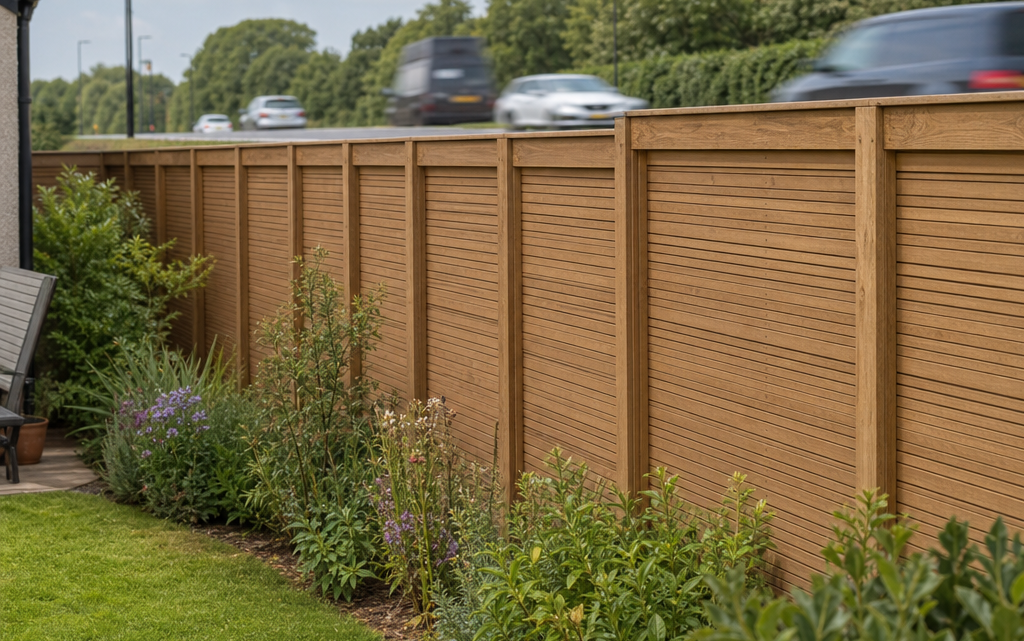
If your garden backs on to a busy road, a standard boundary fence may give you privacy but do very little to make the space feel calmer. Traffic noise is persistent, low-level and variable: cars, buses, motorbikes, braking, tyre noise and the occasional lorry all behave slightly differently. Planning an acoustic timber fence is therefore not simply a matter of buying the tallest panel you can find. You need to think about the route the sound takes, the height and continuity of the barrier, the way panels meet posts, and whether the proposed fence will comply with local rules.
This guide explains how to plan and buy acoustic timber fencing for road-side garden boundaries, with practical decision criteria you can use before ordering materials or speaking to an installer.
Inhaltsverzeichnis
What an acoustic timber fence can and cannot do
An acoustic fence works by interrupting the direct path between the noise source and your ears. In a garden affected by road noise, the aim is usually to reduce the harshness and perceived loudness of traffic rather than to create silence. A well-planned barrier can make a seating area, patio or lawn more comfortable, but it cannot remove all sound, especially where noise travels over the top, around the ends, through gaps, or via nearby reflective surfaces.
It is also important to understand the difference between laboratory performance and real-world performance. Some acoustic panels are tested to recognised standards and may show a significant sound reduction under controlled conditions. In your garden, the result will depend on the whole boundary system: panel construction, post details, gaps at ground level, height, distance from the road, slope, wind direction and neighbouring boundaries.
Start by identifying the main noise path
Before choosing panels, spend time in the garden and work out where the road noise is strongest. Stand or sit where you actually want the benefit, such as a patio, outdoor dining area or children’s play space. Then look towards the road. If you can see the traffic, the sound has a direct path to you. A fence that blocks that line of sight is more likely to help.
In many gardens, the main problem is not the whole road boundary but a particular exposed section: a driveway entrance, a low wall, a gap in planting, or an old open-board fence. Acoustic treatment is most effective when the barrier is continuous. A short run of high-performance panels may underperform if there is a large opening at one end.
Key questions to ask on site
- Can you see moving traffic from the seating area?
- Is the boundary fence lower than nearby walls, hedges or outbuildings?
- Are there obvious gaps under or between existing panels?
- Does noise seem to enter from the side, such as along a driveway or footpath?
- Is the garden higher or lower than the road?
- Are hard surfaces, such as brick walls or patios, reflecting noise back into the garden?
Check planning and boundary constraints early
For road-side boundaries in the UK, planning rules can be particularly relevant. As a general rule, a fence, wall or gate next to a highway used by vehicles may need planning permission if it is more than 1 metre high. Elsewhere, the usual limit is often 2 metres. There are exceptions and additional controls for listed buildings, conservation areas, open-plan estates, restrictive covenants and properties with previous planning conditions.
Do not assume that because an old fence is tall, you can replace it like-for-like without checking. If the boundary is close to a pavement, junction or driveway, visibility splays may also matter. If in doubt, speak to your local planning authority before ordering panels. It is far cheaper to adjust the design on paper than to alter a completed fence.
Choose the right height, but do not rely on height alone
Height is important because the fence needs to break the direct line between the road and the place where you spend time. However, extra height is not automatically better if the structure is full of gaps or the sound simply comes round the side. A dense, well-sealed 1.8 metre acoustic fence may perform better than a taller but lightweight open-board fence.
For many domestic gardens, 1.8 metre panels are a practical starting point because they correspond with common fence panel sizes and can often provide both privacy and acoustic benefit, subject to planning constraints. If the road is elevated above your garden, or your seating area is raised on decking, you may need specialist advice because the line of sight may remain open even with a high fence.
Look for mass, tight joints and tested acoustic design
Noise reduction depends heavily on mass and airtightness. Thin, overlapping or decorative panels with open slats are unlikely to be effective against road noise because sound can pass through and around them. Acoustic timber panels are generally designed with thicker boards, interlocking profiles and robust frames to reduce leakage.
When comparing products, look for clear information rather than vague claims. Useful indicators include independent acoustic testing, stated test standards, board thickness, frame construction and installation guidance. If a manufacturer specifies certain posts or fixing methods for optimum performance, treat that as part of the system rather than an optional extra.
Practical buying criteria
- Panel density: choose a solid, purpose-designed panel rather than a decorative open style.
- Joint design: tongue and groove or interlocking boards help reduce sound paths.
- Frame detail: a rebated or tightly fitting frame can reduce gaps around the panel edge.
- Testing: prefer products with stated testing to recognised acoustic standards.
- Installation system: check whether slotted posts, H posts or direct screw fixing are recommended.
- Durability: confirm timber treatment and guarantees against rot, particularly for exposed roadside locations.
- Appearance: consider whether the board direction and finish suit both your garden and the public-facing side.
As a practical example, a 6 ft by 6 ft acoustic timber panel may be used to create a continuous garden boundary where both privacy and traffic noise reduction are priorities. One example of this type of product is a 1.83 m by 1.80 m acoustic panel with interlocking timber boards, a robust frame and stated independent acoustic testing. The important point is not the individual product alone, but whether the full fence run is designed and installed as a continuous, gap-free barrier.
Plan the full fence run, not just the panels
Acoustic performance is easily lost at weak points. A fence line with excellent panels but loose posts, uneven ground and open ends will not achieve its potential. When planning the layout, draw the complete boundary and mark posts, gates, changes in level, trees, utility covers, walls and existing structures.
Road-side gardens often have awkward features: sloping pavements, retaining walls, driveways, old concrete posts or mature hedges. Decide whether the acoustic fence will replace the existing boundary, sit inside it, or run along only the most exposed section. If the fence stops short of the full boundary, consider returns at each end, turning the fence back into the garden slightly to reduce sound wrapping around the sides.
Ground contact and bottom gaps
A common failing is a neat new fence with a long gap underneath it. Even a small continuous gap can allow noise through. The bottom of the barrier should follow the ground as closely as practical, while still protecting timber from standing water and soil contact where required by the product guidance. Gravel boards, close-fitting kickboards or carefully levelled bases can help, but they need to be planned as part of the acoustic barrier.
Posts and fixings
Posts must be strong enough for heavier acoustic panels and for wind loading, particularly where the fence is close to an open road corridor. Use suitable pressure-treated timber or compatible posts, and set them at the correct centres for the panel size. Where the manufacturer recommends slotted H posts or direct screw fixing to reduce gaps, follow that advice closely. Do not leave loose rattling panels, as movement can create both noise leakage and long-term damage.
Consider gates, driveways and access points
Gates are often the weakest part of a road-side boundary. A lightweight gate with gaps around the frame can undermine the rest of the acoustic fence. If you need a pedestrian gate or driveway gate, choose the most solid design possible and use good-quality hinges, latches and stops so it closes firmly. Brush seals or well-fitted timber stops may help reduce gaps, although any gate will usually be less effective than a fixed panel.
If you cannot treat a driveway opening fully, focus on protecting the area where you sit. For example, a return panel beside a patio or a short internal screen may reduce the direct path from the road even if the main driveway remains open.
Use planting to support comfort, not as the main sound barrier
Hedges, shrubs and climbers can make a road-side garden feel more pleasant and may soften the character of reflected sound, but ordinary garden planting rarely provides major traffic noise reduction on its own. Use planting alongside the acoustic fence for visual screening, wildlife value and psychological comfort rather than relying on it as the primary barrier.
Climbers and dense shrubs can also help the fence blend into the garden, but leave enough space for airflow, inspection and maintenance. Avoid planting that will push panels out of alignment or keep timber constantly wet.
Installation checklist for an acoustic timber fence
- Confirm the boundary line and ownership before work starts.
- Check planning restrictions, especially if the fence is next to a highway.
- Measure the full run accurately, including slopes and changes in level.
- Identify where noise enters from the front, sides and any openings.
- Select solid acoustic panels with suitable test information and construction details.
- Choose posts and fixings recommended for tight, gap-free installation.
- Plan how to close gaps at the base without trapping timber in wet soil.
- Allow for stronger posts and foundations where wind exposure is high.
- Design gates and access points to be as solid and close-fitting as possible.
- Inspect the finished run for light showing through gaps, loose panels or misaligned posts.
Common practical mistakes to avoid
Buying acoustic panels but using open posts or poor joints
Sound will find the easiest route. If panels are not tightly fitted to posts, or if there are vertical gaps between components, the overall result may be disappointing. Treat posts, fixings and edge details as part of the acoustic design.
Stopping the fence too soon
A short section may help in a specific seating area, but noise can travel around the ends. If a full boundary run is not possible, consider returning the fence at the ends or combining it with solid side screening.
Ignoring levels
A fence that looks tall from inside the garden may not block the line of sight if the road is higher. Check the actual eye line between vehicles and the places where you sit or stand.
Leaving a gap below the panels
Uneven ground can create a continuous sound path under the fence. Plan gravel boards or stepped installation details before the panels arrive.
Assuming all timber fencing performs the same
Decorative panels, slatted screens and lightweight overlap fencing are not equivalent to acoustic panels. For road noise, you need density, tight construction and minimal gaps.
Forgetting maintenance access
Even low-maintenance treated timber should be inspected. Make sure you can check posts, fixings, ground clearance and vegetation growth over time.
Budgeting and comparing quotes
When comparing costs, look beyond the panel price. Acoustic timber fencing may require stronger posts, more careful installation, gravel boards, waste removal, ground preparation and gate upgrades. A cheaper quote may omit important details that affect performance, such as sealing gaps at posts or dealing with uneven levels.
Ask installers to specify exactly what is included: panel type, post material, post depth, concrete or fixing method, treatment, disposal of old fencing, handling of slopes, and any gate details. If the fence is near a public pavement or busy road, also ask how the work area will be managed safely.
Short FAQ
Will an acoustic timber fence completely block road noise?
No. It can reduce and soften the noise if designed and installed properly, but it will not create silence. Traffic noise can still travel over, around and sometimes reflect from nearby surfaces.
Is a taller fence always better?
Not always. Height helps when it blocks the line of sight to the road, but gaps, weak gates and poor end details can reduce the benefit. Planning limits may also restrict height, especially next to a highway.
Can I fit acoustic panels into existing posts?
Possibly, but only if the posts are strong, correctly spaced and allow a tight fit. Heavier acoustic panels may not be suitable for old or lightweight posts. Check compatibility before buying.
Do I need planning permission?
You may need permission if the fence is next to a highway and over 1 metre high, or if other restrictions apply. Always check with your local planning authority where the boundary is road-facing or the property is subject to special controls.
Which side should face the road?
Follow the manufacturer’s installation guidance. Some acoustic panels are designed with shaped faces or specific construction details, and orientation may affect appearance or performance.
Conclusion
Planning acoustic timber fencing for a road-side garden is about creating a continuous, solid and carefully installed barrier between the traffic and the areas you use most. Choose panels with suitable acoustic design and clear product information, but pay equal attention to height, line of sight, posts, gates, ground gaps and planning rules. If you approach the fence as a complete system rather than a row of individual panels, you are far more likely to achieve a noticeable improvement in garden comfort.

