Planning a Metal Garden Shed for Mowers and Garden Machinery

Inhaltsverzeichnis
Planning a Metal Garden Shed for Mowers and Garden Machinery
If your mower is wedged behind bags of compost, the strimmer is leaning against the garage wall and your garden tools have to be moved every time you want to reach the fuel can or battery charger, it is time to plan storage properly. A metal garden shed can be a practical choice for mowers and garden machinery because it offers a durable, low-maintenance enclosure that can be secured and kept separate from the house or garage. The best results, however, come from planning the shed around the equipment you actually own, the way you use it and the space available in your garden.
This guide explains how to choose and plan a metal shed for lawn mowers, garden machinery and associated accessories. It covers size, access, base preparation, ventilation, security, positioning and common mistakes, using a compact premium metal shed as a practical example rather than as the focus of the advice.
Start by Listing What You Need to Store
Before you look at shed sizes, make a clear inventory. Garden machinery can take up more space than expected, particularly once handles, wheels, cables, collection boxes and attachments are included.
Typical items may include:
- Rotary, cylinder or hover mower
- Ride-on mower or compact garden tractor, where space allows
- Strimmer, brush cutter or long-reach hedge trimmer
- Leaf blower, scarifier or pressure washer
- Fuel cans, oils, chargers and batteries
- Extension leads, hose fittings and spare blades
- Hand tools such as forks, spades, rakes and loppers
- Seasonal items such as seed spreaders, snow shovels or garden vacuums
Measure the largest items in their stored position. For a mower, measure its full length with the handle folded if that is how you will store it, and with the handle upright if folding is awkward. Also measure the height of machinery if it has a high handle, grass collector or engine cover. Do not rely on nominal mower sizes, as two machines with similar cutting widths may store very differently.
Choosing the Right Shed Size
A common mistake is to buy a shed that fits the machinery only when everything is perfectly arranged. In daily use, you need working space as well as storage space. You should be able to wheel the mower in and out without lifting it, reach small items without unloading the whole shed, and close the doors without forcing tools against the panels.
Allow for Access Space, Not Just Floor Area
For a push mower, a compact metal shed may be suitable if it has wide enough doors and sufficient internal length. For several machines, you may need a wider shed, a deeper shed or a layout with wall storage. If you use a ride-on mower, check door width, ramp suitability and turning space very carefully; many small metal sheds are not designed for that scale of equipment.
As a rule, plan for at least one clear route from the door to the main machine. The mower should be the first item to come out if you use it weekly. Less frequently used attachments and seasonal items can sit further back or above ground level on suitable storage systems.
Check Door Width and Threshold Height
Door access matters as much as the shed’s overall dimensions. Wide double doors are useful for mowers because they reduce the need to angle the machine through the opening. Check the clear opening width, not just the advertised shed width. Also consider the threshold. If there is a raised lip, you may need a small ramp to roll machinery in smoothly.
For heavy machinery, avoid repeated lifting. It increases the risk of back strain and can damage the shed threshold or mower wheels. A firm, non-slip ramp fixed or positioned securely is often a better solution.
Why Choose Metal for Machinery Storage?
Metal sheds are popular for machinery storage because they are generally low maintenance and resistant to rot. They do not need the same routine timber treatment as wooden sheds, and quality galvanised steel models can provide a long service life when installed correctly. Many metal sheds are also designed without windows, which can be an advantage when storing valuable machinery because items are not visible from outside.
However, metal is not automatically the right answer for every garden. It can be more prone to condensation if poorly ventilated or installed on a damp base. It may also feel colder inside than timber. The key is to select a shed with suitable ventilation, install it on the correct base and avoid trapping wet machinery inside for long periods.
Planning the Base and Position
The base is one of the most important parts of any metal shed installation. Unlike some lightweight temporary storage, machinery sheds need a level, stable platform because mowers and tools create concentrated loads. A poor base can cause door misalignment, panel stress, water ingress and difficulty wheeling equipment in and out.
Use a Level, Solid Foundation
Many metal sheds are intended to be fixed down to a concrete base or other solid foundation. Always follow the manufacturer’s instructions for the specific model. If bolting down is required, do not skip it. Fixing the shed helps resist movement in strong winds and keeps the structure aligned.
A concrete slab should be flat, level and appropriately sized for the shed. It should not create a water trap. In many cases, the slab is best finished very slightly proud of the surrounding ground so rainwater does not run across it. Avoid placing a metal shed directly onto soil, grass or an uneven patch of paving.
Think About Everyday Routes
Place the shed where you can use it easily. If the mower has to be dragged through a narrow side passage, over gravel and around furniture, you may avoid putting it away properly. A practical location is close to the lawn, accessible from a firm path and not hidden in a damp, overgrown corner.
Allow room for the doors to open fully. You also need space to stand in front of the shed while moving machinery. If the shed is near a boundary, fence or wall, check that assembly and maintenance access are still possible.
A Practical Example of a Compact Metal Machinery Shed
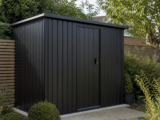
As a practical example, a compact metal shed such as the 8’8 x 4’6 Trimetals Titan 940 Premium Pent Metal Shed may suit a homeowner storing a mower and selected garden machinery rather than a large ride-on mower or extensive workshop equipment. The product description states that it is built from PVC coated galvanised steel, has wide double doors, no windows, ventilation, a key-operated lock and bolts at the top and bottom of the doors. It is also described as fire-resistant, maintenance-free and supplied with a 25-year panel warranty. The manufacturer’s information says it should be bolted down to a concrete base.
The useful lesson from this type of shed is not that one model suits every garden, but that you should examine the same practical points on any shed you consider: door access, fixing method, ventilation, security, warranty terms and the suitability of the base. A narrow but long shed can work well for a mower if the doorway and route inside are adequate; it may work less well if you need to store several wide machines side by side.
Designing the Internal Layout
Once you know the shed footprint, plan the inside before you assemble or fill it. Machinery storage works best when heavy items stay on the floor and lighter items are kept off the ground.
Keep the Floor Clear for Machinery
The mower, scarifier or pressure washer should have a dedicated parking space. If you store fuel-powered equipment, allow it to cool before putting it away and follow the manufacturer’s guidance for fuel storage and maintenance. For battery-powered tools, store batteries and chargers according to the tool manufacturer’s instructions, particularly during winter.
Use vertical storage where appropriate. Long-handled tools can be held on wall-mounted racks if the shed structure and manufacturer guidance allow it. Avoid overloading thin panels with heavy hooks unless a compatible support system is specified. Freestanding shelving can be a good option, but it must be stable and should not obstruct the door opening.
Separate Clean, Sharp and Hazardous Items
Do not let spare blades, oils, chemicals and small parts disappear into an open box on the floor. Use labelled containers, secure storage for sharp items and suitable containers for liquids. Keep chemicals away from children and pets, and follow product labels for storage conditions.
If you store petrol, check current safety guidance and use approved containers. Avoid storing unnecessary quantities. Good organisation is not just tidy; it reduces fire risk, spillage risk and accidental damage to expensive machinery.
Ventilation, Condensation and Moisture Control
Ventilation is particularly important in a metal shed. When warm, damp air meets a cold metal surface, condensation can form. Wet grass clippings on a mower, damp tools and poor air movement can make the problem worse.
To reduce condensation:
- Choose a shed with built-in ventilation where possible.
- Install the shed on a dry, well-drained base.
- Do not block vents with boxes or machinery.
- Brush wet grass off the mower before storage.
- Allow machinery to dry where practical before closing the shed.
- Avoid storing wet sacks, damp timber or saturated garden waste inside.
Condensation is often blamed on the shed alone, but it is usually the result of several factors: damp contents, poor airflow, a cold surface and a wet location. Managing all of these gives the best outcome.
Security Considerations for Mowers and Garden Machinery
Garden machinery can be valuable and portable, so security should be planned from the start. A windowless shed can help by keeping contents out of sight. Locks, bolts and hasps may add useful protection, but they are only as effective as the overall installation.
Position the shed where it is not completely hidden from view if security is a concern. Good lighting, a locked gate and a tidy garden can all reduce opportunity. If the shed is bolted to a concrete base as specified by the manufacturer, it is harder to move or distort.
Inside the shed, consider securing higher-value machinery with a ground anchor or security chain if the shed and base are suitable. Marking equipment, recording serial numbers and checking insurance requirements are also sensible steps. Some home insurance policies have specific conditions for outbuilding storage, including lock standards or maximum cover limits.
Pre-Purchase Checklist
Use this checklist before ordering a metal shed for mower and machinery storage:
- Measure your machinery: Include handles, collectors, wheels and attachments.
- Check clear door opening: Confirm the mower can pass through without being lifted or forced.
- Plan the internal route: Leave space to wheel the main machine in and out.
- Confirm base requirements: Check whether a concrete base and bolting down are required.
- Assess ventilation: Look for vents and make sure your layout will not block them.
- Consider security: Review locks, lack of windows, site visibility and insurance requirements.
- Check delivery access: Ensure panels and components can be carried to the assembly area.
- Allow assembly space: Leave room around the shed for safe construction.
- Think about future purchases: Leave capacity for a new mower, tool rack or seasonal machine.
- Read the warranty terms: Understand what is covered and what installation conditions apply.
Common Practical Mistakes to Avoid
Buying Too Small
The most frequent error is choosing a shed that fits the mower but nothing else. Once you add a strimmer, fuel can, tools and shelves, the space becomes awkward. If your budget and garden allow, choose a size that gives some spare capacity.
Ignoring the Base
A shed installed on an uneven or unsuitable base may never work properly. Doors can catch, panels can twist and water can enter. For machinery storage, a firm, level base is not optional; it is part of the storage system.
Forgetting the Ramp
Even a small threshold can be irritating when moving a mower every week. Plan a ramp if needed, and make sure it is stable, wide enough and suitable for the weight of the equipment.
Blocking Ventilation
Stacking boxes in front of vents defeats the purpose of a ventilated shed. Keep air paths open and avoid storing wet items where possible.
Overloading Walls
Metal shed panels are not always designed to carry heavy loads from hooks and brackets. Check compatibility before fixing racks, or use freestanding storage that transfers weight to the floor.
Neglecting Security Details
Putting expensive machinery in a shed with a poor lock, exposed contents or no thought to the garden’s access points is risky. Security should include the shed, the base, the garden boundary and the way items are stored inside.
FAQ
Is a metal shed suitable for a lawn mower?
Yes, a metal shed can be suitable for a lawn mower if it has adequate floor space, a wide enough door, good ventilation and a proper base. You should measure the mower in its stored position before buying.
Do I need a concrete base for a metal machinery shed?
Many metal sheds require a solid, level base, and some manufacturers specify that the shed should be bolted down to concrete. Always follow the instructions for the model you choose, as the base affects stability, door alignment and warranty conditions.
How can I reduce condensation in a metal shed?
Use a dry, well-drained base, keep ventilation clear, avoid storing wet machinery and remove damp grass or debris before closing the shed. Condensation control depends on both the shed design and how you use it.
Should I choose a windowless shed for machinery?
A windowless shed can be beneficial for security because it keeps mowers and tools out of sight. The trade-off is less natural light, so you may need a torch or suitable battery light when accessing the shed in darker conditions.
Can I store petrol or batteries in a metal shed?
You must follow the equipment and fuel manufacturer’s guidance. Use approved containers for petrol, avoid excessive quantities and store batteries and chargers according to their instructions, especially in cold or damp conditions.
Conclusion
A metal garden shed can be an excellent storage solution for mowers and garden machinery when it is chosen and installed with care. The most important decisions are practical: measure your equipment, check door access, prepare a level base, plan ventilation, think about security and design the internal layout before the shed fills up. A compact premium metal shed may be ideal for a mower and selected tools, while larger machinery or multiple machines will need more generous space. By planning around real use rather than headline dimensions alone, you can create secure, accessible and long-lasting garden machinery storage.