Planning Safe Tool Storage and Lockable Access in a Garden Greenhouse

You have finally cleared a corner of the garden for a walk-in greenhouse, and you are already imagining trays of seedlings, ripening tomatoes and shelves of compost. Then the practical question appears: where will the tools, feeds, labels, secateurs, heater, hose fittings and spare pots actually go, and how will you keep them secure? A greenhouse is not a shed, but many gardeners naturally use it for day-to-day storage. Planning safe tool storage and lockable access from the start helps you protect equipment, avoid trip hazards, maintain healthy growing conditions and make the greenhouse easier to use throughout the year.
This advice article explains how to plan storage and security in a walk-in garden greenhouse, with practical decision criteria you can apply before buying, during installation or when reorganising an existing structure. It uses a typical 6ft x 10ft polycarbonate greenhouse as an example, but the principles apply to most walk-in greenhouses.
Inhaltsverzeichnis
Why greenhouse security and storage need planning together
Security and storage are closely linked. If tools are left on the floor, they are easier to see, easier to steal and more likely to cause accidents. If you add a lock but leave valuable equipment in full view through clear panels, you may still attract unwanted attention. If you cram storage into every corner, you can block ventilation, shade plants and make watering awkward.
A walk-in greenhouse should remain, first and foremost, a growing space. Your storage plan should support that purpose rather than compete with it. The aim is to keep essential items close to hand while storing high-value or hazardous items more securely elsewhere, such as in a locked shed, garage or purpose-built garden storage box.
Start with what you actually need to store
Before buying shelves, hooks or cupboards, list the items you expect to keep in the greenhouse. Separate them into three groups:
- Daily-use items: hand trowel, dibber, labels, pencil, watering can, secateurs, soft ties, gloves and small pots.
- Seasonal items: propagation trays, fleece, plant supports, seed trays, shading material and spare irrigation fittings.
- Items better stored elsewhere: expensive power tools, large quantities of fertiliser, pesticides, sharp blades, fuel, electrical extension leads and anything vulnerable to heat or condensation.
This simple sorting exercise stops the greenhouse from becoming a general dumping ground. It also helps you decide whether you need a small lockable box, a wall-mounted tool rack, under-bench storage, or a separate secure shed for more valuable equipment.
Assess the greenhouse as a security environment
A greenhouse is usually more exposed than a shed. It may have transparent or translucent panels, a lightweight door and a frame designed for light, ventilation and plant protection rather than high-security storage. That does not mean it is unsuitable for keeping basic gardening equipment, but it does mean you should be realistic.
Consider visibility from outside
If passers-by, neighbours or visitors can see directly into the greenhouse, avoid leaving valuable items in plain sight. Even a modest tool kit can look tempting when displayed neatly on a bench. Store hand tools low down, inside a lidded container or behind staging, and keep higher-value items in a more secure outbuilding.
Check the door design
Look at how the door closes, whether it has a catch, whether it can accept a padlock, and whether the door can be forced open easily. A padlock fixing is useful, but the overall strength of the door, frame and fixing points matters too. Use the lock to deter casual interference, not as a guarantee that the greenhouse can replace a secure workshop.
Think about the base
A greenhouse without an integral floor must be fixed to a solid, level base. This is important for stability, but it also affects security. A poorly fixed greenhouse can shift in wind, leave gaps at the base, or make the door difficult to align and lock. A level base helps the door close properly and reduces weak points around the perimeter.
Choose storage that suits greenhouse conditions
Greenhouses are warm, bright and humid. Those conditions are excellent for plants but not always ideal for tools, chemicals, paper packets or electrical items. Storage materials should resist moisture, be easy to clean and avoid shading plants unnecessarily.
Use staging with storage underneath
Staging gives you a working surface and makes good use of the footprint. Under-bench space is ideal for trays, pots, watering cans and compost scoops. If you use open staging, keep items in plastic crates or lidded tubs to prevent clutter and reduce contact with damp flooring.
Add vertical storage carefully
Hooks and racks can hold hand tools, string, brushes and small accessories. However, avoid hanging heavy tools from lightweight greenhouse frames unless the manufacturer allows it. A freestanding rack or a storage board fixed to an independent timber batten or frame may be safer than drilling into structural parts.
Keep chemicals and sharp tools controlled
Fertilisers, pesticides, weedkillers and sharp tools should not be easily accessible to children, pets or visitors. Store them in their original containers, with labels intact, and use a lockable cabinet if they must remain in the greenhouse. In many gardens, the safer option is to keep these items in a locked shed and bring them to the greenhouse only when needed.
Plan the layout before filling the greenhouse
Even a relatively generous walk-in greenhouse can feel cramped once staging, plants, pots and tools are inside. A good layout keeps the central route clear, makes the door easy to use and prevents storage from interfering with light and ventilation.
As a rule, keep the main walkway free of equipment at all times. You should be able to enter carrying a watering can or tray of seedlings without stepping over tools. If you use both sides for staging, measure the remaining aisle width and check that you can turn safely. If one side is used for tall plants such as tomatoes, keep heavier storage on the opposite side or under the bench.
Practical example: applying the principles to a 6ft x 10ft greenhouse
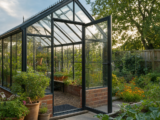
A 6ft x 10ft walk-in greenhouse gives enough room for meaningful growing and some carefully chosen storage, but not enough space to treat it as a full shed. For example, the 6’ x 10’ Palram Canopia Harmony Walk In Silver Polycarbonate Greenhouse measures 1.85m x 3.06m, giving an approximate footprint of 5.66m². It has a single door with a magnetic catch and a padlock fixing, although the padlock is not included. It is designed without a floor and should be fixed to a solid, level base.
In a greenhouse of this type, a sensible plan would be to keep one long side for staging, reserve the opposite side for taller crops or narrow shelving, and use a small lockable storage box under the bench for hand tools and accessories. The door’s padlock fixing can help deter casual access, but valuable power tools and expensive equipment should still be stored in a more secure building.
Checklist: safe storage and lockable access planning
Use this checklist before installing storage or relying on your greenhouse for equipment security:
- List what you will store: separate daily-use, seasonal and high-value items.
- Keep valuables elsewhere: do not treat a greenhouse as a high-security shed.
- Check the door: confirm whether it has a lockable fixing and what type of padlock is suitable.
- Install on a level base: a stable base helps the door align and close properly.
- Keep the walkway clear: never store tools where you need to step.
- Use moisture-resistant containers: choose plastic crates, galvanised storage or treated timber where appropriate.
- Control chemicals: store fertilisers and pesticides safely, ideally in a locked cabinet or separate secure store.
- Avoid overloading the frame: do not hang heavy tools from greenhouse glazing bars unless approved.
- Maintain ventilation: do not block roof vents, side vents or airflow around plants.
- Reduce visibility: keep tools low, boxed or screened by staging rather than displayed against clear panels.
Choosing a padlock and improving everyday access
If your greenhouse door includes a padlock fixing, choose a padlock suitable for outdoor use. Look for weather resistance, a shrouded shackle if the fixing allows it, and a size that fits properly without leaving excessive movement. A lock that is too large can rattle, strain the fixing or be awkward to use. A lock that is too small may be easier to cut or may not close correctly.
Keep a spare key in a secure place, not under a nearby pot. If several family members use the greenhouse, consider a weather-resistant combination padlock, but choose a quality model and change the code if helpers or contractors have had temporary access.
Do not make access so awkward that you stop using the lock. Security measures only work if they become part of your routine. If you visit the greenhouse several times a day, you may lock it only overnight or when away from home, but you should still keep dangerous and valuable items secured.
Safe storage for different types of tools and supplies
Hand tools
Hand tools are best stored clean, dry and off the ground. A small lidded box under staging is often more practical than a wall display. If you prefer hooks, place them where handles will not catch on clothing as you walk past. Wipe soil from metal parts before storing to reduce rust, even if the greenhouse itself is low maintenance.
Watering equipment
Watering cans, hose connectors and irrigation parts can be stored low down because they are not usually high-value. However, keep hoses coiled to prevent tripping. If your greenhouse has rain gutters, plan where the water butt or collection container will sit so that it does not block the entrance or create a slippery area.
Seeds and labels
Seeds should generally be stored somewhere cool, dry and stable, rather than in a hot greenhouse. Keep only current packets in a sealed container for short-term use. Wooden labels, pens and ties can stay in the greenhouse, provided they are kept dry enough to remain usable.
Compost and fertiliser
Small amounts of compost can be kept under staging in a sealed bag or lidded bin. Avoid storing large, open bags inside the greenhouse, as they take up space, attract pests and contribute to mess. Fertilisers should be stored upright, sealed and away from children and pets.
Electrical items and heaters
If you use a greenhouse heater, propagator or fan, follow the manufacturer’s instructions and ensure any electrical supply is suitable for outdoor or greenhouse use. Do not store extension leads in damp corners or leave electrical accessories where water can drip onto them. For permanent or regular power use, seek advice from a qualified electrician.
Common practical mistakes to avoid
Using the greenhouse as an overflow shed
The most common mistake is storing too much. Once old pots, tools, compost bags and unused accessories accumulate, the greenhouse becomes harder to clean and less effective for growing. Review the contents at the start and end of each season.
Blocking the door area
The area just inside the door often becomes a drop zone for tools and bags. This is unsafe and inconvenient. Keep the entrance clear so that you can step in and out easily, especially when carrying glass, trays or watering cans.
Ignoring condensation
Metal tools, paper seed packets and cardboard boxes can all suffer in a humid greenhouse. Use sealed containers and avoid long-term storage of items that dislike damp. Good ventilation helps plants and equipment alike.
Overloading shelves
Greenhouse staging and shelves have limits. Heavy compost bags, large pots and water-filled trays can overload flimsy units. Put heavy items low down and check that staging stands level on the base.
Relying on the lock alone
A lockable door is useful, but it is only one part of security. Visibility, location, lighting, garden boundaries and what you choose to store all matter. A modest padlock will deter casual interference, but it will not make a lightweight structure suitable for storing expensive machinery.
Step-by-step plan for setting up secure greenhouse storage
- Measure the usable space: note the internal length, width, door swing and any vents or gutters that affect layout.
- Choose your growing priority: decide whether you need more bench space, tall crop space or propagation space.
- Select storage zones: allocate one area for daily tools, one for pots and trays, and one for watering accessories.
- Install staging first: position benches before adding smaller storage items so you can judge the remaining walkway.
- Add lockable storage if needed: use a small cabinet or box for sharp tools and controlled products.
- Fit the padlock: check the door closes cleanly and the lock does not strain the fixing.
- Test your routine: walk in with a watering can, open vents, reach tools and move trays without obstruction.
- Review after one month: remove anything you have not used and adjust the layout before clutter builds up.
FAQ
Can I store all my garden tools in a greenhouse?
You can store basic hand tools and daily gardening accessories in a greenhouse, but it is not usually the best place for expensive power tools, sharp equipment, chemicals or items affected by heat and humidity. Use a locked shed or garage for higher-value storage.
Is a padlock fixing enough for security?
A padlock fixing is useful for deterring casual access, especially if used with a weather-resistant padlock. However, greenhouse doors and panels are generally not designed to provide the same security as a solid shed or outbuilding. Keep valuable items elsewhere.
Should I choose clear or opaque storage boxes?
Clear boxes help you find items quickly, but they also make contents visible. For tools or products you do not want seen from outside, use opaque, labelled containers or place boxes below staging.
Where should sharp tools be kept?
Sharp tools should be stored off the floor, with blades protected, and away from children and pets. A small lockable box or cabinet is sensible if children may enter the garden.
Does the greenhouse base affect security?
Yes. A solid, level base helps the structure remain stable and allows the door to align and close properly. Poor installation can create gaps, sticking doors and weaker access points.
Conclusion
Good greenhouse storage is not about fitting in as much as possible. It is about keeping the right items close to hand, protecting them from damp and heat, maintaining safe access, and recognising the limits of a lightweight garden structure. Plan your layout around clear walkways, sensible staging, moisture-resistant containers and a door that can be locked when needed. Use the greenhouse for practical day-to-day gardening equipment, but store high-value or hazardous items in a more secure place. With a little planning at the start, your greenhouse will be safer, tidier and far more enjoyable to use throughout the growing year.