Planning Safer Ground Surfaces Around Raised Garden Playhouses

A raised timber playhouse can quickly become the most popular part of a family garden. Children climb up to the platform, run around the base, make dens underneath and often jump down in ways adults did not expect. That is why the ground around the structure matters just as much as the playhouse itself. If you are planning a new raised playhouse, or improving an existing one, you need to think about the likely fall points, the space children need to move safely and the surface that will help reduce the risk of injury.
This article explains how to plan safer ground surfaces and fall zones around raised garden playhouses in a practical, domestic setting. It is not a substitute for supervision or manufacturer instructions, but it will help you make informed decisions about layout, materials and ongoing maintenance.
Inhaltsverzeichnis
Why the ground around a raised playhouse needs careful planning
Raised playhouses are different from ground-level wendy houses because they introduce climbing, height and more active movement. The main areas of concern are usually the ladder, platform edge, doorway, slide if fitted, and any informal play area underneath. Children do not always use play equipment in the intended way, so you should plan for foreseeable behaviour such as stepping backwards, sitting on platform edges, hopping off the lowest rungs or gathering in groups around the ladder.
A hard patio, compacted gravel or uneven paving beneath a raised structure can make a minor fall far more serious. Even a neat lawn may not provide enough impact reduction if the ground is dry, compacted, thin or sloping. Safer surfacing does not make a playhouse risk-free, but it can reduce the severity of injuries and make the whole garden layout more suitable for children’s play.
Start with the fall height and likely landing areas
The first decision is not which surface looks best; it is where a child could realistically fall from. In playground design, the relevant concept is the fall height: the height from which a child could fall to the ground. For a domestic raised playhouse, this may include the platform level, ladder rungs, doorway threshold and any elevated deck area.
You should check the manufacturer’s assembly manual for installation guidance, recommended clearances and warnings. If the playhouse has a raised platform, railing and ladder, assume the space around the ladder and below the platform needs particular attention. Where measurements are not available from the product listing, do not guess critical safety figures; measure the assembled equipment or refer to the manual before finalising the surface.
Key questions to ask before choosing a surface
- How high is the standing platform? Higher platforms generally need more capable impact-absorbing surfacing.
- Where will children climb up and down? Ladder entrances need clear, level and forgiving landing zones.
- Is there enough space around the structure? Crowding a raised playhouse against a fence, wall, shed or greenhouse can create additional hazards.
- Will the area drain properly? Wet bark, boggy grass and standing water all create maintenance and slip problems.
- How much maintenance can you realistically do? Loose-fill surfaces need topping up and raking; rubber systems need cleaning and inspection.
Allow a proper fall zone, not just a neat border
A fall zone is the area around play equipment where a child may land after falling. In a domestic garden, it is tempting to create a narrow decorative strip of bark or rubber tiles close to the playhouse legs. In practice, children rarely fall in a tidy vertical line. They may jump forward from a ladder, stumble sideways from the base, or step back while playing near the platform.
As a practical starting point, leave generous clear space around all access points and sides where a fall could occur. Keep the area free from rocks, edging stakes, low walls, raised beds, plant pots, washing line bases and garden furniture. If space is tight, it may be safer to choose a smaller or lower play structure rather than squeezing a raised one into an unsuitable corner.
What should be kept out of the fall zone?
- Concrete, paving slabs, brick edging and exposed kerbs
- Sharp gravel, cobbles or decorative stone
- Tree roots, stumps and uneven hard ground
- Raised beds, planters, posts and low fences
- Water butts, bins, composters and storage boxes
- Garden tools, toys, bikes and scooters left on the ground
Choosing a suitable surface material
There is no single best surface for every garden. The right choice depends on the fall height, drainage, budget, appearance, maintenance and how intensively the playhouse will be used. You should also consider whether the material has an independently tested critical fall height, especially for higher platforms. Products tested to playground surfacing standards, such as BS EN 1177, provide clearer performance information than decorative landscaping materials.
Grass: attractive but often overestimated
Grass looks natural and is comfortable for general play, but it is not always reliable as impact-absorbing surfacing. A healthy, well-rooted lawn over good topsoil may be acceptable for very low-risk play areas, but it becomes less effective when compacted, worn, dry or muddy. Under ladders and around popular routes, grass can quickly turn into hard earth. If you rely on grass, inspect it regularly and be honest about its condition.
Play bark, wood chips and engineered wood fibre
Loose-fill timber products are common around domestic play equipment because they are relatively affordable, natural-looking and easy to install. However, not all bark is suitable. Decorative bark used for borders may contain large chunks, splinters or inconsistent particle sizes. Look for play-grade bark, wood chips or engineered wood fibre intended for play areas, and check the supplier’s guidance on depth and fall height.
Loose-fill material must be installed deep enough, contained with safe edging and maintained over time. It migrates, compresses and decomposes, especially near ladders and high-traffic areas. Raking and topping up are part of the system, not optional extras.
Rubber mulch, tiles and wet-pour surfaces
Rubber surfacing can offer good impact performance when correctly specified and installed. Wet-pour rubber is common in public playgrounds and can be shaped to fit awkward areas, but it is usually more expensive and often needs professional installation. Rubber tiles may suit simple rectangular zones, provided the sub-base is level, stable and well drained. Rubber mulch can look more informal, but quality varies and it still needs proper edging.
When considering rubber, ask for the tested critical fall height, installation requirements and maintenance instructions. A rubber product is not automatically safe simply because it is soft to the touch.
Sand and pea gravel
Sand and rounded pea gravel can provide some impact absorption at suitable depths, but they are often less practical in a domestic garden. Sand can attract cats, blow into the lawn and become compacted or contaminated. Pea gravel can scatter widely and may be unsuitable for younger children who put objects in their mouths. Both need containment and regular cleaning. For many family gardens, play-grade bark or a tested rubber surface is easier to manage.
Using a raised timber playhouse as a practical example
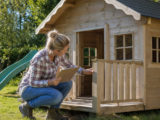
Consider a typical raised timber playhouse with a ladder, platform railing and space underneath for den play or storage. The raised access creates more than one activity zone: children climb, gather at the entrance, move underneath the platform and play around the base. In this kind of layout, the safest surface plan is not a small patch at the foot of the ladder; it is a continuous, clear and impact-absorbing zone around the structure, with extra attention to the climbing side.
For example, the 4×6 Shire Bunny Tower Kids Wooden Playhouse is described as a raised version of a traditional wendy house, with a platform accessed by a ladder and a railing. It uses 12mm smooth planed tongue and groove shiplap cladding, 34x34mm framing, 11mm OSB board to the floor and roof, and a felted reverse apex roof. Its listing also notes compliance with BS EN 71-1:2014. Those details are useful for understanding the type of structure, but they do not remove the need to plan a suitable fall zone and ground surface for your own garden.
When assessing any similar raised playhouse, treat the platform, ladder and area underneath as part of one play environment. Measure the available garden space, check the assembly guidance and choose surfacing based on the actual height and use pattern rather than appearance alone.
How to install a safer surface in practical steps
Once you have selected the surface type, the quality of installation will determine how well it performs. A carefully chosen material can fail if it is laid too thinly, placed on poor ground or allowed to wash away.
1. Mark out the full play zone
Before digging or ordering materials, mark the intended playhouse footprint and surrounding fall zone with string, spray marker or canes. Open the door, check the ladder position and imagine children moving around the whole structure. Make sure there is no conflict with paths, fences, washing lines, ponds, greenhouses or driveways.
2. Prepare a level, well-drained base
Remove sharp debris, rubble, roots and old hardstanding from the play area. The ground should be reasonably level so children do not land on a slope or trip at the edge of the surface. If the garden holds water, improve drainage before installing the surface. A permanently wet play area can become slippery, unhygienic and difficult to maintain.
3. Use appropriate edging
Loose-fill surfacing needs containment. Choose edging that is smooth, secure and not itself a hazard. Avoid sharp timber stakes protruding into the play area, high kerbs or rigid borders close to likely landing points. If you use timber edging, keep it low, rounded where possible and outside the main landing area.
4. Install to the correct depth
Follow the surfacing supplier’s stated depth for the relevant fall height. As a general principle, loose-fill materials are normally installed at a greater depth than they will appear after settlement, because they compact with use. Do not spread a thin decorative layer and assume it will work as safety surfacing. If you are using rubber tiles or wet-pour, follow the installer’s specification for sub-base and thickness.
5. Check the playhouse stability after surfacing
The surface should not conceal structural issues. The playhouse must be assembled on a suitable base in accordance with the manufacturer’s instructions. Legs, supports and fixings should remain visible enough to inspect, and the surfacing should not trap persistent moisture against timber components. Where timber is in contact with or close to the ground, good drainage and maintenance are particularly important.
Checklist for planning your playhouse surface
- Read the manufacturer’s installation and safety instructions before choosing the final location.
- Measure the platform height and identify all possible fall points.
- Allow a generous clear zone around the ladder, entrance, platform sides and base.
- Remove hard, sharp or fixed objects from the fall zone.
- Choose surfacing suitable for the likely fall height, not merely for decoration.
- Check whether the surface has a tested critical fall height and clear installation guidance.
- Prepare a level, free-draining base before installation.
- Install loose-fill surfacing to the correct depth and expect settlement.
- Use safe edging that does not create a new trip or impact hazard.
- Inspect and maintain the area regularly, especially after heavy rain and busy play.
Common practical mistakes to avoid
Using decorative landscaping bark as safety surfacing
Decorative bark may look similar to play bark, but it is not necessarily processed or tested for impact protection. It may contain oversized pieces, sharp fragments or inconsistent material. Always check that the product is intended for play use.
Making the surface area too small
A narrow border around the playhouse may look tidy, but it rarely matches how children move. The highest-wear and highest-risk areas are often just beyond the obvious footprint, especially in front of the ladder and door.
Forgetting that loose-fill material moves
Bark, chips and fibre will be displaced by feet, rain, wind and play. Hollows often appear at the bottom of ladders and below popular jumping spots. Rake the material level and top it up when it falls below the recommended depth.
Installing over poor drainage
If the area already becomes boggy, adding bark or rubber will not automatically fix the problem. Wet timber surfacing can break down more quickly, while rubber surfaces can become slippery if dirt and algae build up. Address drainage first.
Placing the playhouse too close to boundaries
Fences and walls are not soft barriers. Children can fall against them, trap limbs or climb from the playhouse onto them. Leave enough clearance for both safe play and adult access for inspection and maintenance.
Assuming a safety standard removes the need for supervision
Product compliance and safer surfacing are valuable, but they do not replace adult judgement. Children still need age-appropriate supervision, especially on ladders, platforms and raised play structures.
Maintenance: keeping the surface safe over time
A play surface is not a one-off installation. It changes with weather, use and age. Set a simple inspection routine, particularly during spring and summer when the playhouse is used more frequently.
For loose-fill surfaces, rake level areas weekly during heavy use and check the depth at the ladder base, platform exit and any informal jumping spots. Remove leaves, litter, animal mess and broken twigs. Top up material when it has settled or decomposed.
For rubber tiles or wet-pour, sweep away debris, wash off mud and watch for lifted edges, gaps, cracking or moss. Check that water drains away and that the surface has not become slippery. If damage appears, repair it promptly rather than waiting until it spreads.
Also inspect the playhouse itself. Check ladders, rails, fixings, timber condition and any areas where surfacing may hold moisture. Follow the manufacturer’s treatment schedule for timber products, as decayed or weakened timber can create risks that surfacing cannot compensate for.
Short FAQ
Can I put a raised playhouse directly on a patio?
A patio may provide a stable base for some garden structures, but it is not suitable as a fall surface around raised play equipment. If a playhouse is installed near hardstanding, you should create an appropriate impact-absorbing fall zone where children may land.
Is ordinary lawn enough under a raised playhouse?
Sometimes grass may be acceptable for very low-risk areas, but it is often worn away or compacted under ladders and platforms. For raised structures, you should assess the fall height and consider a purpose-made play surface, particularly in high-use landing areas.
How deep should play bark be?
The required depth depends on the product and the fall height it is intended to protect against. Follow the supplier’s stated installation depth and critical fall height information. Do not rely on a thin decorative layer.
Do I need professional installation?
For loose-fill surfaces, competent DIY installation may be possible if you follow the guidance carefully. Wet-pour rubber and some tile systems often benefit from professional installation because the sub-base, thickness and finish affect performance.
Should the area underneath the platform be surfaced too?
Usually, yes. The space beneath a raised playhouse is often used as a den, storage area or crawl-through play space. It should be free from sharp objects, hard debris and trip hazards, with surfacing appropriate to how children will use it.
Conclusion
Planning safer ground surfaces around a raised timber playhouse is about understanding real play behaviour, not simply adding a decorative finish. Start by identifying fall heights and landing areas, then allow a generous clear zone around the ladder, platform and base. Choose a surface that is suitable for the risk, install it properly and maintain it throughout the year.
A well-designed fall zone will not prevent every bump or scrape, but it can significantly improve the safety and usability of your garden play area. By combining suitable surfacing, careful siting, regular inspection and sensible supervision, you can give children a more enjoyable outdoor space while reducing avoidable hazards.